
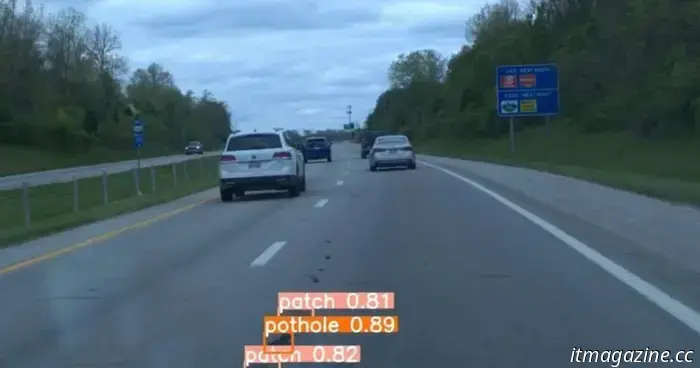
Honda has recently tested an AI system that enables your car to automatically report potholes and damaged signage.
The pilot program in Ohio employed sensors to identify road hazards and provide real-time data to relevant authorities.
If you've navigated the same roads for a while, you likely have a mental map of where the signs are worn out or where a pothole is frequently patched but remains problematic. While these road issues are easy to notice while driving, getting them scheduled for maintenance can take significantly longer. To tackle this challenge, Honda has partnered with DriveOhio to launch a new AI-driven road safety initiative aimed at proactively detecting and reporting issues using data collected from vehicles in regular traffic.
In its official announcement, Honda highlighted the completion of what it refers to as a national-first test in Ohio, utilizing advanced vision and LiDAR sensors to identify problems such as potholes, deteriorating pavement, damaged guardrails, and missing or blocked road signs. During the trial, a small fleet of Honda vehicles traveled approximately 3,000 miles across various urban and rural routes under diverse weather conditions and at different times of day, accurately detecting these issues.
Results indicated that the Proactive Roadway Maintenance System excelled in recognizing signage and guardrail concerns, achieving accuracies of 99 percent and 93 percent, respectively. It also detected potholes and rough road surfaces with close to 90 percent accuracy.
Real-time data sharing could expedite road maintenance
The system transmitted the gathered data to the Ohio Department of Transportation, enabling it to be reviewed and transformed into maintenance tasks without the delay of manual inspections or public reports. Honda suggests that this methodology could greatly decrease the time for identifying and addressing road problems, while also reducing costs related to conventional inspection techniques.
Although the project was limited in scope, Honda envisions expanding the system's reach by utilizing anonymized data from connected vehicles currently on the road. If implemented more broadly, Honda estimates that the system could save the Ohio Department of Transportation over $4.5 million annually by minimizing the necessity for manual inspections.
Pranob is a veteran tech journalist with over eight years of experience in reporting on consumer technology. His work has been…
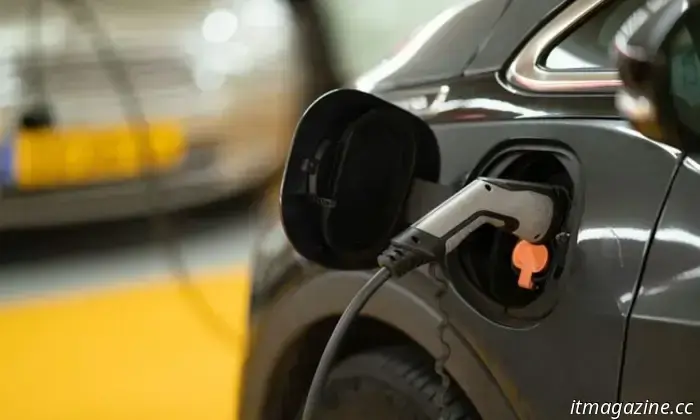
This innovative battery technology will allow rapid charging of your electric vehicle without compromising battery longevity.
Chinese EV battery manufacturer CATL asserts it has successfully developed a solution for ultra-fast charging that does not harm long-term battery health. If verified, this advancement could resolve one of the major challenges facing electric vehicles. In a video released in late January, the company introduced its new 5C lithium-ion battery, engineered to support ultra-fast charging without negatively impacting long-term battery performance. According to Inside EVs, CATL claims that the 5C battery can maintain 80% of its initial capacity after 1,400 charge cycles at a temperature of 140°F (60°C), equating to roughly 522,000 miles of usage.
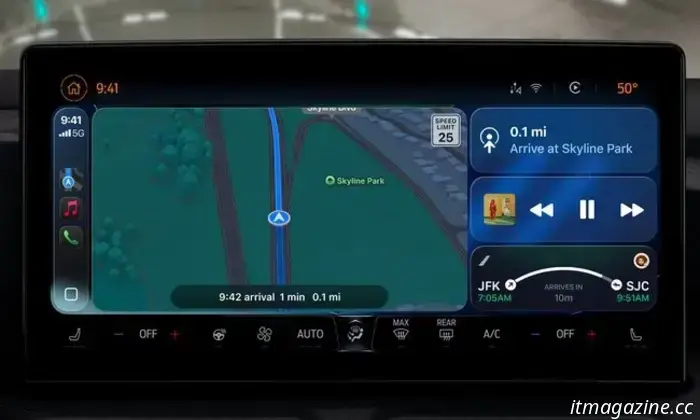
You might soon find CarPlay Ultra outside of a $200,000 Aston Martin.
CarPlay Ultra has had a challenging start, largely limited to high-end vehicles like those from Aston Martin, which come with a hefty price tag exceeding $200,000. This seems an unusual circumstance for a company of Apple’s magnitude to confine a new platform to such an exclusive market. However, according to a Bloomberg report, this may change by the end of the year, with CarPlay Ultra expected to be included in at least one significant new model from Hyundai or Kia in the latter half of 2023, potentially making the system accessible to many more drivers than its current limited availability allows.
Slate aims to develop more than just an affordable truck.
The electric vehicle startup Slate Auto has made headlines with its extremely affordable electric pickup, but it has no plans to stop there. In a recent conversation with InsideEVs, CEO Chris Barman stated that while the first model—a basic EV truck aimed to cost in the “mid-$20,000” range—still awaits a final price and manufacturing ramp-up, Slate aims to create more electric vehicles beyond its inaugural offering. The first Slate truck is a compact, rear-motor, two-door electric pickup available with an optional extended-range battery. It has quickly become one of the anticipated EVs, with production expected to begin toward the end of 2026 at a facility in the Midwest. Slate reported over 150,000 refundable reservations last year, roughly aligning with the company’s projected maximum annual production once it peaks in 2027.


Other articles
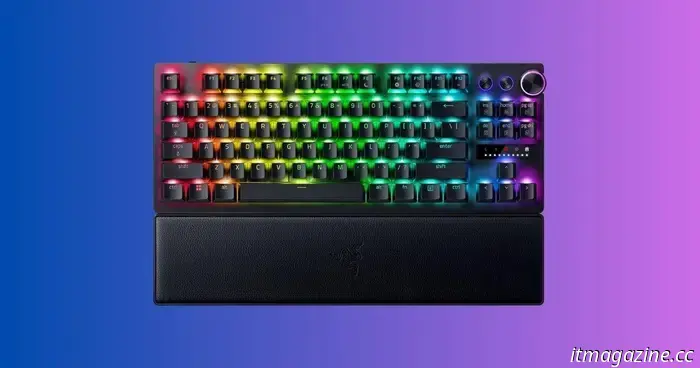 The "rapid trigger" revolution: the end of mechanical switches.
Over the past ten years, "Cherry MX Red" has been regarded as the benchmark for gaming. However, by 2026, this mechanical switch has become officially outdated for competitive gaming. The current trend is "Hall Effect" (magnetic) technology. In contrast to a mechanical switch, which requires a physical contact to log a keypress, a Hall Effect switch employs a […]
The "rapid trigger" revolution: the end of mechanical switches.
Over the past ten years, "Cherry MX Red" has been regarded as the benchmark for gaming. However, by 2026, this mechanical switch has become officially outdated for competitive gaming. The current trend is "Hall Effect" (magnetic) technology. In contrast to a mechanical switch, which requires a physical contact to log a keypress, a Hall Effect switch employs a […]
 Ring has now made it possible for everyone to utilize the Neighbors app to report and locate lost pets.
Ring is broadening its Search Party for Dogs feature, allowing anyone to utilize the Neighbors app to report and locate lost pets by accessing nearby outdoor cameras and community notifications.
Ring has now made it possible for everyone to utilize the Neighbors app to report and locate lost pets.
Ring is broadening its Search Party for Dogs feature, allowing anyone to utilize the Neighbors app to report and locate lost pets by accessing nearby outdoor cameras and community notifications.
 Your anticipation for an updated Apple Studio Display could soon be at an end.
A recent report indicates that Apple's Studio Display update may be released in the next few months.
Your anticipation for an updated Apple Studio Display could soon be at an end.
A recent report indicates that Apple's Studio Display update may be released in the next few months.
 Sony's innovative patent for a PlayStation controller allows for buttons to be placed wherever you desire.
Sony has obtained a new patent that envisions a PlayStation controller featuring reconfigurable on-screen buttons. This concept replaces many of the traditional fixed top-face controls with a sizable touchscreen area. Rather than being constrained to a single D-pad and a cluster of face buttons, you could position touch zones according to where your thumbs naturally rest. Additionally, you would have the option to resize these zones or rotate them.
Sony's innovative patent for a PlayStation controller allows for buttons to be placed wherever you desire.
Sony has obtained a new patent that envisions a PlayStation controller featuring reconfigurable on-screen buttons. This concept replaces many of the traditional fixed top-face controls with a sizable touchscreen area. Rather than being constrained to a single D-pad and a cluster of face buttons, you could position touch zones according to where your thumbs naturally rest. Additionally, you would have the option to resize these zones or rotate them.
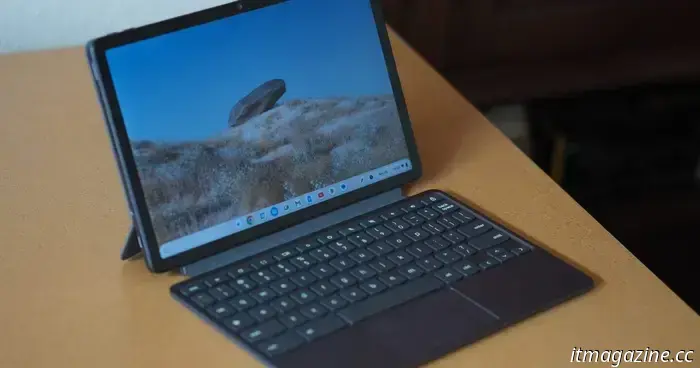 Google's Android PCs might come equipped with a basic version of the Pixel Camera app.
Google's newly launched Desktop Camera app on the Play Store offers us a preview of the camera experience anticipated on the forthcoming Android PCs.
Google's Android PCs might come equipped with a basic version of the Pixel Camera app.
Google's newly launched Desktop Camera app on the Play Store offers us a preview of the camera experience anticipated on the forthcoming Android PCs.
 A leak from Sony reveals a fresh design for the forthcoming WF-1000XM6 earbuds along with a significant audio enhancement.
According to a comprehensive new leak, Sony's upcoming flagship true wireless earbuds are expected to feature advanced AI audio capabilities, enhanced noise cancellation, updated design elements, and a higher price point.
A leak from Sony reveals a fresh design for the forthcoming WF-1000XM6 earbuds along with a significant audio enhancement.
According to a comprehensive new leak, Sony's upcoming flagship true wireless earbuds are expected to feature advanced AI audio capabilities, enhanced noise cancellation, updated design elements, and a higher price point.
Honda has recently tested an AI system that enables your car to automatically report potholes and damaged signage.
Honda has recently evaluated an AI system that enables vehicles to identify and automatically report potholes, damaged signs, and various other road hazards.