

You will be amazed by the sheer volume of AI-generated garbage and mindless videos on YouTube.
A recent study conducted by Kapwing reveals that a significant amount of videos on YouTube consists of what is described as brainrot content and ‘AI slop’: a term that refers to low-quality, AI-generated material primarily created to gain views instead of providing genuine value.
To investigate this, Kapwing's researchers set up a new YouTube account and monitored the first 500 videos the platform recommended. They found that 104 of these videos, approximately 21%, were identified as AI slop, while 165 videos, around 33%, were grouped into a broader "brainrot" category.
Brainrot encompasses repetitive, bizarre, or hypnotic videos that are easy to consume but lack depth. The results imply that a substantial portion of content recommended to new users is automated rather than produced by actual creators.
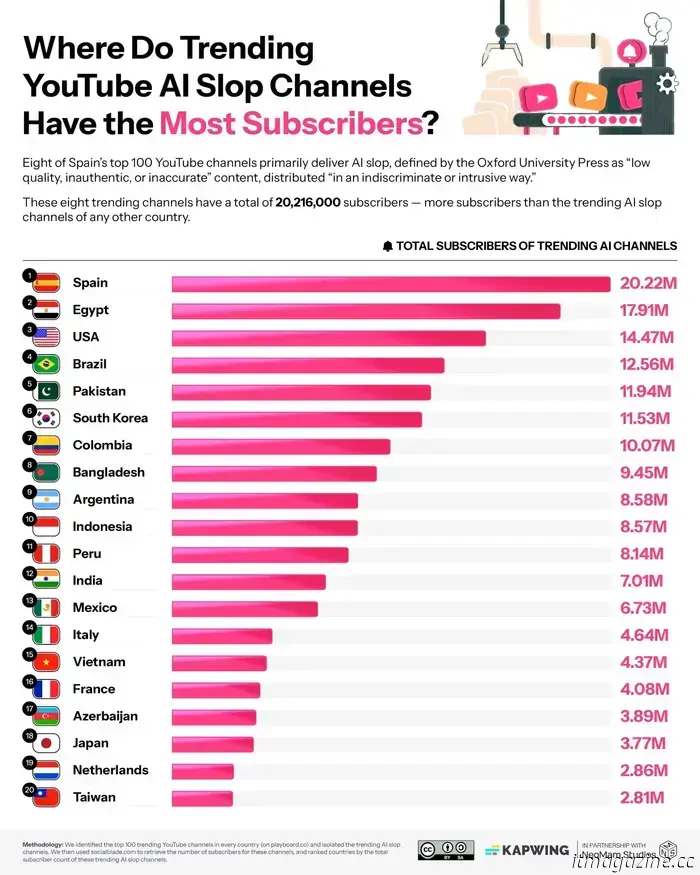
The extent of AI slop on YouTube is significant, extending beyond just a handful of odd suggestions. Kapwing also examined trending YouTube channels in various countries and discovered 278 channels composed entirely of AI slop, present within the global top 100 rankings.
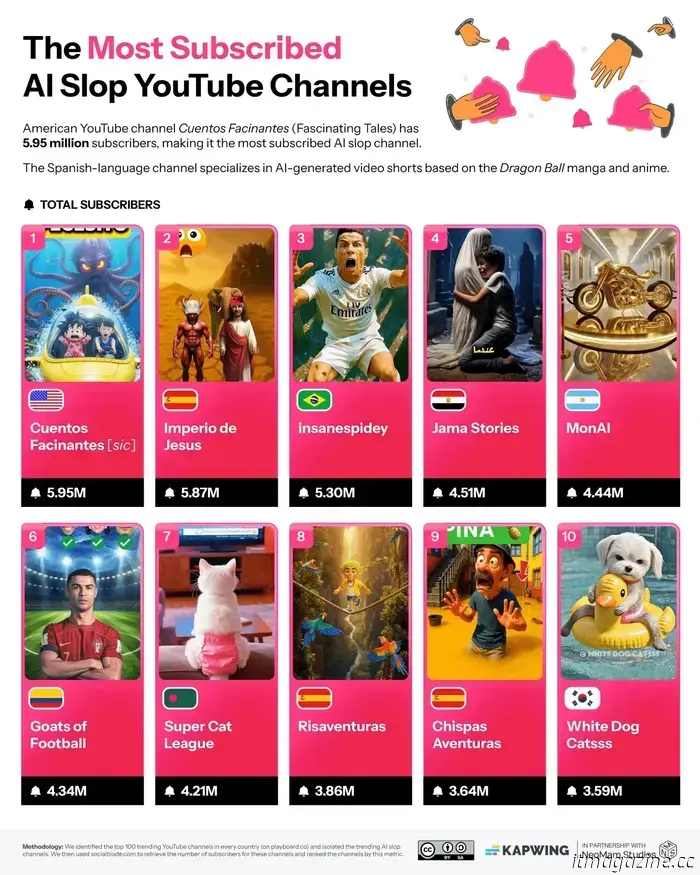
These channels are not insignificant; collectively, they have garnered billions of views and millions of subscribers, resulting in tens of millions of dollars in estimated annual advertising revenue. Certain regions are particularly notable; for example, AI slop channels in Spain boast over 20 million combined subscribers, outpacing totals in the United States or Brazil.
In South Korea, these slop channels have generated over 8.45 billion views, while India's leading AI slop channel has alone exceeded 2 billion views. These statistics indicate that AI slop is not restricted to a single market but is expanding worldwide.
The rapid expansion of this content can be attributed less to individual creators and more to the incentives embedded within recommendation algorithms. Videos generated by AI are inexpensive to create, can be uploaded on a large scale, and are frequently optimized to evoke curiosity or encourage endless scrolling.
New users are particularly susceptible because the algorithm lacks a viewing history to guide its recommendations. For YouTube, these findings pose challenging questions. If 20% of initial recommendations consist of AI slop videos, this could alter the way users perceive YouTube before they even discover creators they genuinely wish to watch.
While YouTube has introduced tools aimed at addressing deepfakes, I would like to see the platform implement improved controls to limit AI slop, similar to the measures TikTok has already adopted. A report from Amazon Web Services (AWS) suggests that 57% of the internet may already comprise AI sludge.
This leads DuckDuckGo to provide tools for filtering out low-quality AI content, whereas some tools like Slop Evader take it a step further by restoring the web to its appearance before generative AI became prevalent.
As AI tools facilitate the inundation of platforms with synthetic media, the challenge will be determining whether engagement alone should dictate what new viewers encounter first.

Other articles
 LG's latest Gallery TV might finally offer a viable alternative to Samsung's The Frame.
LG is preparing to unveil a new art-themed Gallery TV at CES 2026 to compete with Samsung's The Frame series.
LG's latest Gallery TV might finally offer a viable alternative to Samsung's The Frame.
LG is preparing to unveil a new art-themed Gallery TV at CES 2026 to compete with Samsung's The Frame series.
 I experienced an excellent compact phone, and I hope Samsung and Apple take notice.
Since I acquired my first smartphone and later ventured into tech journalism, I've developed a fondness for compact devices. However, discovering one that offers practical advantages has proven to be quite difficult, either because of technical limitations or poor decisions. The OnePlus 13s almost met my expectations, but its absence of an ultrawide sensor [...]
I experienced an excellent compact phone, and I hope Samsung and Apple take notice.
Since I acquired my first smartphone and later ventured into tech journalism, I've developed a fondness for compact devices. However, discovering one that offers practical advantages has proven to be quite difficult, either because of technical limitations or poor decisions. The OnePlus 13s almost met my expectations, but its absence of an ultrawide sensor [...]
 IQ tests are evolving into data tools, and MyIQ is at the forefront of this change.
As the self-quantification movement evolves, individuals are moving beyond merely tracking their physical activities to evaluate their thoughts, decision-making processes, and adaptability. In this transition, platforms such as MyIQ are becoming increasingly significant. Previously focused on metrics like steps, calorie intake, and sleep patterns, the realm of self-tracking is now shifting towards cognitive assessments. It's no longer solely about physical actions – but […]
IQ tests are evolving into data tools, and MyIQ is at the forefront of this change.
As the self-quantification movement evolves, individuals are moving beyond merely tracking their physical activities to evaluate their thoughts, decision-making processes, and adaptability. In this transition, platforms such as MyIQ are becoming increasingly significant. Previously focused on metrics like steps, calorie intake, and sleep patterns, the realm of self-tracking is now shifting towards cognitive assessments. It's no longer solely about physical actions – but […]
 The upcoming OnePlus battery champion will be released on January 8 in China.
OnePlus has announced that the Turbo 6 and Turbo 6V will be launched in China on January 8, featuring 9,000mAh batteries. Preliminary tests indicate a battery life of 10 hours and 37 minutes on a single charge, with the Turbo 6 being the standout model.
TSMC has ushered in a new two-nanometer era.
Leading processor manufacturer TSMC has begun mass production of chips using a 2‑nanometer process. Simply because that's what the plan said. Without fanfare but with unfailing punctuality, the production lines at Fab 22 in Kaohsiung began stamping out the future.
The upcoming OnePlus battery champion will be released on January 8 in China.
OnePlus has announced that the Turbo 6 and Turbo 6V will be launched in China on January 8, featuring 9,000mAh batteries. Preliminary tests indicate a battery life of 10 hours and 37 minutes on a single charge, with the Turbo 6 being the standout model.
TSMC has ushered in a new two-nanometer era.
Leading processor manufacturer TSMC has begun mass production of chips using a 2‑nanometer process. Simply because that's what the plan said. Without fanfare but with unfailing punctuality, the production lines at Fab 22 in Kaohsiung began stamping out the future.
 OnePlus has announced the launch date for the OnePlus Turbo 6 in China. According to a teaser on Weibo, the OnePlus Turbo 6 series will be revealed on January 8 at 7 PM local time, featuring two models: the Turbo 6 and Turbo 6V.
The standout feature is battery life. OnePlus claims both models are equipped with 9,000mAh batteries, which it describes as the largest it has ever incorporated into a smartphone. For comparison, the OnePlus 15 utilizes a dual-cell design with a typical rating of 3,650mAh, translating to 7,300mAh; therefore, the Turbo 6 represents a substantial improvement on paper.
The 9,000mAh battery is the main selling point.
OnePlus is also providing expected runtime figures ahead of the launch. Referencing a battery test from New Review Technology, they state that the regular Turbo 6 achieved 10 hours and 37 minutes on a full charge. Under “ultra-high intensity” conditions, OnePlus claims it lasts for “nearly” nine hours.
With moderate use, OnePlus asserts that users can expect 1 to 2 days of battery life per charge, amounting to roughly 10 hours of total usage time. However, the specifics of the testing setup, including display settings and the type of tasks performed, remain unclear, which is significant for users who play games or operate in high brightness conditions outdoors. Aside from the impressive battery life, OnePlus has also ensured that the Turbo 6 and 6V appear stylish.
Turbo 6 versus Turbo 6V?
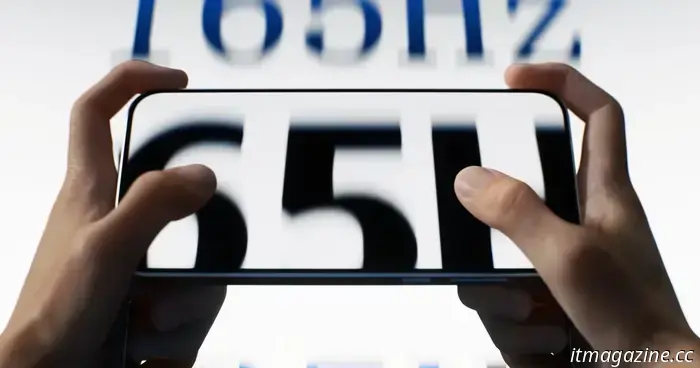
Since both models have the same battery capacity, the differentiation lies in performance and displays. OnePlus indicates that the Turbo 6 is powered by the Snapdragon 8s Gen 4, complemented by LPDDR5X RAM and UFS 4.1 storage, along with an Adreno 825 GPU. It features a 1.5K screen with a refresh rate of 165Hz, a plastic frame, and has an IP68 and IP69K rating for dust and water resistance. It will come with Android 16 based on OxygenOS 16.
The Turbo 6V is anticipated to retain the 9,000mAh battery but is speculated to have a 6.8-inch 1.5K OLED display with a 144Hz refresh rate, possibly powered by the Snapdragon 7s Gen 4.
What to anticipate on January 8
The launch is expected to clarify purchasing details such as pricing, charging speeds, storage options, and the availability of the phones in China. It should also give insight into how OnePlus manages the extensive battery life alongside high refresh rates during real-world usage, beyond just laboratory tests.
---
Paulo Vargas is an English major turned reporter and then a technical writer, with a career that has consistently circled back to...
---
Samsung is introducing AI-generated visuals in the Calendar app.
Calendar receives several quality-of-life improvements.
Samsung believes that even your calendar deserves a touch of artificial intelligence. With One UI 8.5, they are enhancing the Calendar app (version 12.7.05.36) to make it more dynamic and contextually aware.
The most notable update is the integration of AI-generated visuals into the Calendar widget, indicating that the company prioritizes visual context even for everyday scheduling. The concept is straightforward yet somewhat unconventional. Samsung is adding AI-generated background images to the Countdown widget in Calendar, derived from the title of upcoming events.
---
6 best apps to download on your new iPhone and enhance the experience.
Ready to elevate your iPhone experience with some functional upgrades?
There’s no better time than the holiday season to spread cheer by gifting tech products and treating yourself, too. iPhones are highly desirable gadgets, and I frequently observe people around me upgrading to the latest models. However, the transition isn’t always seamless, especially for those switching from Android devices.
Even for seasoned iPhone users, many tend to stick with the basic experience Apple offers rather than maximizing the device's potential. This is where apps become essential. I have been using an iPhone for five years now and have the opportunity to test new and exciting apps professionally.
---
Watch Samsung’s TriFold face unfortunate challenges in this durability test.
Yes, it is quite a fragile device.
Zack Nelson’s holiday gift to his 9.7 million YouTube subscribers was a durability test of Samsung’s TriFold smartphone.
“Occasionally, a piece of technology arrives on my desk that makes me feel a twinge of guilt for what’s about to happen... almost,” the JerryRigEverything creator states at the beginning of the test, creating a strong impression that the outcome will not be favorable for Samsung’s first-ever smartphone featuring not just one but two hinges.
Meta has purchased Manus, a startup from Singapore that has developed a general-purpose autonomous agent intended for integration into its products. The Meta Manus AI agents are positioned as a progression beyond traditional chat, functioning as software capable of completing tasks from start to finish. Both Meta and Manus assert that the agent can autonomously manage activities such as market research, coding, and more.
OnePlus has announced the launch date for the OnePlus Turbo 6 in China. According to a teaser on Weibo, the OnePlus Turbo 6 series will be revealed on January 8 at 7 PM local time, featuring two models: the Turbo 6 and Turbo 6V.
The standout feature is battery life. OnePlus claims both models are equipped with 9,000mAh batteries, which it describes as the largest it has ever incorporated into a smartphone. For comparison, the OnePlus 15 utilizes a dual-cell design with a typical rating of 3,650mAh, translating to 7,300mAh; therefore, the Turbo 6 represents a substantial improvement on paper.
The 9,000mAh battery is the main selling point.
OnePlus is also providing expected runtime figures ahead of the launch. Referencing a battery test from New Review Technology, they state that the regular Turbo 6 achieved 10 hours and 37 minutes on a full charge. Under “ultra-high intensity” conditions, OnePlus claims it lasts for “nearly” nine hours.
With moderate use, OnePlus asserts that users can expect 1 to 2 days of battery life per charge, amounting to roughly 10 hours of total usage time. However, the specifics of the testing setup, including display settings and the type of tasks performed, remain unclear, which is significant for users who play games or operate in high brightness conditions outdoors. Aside from the impressive battery life, OnePlus has also ensured that the Turbo 6 and 6V appear stylish.
Turbo 6 versus Turbo 6V?
Since both models have the same battery capacity, the differentiation lies in performance and displays. OnePlus indicates that the Turbo 6 is powered by the Snapdragon 8s Gen 4, complemented by LPDDR5X RAM and UFS 4.1 storage, along with an Adreno 825 GPU. It features a 1.5K screen with a refresh rate of 165Hz, a plastic frame, and has an IP68 and IP69K rating for dust and water resistance. It will come with Android 16 based on OxygenOS 16.
The Turbo 6V is anticipated to retain the 9,000mAh battery but is speculated to have a 6.8-inch 1.5K OLED display with a 144Hz refresh rate, possibly powered by the Snapdragon 7s Gen 4.
What to anticipate on January 8
The launch is expected to clarify purchasing details such as pricing, charging speeds, storage options, and the availability of the phones in China. It should also give insight into how OnePlus manages the extensive battery life alongside high refresh rates during real-world usage, beyond just laboratory tests.
---
Paulo Vargas is an English major turned reporter and then a technical writer, with a career that has consistently circled back to...
---
Samsung is introducing AI-generated visuals in the Calendar app.
Calendar receives several quality-of-life improvements.
Samsung believes that even your calendar deserves a touch of artificial intelligence. With One UI 8.5, they are enhancing the Calendar app (version 12.7.05.36) to make it more dynamic and contextually aware.
The most notable update is the integration of AI-generated visuals into the Calendar widget, indicating that the company prioritizes visual context even for everyday scheduling. The concept is straightforward yet somewhat unconventional. Samsung is adding AI-generated background images to the Countdown widget in Calendar, derived from the title of upcoming events.
---
6 best apps to download on your new iPhone and enhance the experience.
Ready to elevate your iPhone experience with some functional upgrades?
There’s no better time than the holiday season to spread cheer by gifting tech products and treating yourself, too. iPhones are highly desirable gadgets, and I frequently observe people around me upgrading to the latest models. However, the transition isn’t always seamless, especially for those switching from Android devices.
Even for seasoned iPhone users, many tend to stick with the basic experience Apple offers rather than maximizing the device's potential. This is where apps become essential. I have been using an iPhone for five years now and have the opportunity to test new and exciting apps professionally.
---
Watch Samsung’s TriFold face unfortunate challenges in this durability test.
Yes, it is quite a fragile device.
Zack Nelson’s holiday gift to his 9.7 million YouTube subscribers was a durability test of Samsung’s TriFold smartphone.
“Occasionally, a piece of technology arrives on my desk that makes me feel a twinge of guilt for what’s about to happen... almost,” the JerryRigEverything creator states at the beginning of the test, creating a strong impression that the outcome will not be favorable for Samsung’s first-ever smartphone featuring not just one but two hinges.
Meta has purchased Manus, a startup from Singapore that has developed a general-purpose autonomous agent intended for integration into its products. The Meta Manus AI agents are positioned as a progression beyond traditional chat, functioning as software capable of completing tasks from start to finish. Both Meta and Manus assert that the agent can autonomously manage activities such as market research, coding, and more.
You will be amazed by the sheer volume of AI-generated garbage and mindless videos on YouTube.
A study by Kapwing shows that AI-generated content has established a significant presence on YouTube, amassing billions of views and expanding its influence across various markets.