
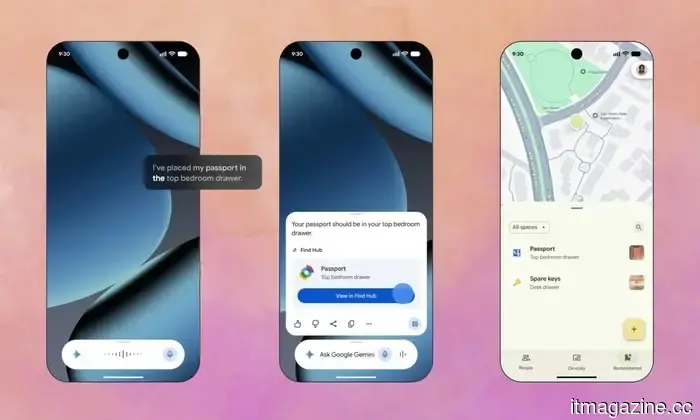
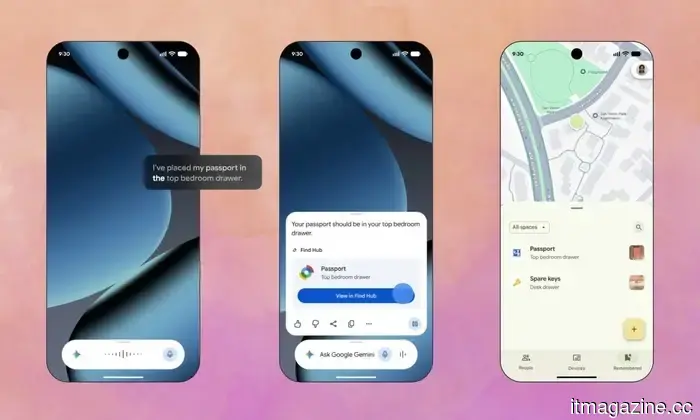
Gemini is now capable of remembering the locations of your belongings so you don't need to.
Google has introduced a memory feature for Gemini to help you keep track of your belongings.
If you often misplace important documents, the latest update to Gemini could be beneficial. Google is set to launch a new function that remembers where you’ve placed items based on your descriptions. This feature is being released with four other updates in the September Android Drop.
With this latest Android Drop, you will be able to: • Locate items in the Find Hub without needing tracking tags—just ask Gemini. • Use Motion Assist to ease motion sickness while in the passenger seat, featuring a subtle bubble overlay on your screen that moves along with the vehicle.
So, what can this new Gemini feature do?
Once the feature is available, you will be able to tell Gemini something like, “I put my passport in the bedroom drawer,” attach a photo, and have it store that location in Find Hub. You won’t need any additional accessories, pairing, charging, or battery changes.
Later, if you forget again (and it seems Google expects this will happen), you can simply ask Gemini where it is or check the 'remembered' items tab in Find Hub. This feature requires Android 16 or newer and is available only in regions where both Gemini and Find Hub are offered.
It's important to clarify that this feature is not a tracking system. Gemini will only recall the information you provided. Honestly, I’ve been doing something similar in the Notes app on my iPhone, and I don’t quite grasp why Google is interested in the locations of your important documents.
What if being a passenger didn't mean dealing with motion sickness? Motion Assist is designed to alleviate motion sickness, allowing you to catch up on texts and reading while in the car.
What else is being introduced this month?
Motion Assist aims to alleviate car sickness caused by focusing on your phone (a static object) in a moving vehicle. It shows little bubbles on your screen that move with the vehicle’s motion.
Additionally, three smaller yet significant features are being introduced in the September Drop. The first, Guided Vision, is designed for users with blindness or low vision, narrating what the camera sees during a Gemini Live session, including reading labels or menus aloud.
Google Keep will soon be integrated directly within a Google Messages thread, allowing a group to create a shared list without leaving the chat. Custom themes will also enable users to change backgrounds and colors for each conversation. Both of these features are available starting today, while the others will be added later in the month.
For over five years, Shikhar has consistently simplified developments in consumer tech and presented them...
Dyson has launched its first toothbrush, which costs about the same as an entry-level smartphone and justifies its price with a camera and AI capabilities.
It features a camera, utilizes AI, and has a companion app that can be installed on your smartphone. I never thought I would say this, but there is a toothbrush priced like a mid-range Android smartphone, equipped with Wi-Fi and a built-in camera. Dyson has introduced the CameraJet, a toothbrush that includes an actual camera and an AI detection system designed specifically to identify and eliminate gaps between teeth that regular toothbrushes often miss.
Ultrahuman aims to leverage your sleep data to enhance its Ring's ability to personalize health insights.
Ultrahuman believes that ordinary sleep patterns, recorded from numerous real people, can solve issues that small lab studies could not.
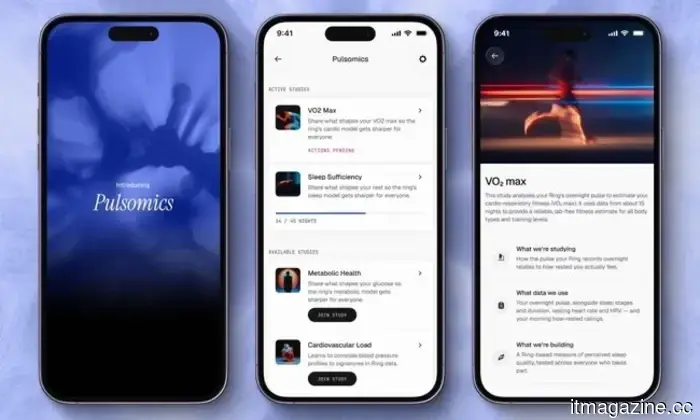
New health wearables, especially rings, have historically had a significant limitation. The data processing behind their scores is typically based on a small, controlled group. Ultrahuman has proposed a solution, perfectly timed for IFA 2026: Pulsomics. This program will transform Ring owners' sleep data into research insights on a scale that can genuinely benefit all users.
OlloBot is redefining home AI to be more interactive and suited for everyday life.
For the past decade, interacting with home AI has followed a predictable pattern: a person utters a wake word, requests something like the weather or turning off the lights, the device responds, and that’s where the interaction ends. While functional, this approach makes smart devices purely transactional, treating them as tools for specific tasks instead of integrated systems within a living space. OlloBot is taking a different approach with the OlloNi SS1, a physical AI companion that is built into a movable body rather than confined to a screen.


Other articles
 Apple's newly appointed CEO will receive a salary of $3 million along with an equity target of $55 million.
John Ternus receives a base salary of $3 million, a prorated stock award of $2.5 million, and an award for fiscal 2027 aimed at $55 million, with three-quarters of it linked to shareholder return.
Apple's newly appointed CEO will receive a salary of $3 million along with an equity target of $55 million.
John Ternus receives a base salary of $3 million, a prorated stock award of $2.5 million, and an award for fiscal 2027 aimed at $55 million, with three-quarters of it linked to shareholder return.
 Huskeys Secures $27M in Series A Funding Led by Blackstone to Develop a New Security Layer for the Network Edge.
Huskeys has secured $27 million in a Series A funding round, led by Blackstone Innovations Investments, which brings its total funding to $35 million after previously raising $8 million in a seed round.
Huskeys Secures $27M in Series A Funding Led by Blackstone to Develop a New Security Layer for the Network Edge.
Huskeys has secured $27 million in a Series A funding round, led by Blackstone Innovations Investments, which brings its total funding to $35 million after previously raising $8 million in a seed round.
 Claude Fable 5.1 and Mythos 5.1 come with improved coding capabilities and more affordable cache pricing.
Anthropic has introduced Claude Fable 5.1 and Mythos 5.1, which provide enhanced coding and research capabilities, as well as a 75% reduction in cache read costs for developers.
Claude Fable 5.1 and Mythos 5.1 come with improved coding capabilities and more affordable cache pricing.
Anthropic has introduced Claude Fable 5.1 and Mythos 5.1, which provide enhanced coding and research capabilities, as well as a 75% reduction in cache read costs for developers.
 Razer's latest Prio controller is compact enough to fit into your pocket when folded.
Razer's latest Prio collapses into a pocket-sized form and unfolds into a complete console arrangement, allowing any free moment to become a genuine gaming experience.
Razer's latest Prio controller is compact enough to fit into your pocket when folded.
Razer's latest Prio collapses into a pocket-sized form and unfolds into a complete console arrangement, allowing any free moment to become a genuine gaming experience.
 Brussels is inquiring with publishers about the effectiveness of Google's AI opt-out option.
The Commission distributed a questionnaire to publishers regarding Google's AI search opt-out, with responses expected by 28 August. The replies could determine if the opt-out is adequate.
Brussels is inquiring with publishers about the effectiveness of Google's AI opt-out option.
The Commission distributed a questionnaire to publishers regarding Google's AI search opt-out, with responses expected by 28 August. The replies could determine if the opt-out is adequate.
 AEREDIUM introduces AERSeal to eliminate single-key control over smart contracts.
AERSeal requires M-of-N approvals within hardware enclaves for managing smart contract administration. No individual key has the ability to mint, upgrade, or alter settings on its own.
AEREDIUM introduces AERSeal to eliminate single-key control over smart contracts.
AERSeal requires M-of-N approvals within hardware enclaves for managing smart contract administration. No individual key has the ability to mint, upgrade, or alter settings on its own.
Gemini is now capable of remembering the locations of your belongings so you don't need to.
Gemini can now recall where you mentioned you placed items such as a passport, storing the location in Find Hub without needing a tracker tag.