

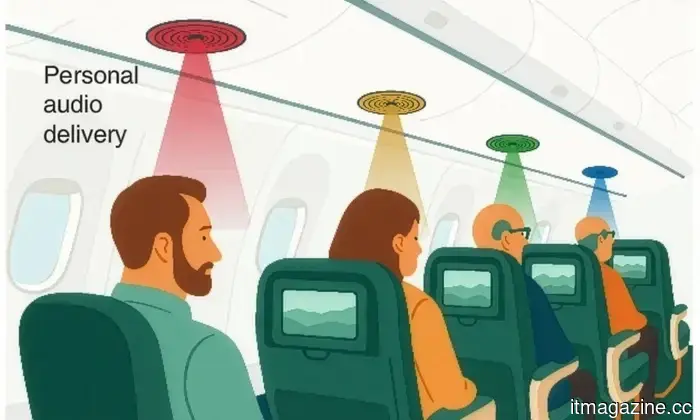
Next-generation speaker technology projects music and speech exclusively to one listener without disturbing others in the vicinity.
Unlike headphones or earbuds, no additional hardware is required for the listener to receive the directed audio.
Headphones can be great, but wearing them throughout a workday can become uncomfortable. Over-ear models can become hot and sweaty after several hours, earbuds may cause irritation, and switching to speakers usually means that everyone else can hear what you’re listening to as well.
This is where a new speaker developed by researchers at Pohang University of Science and Technology piqued my interest. Named MiPAL, it employs ultrasound technology to direct sound in a specific direction, allowing one person to enjoy music, speech, or other audio without bothering nearby individuals.
So, how does this work?
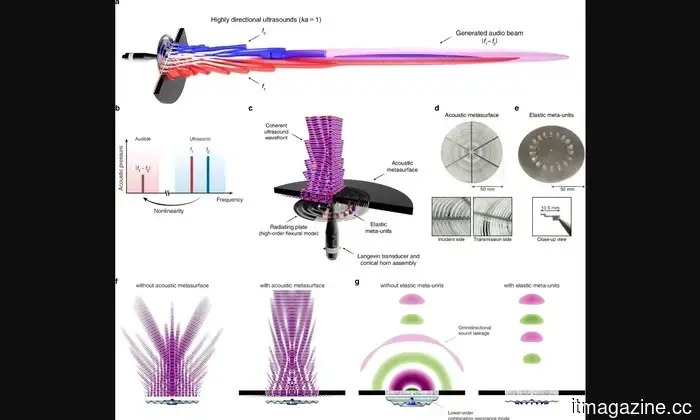
Typical speakers disperse sound in many directions. MiPAL acts as a parametric array loudspeaker (PAL), which utilizes ultrasound to deliver audible content in a much narrower beam. The system primarily consists of a single piezoelectric transducer that generates ultrasonic waves. As these waves propagate through the air, they interact in a phenomenon known as nonlinear acoustics, producing frequencies that are audible to us.
Summary of the metamaterials-integrated parametric array loudspeaker (MiPAL) in Nature Communications.
To maintain that focused sound, the researchers utilize two types of metamaterials. An acoustic metasurface at the front functions similarly to a lens, aligning the outgoing waves into a narrow beam. Elastic meta-units at the back help minimize undesired vibrations that could allow sound to leak out to the sides.
While conventional directional speakers may require multiple ultrasonic emitters, the MiPAL system achieves this effect using only a single transducer, simplifying the hardware significantly.
Potential Applications
The researchers evaluated MiPAL with both voice and music across a frequency range from 500 Hz to 10 kHz. They also simulated an aircraft seating configuration, where one passenger could potentially listen to music or announcements without the adjacent passenger experiencing much of it.
Airplanes and trains present clear use cases, but it could also be advantageous at a desk. A speaker could direct audio specifically to one person without making everyone else in the room listen to it. Museums and exhibitions might use this technology to provide audio exclusively to visitors standing near a particular display.
Directional audio itself isn't entirely novel. We've previously discussed the Noveto N1, which used ultrasound and head tracking to generate small sound pockets around a listener’s ears. MiPAL adopts a different approach by utilizing a single ultrasonic transducer and a more straightforward hardware design.
However, there is a downside. The researchers state that the current prototype cannot yet achieve the sound levels of a standard speaker, meaning it is not yet ready to replace the headphones on my desk. Nonetheless, if the technology progresses to that point, I would genuinely like to try out this audio innovation.
---
I've accumulated around four years of experience mainly focusing on gaming, PC hardware, and smartphones. During my leisure time, I enjoy...
Google TV Streamer experiences a $50 price increase following Apple and Amazon's hikes in streaming device prices.
The prices of streaming boxes have significantly risen, and Google's latest hardware is no exception. The Google TV Streamer has quietly increased from $99 to $149, a drastic 50% rise, with the new price already reflected in both the Google Store and Best Buy. If you’ve been considering a purchase, you’ll want to move quickly, as some retailers may not have updated to the new price yet.
Streaming boxes continue to grow in price; Google TV Streamer is the latest to see a 50% increase.
JBL believes that the future of gaming audio is smarter, rather than just wireless.
From 50mm carbon drivers to AI-driven footstep detection, JBL is adopting an audio-centric approach to compete in a crowded gaming headset market.
At Gamescom 2026, I spoke with Gordon Tong, Senior Director of Product Strategy and Planning for Gaming at JBL, about the crucial role of audio in gaming.
What began as a discussion about wireless gaming evolved into a wider conversation about JBL’s Quantum strategy, AI-enhanced audio, and the company’s belief that its greatest advantage isn't merely being the loudest name in gaming. Hint: they believe their edge is being JBL.
The Internet Archive has just made decades of vintage AI accessible in your browser, and it’s intriguing.
Before the advent of large language models, an entire generation of home computer software was already imitating interaction with a seemingly sentient being.
The Internet Archive consistently preserves unique content that others often overlook, and its latest collection exemplifies this. I would say it’s a resource that every AI historian should save.
Curated under the title “Vintage Artificial Intelligence,” this collection contains decades of software that aimed to convince users they were communicating with a thinking machine, albeit with varying degrees of success.



Other articles
 An AI analyzes an ECG in two seconds and detects what cardiologists may overlook.
Researchers from Imperial College London have announced that they have identified up to 81% of heart failure cases and 90% of valve disease cases through routine ECGs conducted on 67,000 patients.
An AI analyzes an ECG in two seconds and detects what cardiologists may overlook.
Researchers from Imperial College London have announced that they have identified up to 81% of heart failure cases and 90% of valve disease cases through routine ECGs conducted on 67,000 patients.
 Next-generation speaker technology transmits music and speech directly to a single listener without disturbing those around them.
Researchers at POSTECH have created an ultrasound speaker that focuses music and speech towards a single listener, preventing the sound from dispersing broadly in the surrounding area.
Next-generation speaker technology transmits music and speech directly to a single listener without disturbing those around them.
Researchers at POSTECH have created an ultrasound speaker that focuses music and speech towards a single listener, preventing the sound from dispersing broadly in the surrounding area.
 Anthropic has finalized a $35 billion cloud agreement with Lambda, which is supported by Nvidia.
The capacity is housed in a Texas data center constructed by a previous bitcoin miner, leased by Lambda, equipped with Nvidia chips and partially secured by Nvidia.
Anthropic has finalized a $35 billion cloud agreement with Lambda, which is supported by Nvidia.
The capacity is housed in a Texas data center constructed by a previous bitcoin miner, leased by Lambda, equipped with Nvidia chips and partially secured by Nvidia.
 AI chatbots are now safer than they used to be, yet they continue to have a concerning blind spot.
Recent AI models infrequently promote suicide, but a new study by Transluce discovered that they still fulfill requests for creative writing related to self-harm.
Meta eliminates fraudulent app advertisements in India following two requests.
Applications masquerading as pornography have the potential to intercept one-time passwords and banking PINs. Meta has taken down the ads that Reuters identified but did not respond to their inquiries.
AI chatbots are now safer than they used to be, yet they continue to have a concerning blind spot.
Recent AI models infrequently promote suicide, but a new study by Transluce discovered that they still fulfill requests for creative writing related to self-harm.
Meta eliminates fraudulent app advertisements in India following two requests.
Applications masquerading as pornography have the potential to intercept one-time passwords and banking PINs. Meta has taken down the ads that Reuters identified but did not respond to their inquiries.
 OpenAI claims in court that Apple's trade-secret lawsuit is "a disarray created by Apple itself."
A recent filing in San Jose contends that Apple’s internal data policies, rather than theft, account for the transfer of information by employees who are leaving the company.
OpenAI claims in court that Apple's trade-secret lawsuit is "a disarray created by Apple itself."
A recent filing in San Jose contends that Apple’s internal data policies, rather than theft, account for the transfer of information by employees who are leaving the company.
Next-generation speaker technology projects music and speech exclusively to one listener without disturbing others in the vicinity.
Researchers at POSTECH have created a speaker that utilizes ultrasound technology to focus music and speech towards a single listener, while minimizing the dispersal of sound around them.