
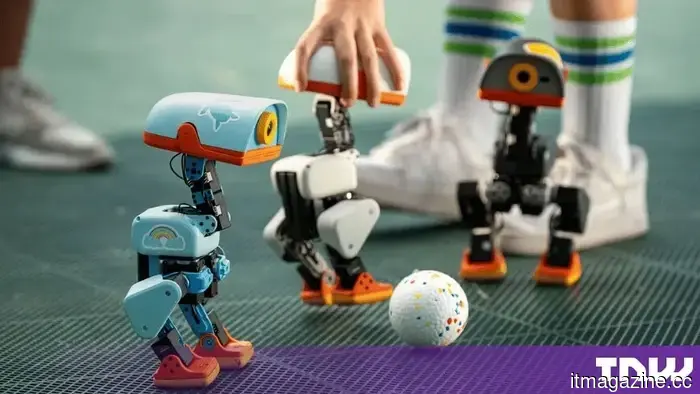
Hugging Face is offering a robot duck priced at $399 that comes with open-source software.
Pollen Robotics has introduced a bipedal robot named Microduck, priced at $399 before taxes and shipping. The Bordeaux-based company is owned by the AI platform Hugging Face. Microduck features one eye and 15 motors, stands at 25cm high, and weighs less than 800g. Preorders began on Thursday, with Pollen aiming to make initial deliveries before Christmas 2026 to North America, Europe, and the UK.
This robot can walk, crouch, recover from falls, and pick up small items using its beak. Launch videos demonstrate it retrieving socks and a marker pen. An optional accessory pack provides wheeled feet for roller skating, along with a ball, an NFC chip and tags, and a laser pointer that it follows with its camera.
Microduck operates on a Rockchip RK3566 featuring an AI accelerator, with 1GB of RAM and 32GB of onboard storage, a configuration first reported by The Verge. It utilizes a front camera for vision and employs a compact LiDAR sensor, an 8×8 time-of-flight matrix, for distance measurement. There’s one inertial measurement unit in the body and another in the head, with a 50Hz policy loop connecting the onboard model to these sensors to determine subsequent actions, according to The Register.
The robot is powered by a removable NP-F550 camera battery, a 2600mAh cell that is common in video equipment, allowing for approximately one hour of runtime.
While the entire software stack is open source and currently available, the hardware is not. Pollen's press materials clarify that the open-source designation applies only to the software stack; mechanical and electronic design files are not publicly accessible, and reporters are requested not to label the robot as open-source hardware. A representative from Pollen confirmed to The Register that there are no plans to open-source the hardware.
Purchasers receive an open software stack with a closed chassis. Pollen employs this model with its Reachy Mini robot, which it claims has sold over 10,000 units since its launch last year.
Clement Delangue, CEO of Hugging Face, described it as “a tiny $399 open-source robot you can teach new tricks with reinforcement learning.” His post on X garnered 4.4 million views. He has advocated that open models are gaining traction, proclaiming the start of an era for affordable open-source robots aimed at democratizing physical AI and world modeling.
However, Microduck's lifting capacity is limited to around 100 grams, roughly equivalent to the weight of a bar of soap. While the beak has articulation and the camera can locate an object, Santiago Pavon from Pollen acknowledged that the robot's grasping ability will remain constrained at this size. TechCrunch corrected its initial launch article after mischaracterizing the beak's capacity.
Pollen is not marketing Microduck as a home helper. The Register referred to it as an affordable platform for teaching users about hardware AI, machine learning, and modern robotics, emphasizing that it does not serve as an in-home assistant or cleaner. This distinction is vital, especially in a year where robot demonstrations have outpaced technological advancements, as illustrated by a humanoid robot that supposedly surpassed Usain Bolt’s running record, leaving roboticists unimpressed.
Microduck lacks an inherent purpose; rather, Pollen hopes users will develop capabilities such as voice recognition, navigation, and grasping functionalities atop the platform. They also aspire for the integration of simultaneous localization and mapping. The company is inviting community engagement for these developments rather than offering a detailed roadmap, relying on a user base that is yet to form.
“Adding purpose and autonomy to the robot is something we are still working on, and we expect the community to pick up and contribute,” Pavon stated, expressing excitement about the initiative. Users can use reinforcement learning for training new behaviors in simulation.
Pollen encourages users to create more robotic “ducks,” claiming the robot is significantly more entertaining in groups, engaging in races, football, and interactive behaviors, bringing it to life in a communal setting. For developers, it presents a low-cost entry into studying multi-robot interactions without requiring extensive hardware resources.
Pollen is not the sole organization advancing standardization on how AI models interface with physical hardware. On the same day that Microduck became available for preorder, Anthropic issued standards for laboratory hardware.
Every Microduck robot has its own unique voice, generating distinct sounds, and creating an audio identity that remains with the unit throughout its lifetime. Available colors include cream, graphite, lavender, and sky.
This launch coincides with a $12.9 billion acquisition deal. Hugging Face acquired Pollen Robotics in April 2025 with the aim of producing affordable open hardware, subsequently releasing Reachy Mini shortly thereafter. Microduck arrives amidst reports that Nvidia is poised to acquire Hugging Face for $12.9 billion, following announcements of negotiations. Business Insider cited a figure exceeding $13
Otros artículos
 Windows 11 is now introducing the choice to remove Bing from Search.
Microsoft is progressively launching its revamped Windows 11 Search, which includes an option to disable Bing. However, this feature is being activated gradually and might not be available right away.
Windows 11 is now introducing the choice to remove Bing from Search.
Microsoft is progressively launching its revamped Windows 11 Search, which includes an option to disable Bing. However, this feature is being activated gradually and might not be available right away.
 Google will disburse £260 million to resolve a UK class action regarding fees associated with the Play Store.
Alphabet has agreed to a £260 million settlement for a UK Play Store class action, which is a quarter of the initial £1 billion claim, without admitting any wrongdoing.
Google will disburse £260 million to resolve a UK class action regarding fees associated with the Play Store.
Alphabet has agreed to a £260 million settlement for a UK Play Store class action, which is a quarter of the initial £1 billion claim, without admitting any wrongdoing.
 Starting in February 2027, Google will restrict the amount of memory that Android apps can utilize.
Starting in February 2027, Google will implement memory limits on a per-app basis in the Play Store, due to an approaching memory crisis resulting from increasing RAM prices.
Starting in February 2027, Google will restrict the amount of memory that Android apps can utilize.
Starting in February 2027, Google will implement memory limits on a per-app basis in the Play Store, due to an approaching memory crisis resulting from increasing RAM prices.
 Starting in February 2027, Google will restrict the amount of memory that Android apps can utilize.
Google plans to implement per-app memory limits on the Play Store starting in February 2027, attributing this decision to an approaching memory crisis caused by increasing RAM prices.
Starting in February 2027, Google will restrict the amount of memory that Android apps can utilize.
Google plans to implement per-app memory limits on the Play Store starting in February 2027, attributing this decision to an approaching memory crisis caused by increasing RAM prices.
 Research suggests that your concerns about AI replacing your job stem from your extensive knowledge about AI.
Almost 43% of respondents with extensive AI knowledge anticipate that AI could soon replace their jobs, a significantly higher percentage than those who have a limited understanding of AI.
Research suggests that your concerns about AI replacing your job stem from your extensive knowledge about AI.
Almost 43% of respondents with extensive AI knowledge anticipate that AI could soon replace their jobs, a significantly higher percentage than those who have a limited understanding of AI.
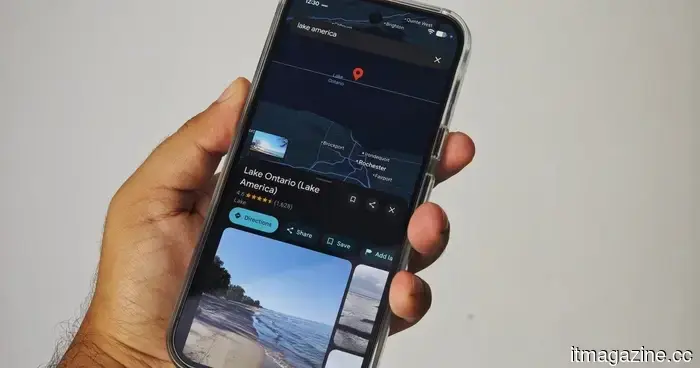 Google Maps features another "America," and Canadians are not pleased.
Google Maps is now referring to Lake Ontario as “Lake America” for users in the U.S., following the same regional naming strategy it implemented for the Gulf of Mexico last year.
Google Maps features another "America," and Canadians are not pleased.
Google Maps is now referring to Lake Ontario as “Lake America” for users in the U.S., following the same regional naming strategy it implemented for the Gulf of Mexico last year.
Hugging Face is offering a robot duck priced at $399 that comes with open-source software.
Hugging Face's Microduck is an open-source robot duck priced at $399 that can walk, skate, and lift approximately 100 grams. Preorders are available now, with shipping expected by Christmas.