

A Chinese DRAM manufacturer is incorporating its newest LPDDR6 memory into Xiaomi's upcoming foldable smartphone.
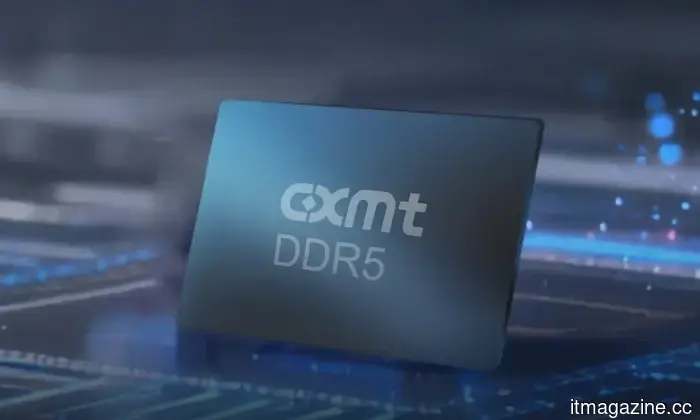
China is attempting to reshape the memory-chip supply chain, with a significant step about to take place in a Xiaomi smartphone. ChangXin Memory Technologies (CXMT), a Chinese memory manufacturer, is set to provide its latest LPDDR6 DRAM for Xiaomi’s forthcoming foldable smartphone, representing a crucial move in China's efforts to lessen its reliance on foreign semiconductor suppliers.
According to Reuters, CXMT has begun mass production of LPDDR6, which Xiaomi intends to incorporate into its new foldable phone expected to debut in September. Xiaomi confirmed the collaboration on its official Weibo account. This development is noteworthy as LPDDR6 is CXMT’s most advanced mobile DRAM technology to date, bringing the company closer to leading global memory producers.
The importance of the Xiaomi agreement extends beyond a single smartphone. Memory is a core component within modern electronics, driving everything from phones and PCs to servers and AI systems. Historically, the global DRAM market has been controlled by companies like Samsung Electronics, SK Hynix, and Micron.
CXMT is striving to shift this balance from within China. Reuters reported that the company has already dispatched samples of its LPDDR6 chips for use in mobile devices, servers, and smart vehicles. Its current production effort builds on its previous development of LPDDR5 chips, indicating a consistent move toward more advanced memory technology.
Xiaomi's upcoming foldable is also anticipated to feature a new iteration of the company's internal 3-nanometer Xring O3 processor, which will support LPDDR6. This combination makes the phone an intriguing example of China's developing self-sufficient semiconductor ecosystem.
If CXMT can consistently provide advanced memory at scale, it could offer Chinese smartphone manufacturers another domestic option at a time when geopolitical tensions have complicated access to foreign semiconductor technology.
CXMT’s advancements occur against a complex geopolitical backdrop. In January 2025, the U.S. Defense Department labeled CXMT as a Chinese military company. The Trump administration retained this designation in a June update. CXMT has denied any ties to the Chinese military, asserting that it designs, produces, and sells DRAM chips solely for civilian and commercial purposes.
The company is currently suing the Pentagon in U.S. federal court, claiming that the designation was arbitrary, unsupported by evidence, and violated its due-process rights. CXMT argues that the designation has caused damage to its reputation and commercial interests and seeks removal from the list.
The Wall Street Journal also reported earlier that Apple is testing DRAM from CXMT across various products, including iPhones and MacBooks. Apple has also engaged in preliminary discussions with CXMT regarding memory supply for some devices intended for the Chinese market, seeking U.S. government support before moving forward.
The timing is quite notable. It was recently revealed that a shortage of DRAM could be affecting the production of the A20 Pro chip expected to be used in the iPhone 18 Pro. TSMC reportedly has around $1 billion worth of completed chips waiting for memory before packaging can continue.
Apple had approached CXMT as a potential secondary DRAM supplier; however, negotiations for a lower price did not yield positive results. CXMT's pricing was comparable to or higher than that of Samsung and SK Hynix. Chinese manufacturers like Huawei and Xiaomi have secured much of CXMT’s output through long-term contracts, reducing the company's incentive to offer Apple significant discounts.
For consumers, the immediate outcome is simply another Xiaomi foldable featuring Chinese-made memory. However, for the semiconductor sector, this signifies a potentially larger shift: a new beginning for the RAM supply chain, as Chinese manufacturers progress from merely catching up to supplying increasingly sophisticated consumer electronics.
The crucial challenge ahead is whether CXMT can ramp up LPDDR6 production, maintain quality, and attract additional customers.
Other articles
.jpg) Three overlooked films on HBO Max that you should check out this weekend (August 29-30).
Three underrated HBO Max films to consider streaming this weekend, featuring a Swedish coming-of-age classic and a gripping thriller by Soderbergh.
Three overlooked films on HBO Max that you should check out this weekend (August 29-30).
Three underrated HBO Max films to consider streaming this weekend, featuring a Swedish coming-of-age classic and a gripping thriller by Soderbergh.
 Hisense created a phone that features a detachable second screen.
Hisense’s A10 Ultra merges a standard color display with a detachable E Ink screen, offering users both a smartphone and a specialized reading display within a single unique device.
Hisense created a phone that features a detachable second screen.
Hisense’s A10 Ultra merges a standard color display with a detachable E Ink screen, offering users both a smartphone and a specialized reading display within a single unique device.
 Apple reportedly experimented with a stylus for the foldable iPhone but ultimately decided against it.
Apple has experimented with a compact, magnetic Apple Pencil designed for the foldable iPhone, but Mark Gurman from Bloomberg is skeptical that it will be released next month.
Apple reportedly experimented with a stylus for the foldable iPhone but ultimately decided against it.
Apple has experimented with a compact, magnetic Apple Pencil designed for the foldable iPhone, but Mark Gurman from Bloomberg is skeptical that it will be released next month.
 A revamped Apple Watch now appears to be further away.
The Apple Watch Series 12 and Ultra 4 are anticipated to feature minor enhancements, as Apple gears up for a more significant redesign that will include new health tracking capabilities and software updates.
A revamped Apple Watch now appears to be further away.
The Apple Watch Series 12 and Ultra 4 are anticipated to feature minor enhancements, as Apple gears up for a more significant redesign that will include new health tracking capabilities and software updates.
 You no longer require a subscription to test out Google’s Dreambeans app.
Previously limited to Google AI Ultra subscribers, Dreambeans is now available for free to all US Google Account users on Android and iOS.
You no longer require a subscription to test out Google’s Dreambeans app.
Previously limited to Google AI Ultra subscribers, Dreambeans is now available for free to all US Google Account users on Android and iOS.
 Google Maps has renamed Lake Ontario to Lake America for users in the United States.
Google Maps has recently started designating Lake Ontario as Lake America for users in the United States, following an update to a federal database. Meanwhile, users in Europe can view both names for the same body of water.
Google Maps has renamed Lake Ontario to Lake America for users in the United States.
Google Maps has recently started designating Lake Ontario as Lake America for users in the United States, following an update to a federal database. Meanwhile, users in Europe can view both names for the same body of water.
A Chinese DRAM manufacturer is incorporating its newest LPDDR6 memory into Xiaomi's upcoming foldable smartphone.
CXMT is set to provide its newest LPDDR6 memory for Xiaomi's forthcoming foldable device, a development that may indicate a significant change in the international DRAM supply chain.