
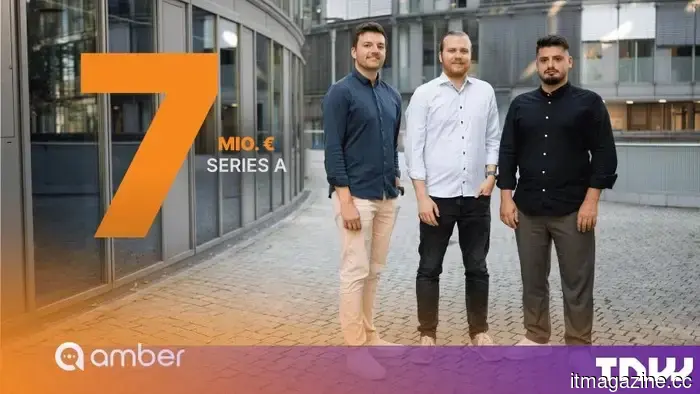
Aachen's amber secured €7 million to promote AI sovereignty for small and medium-sized enterprises (Mittelstand).
The Aachen-based company amber has successfully secured a €7 million Series A funding round. The investment was co-led by Ventech and NRW.Venture, the venture division of NRW.BANK, which is a development bank owned by the German state of North Rhine-Westphalia.
Compared to this year's AI funding rounds, €7 million is relatively modest, but the justification for it is significant. Amber's platform organizes and connects a company’s internal data prior to interaction with any large language model, which includes emails, documents, cloud applications, and business systems. The company refers to this as its AI Data Layer, and their announcement clarifies that this is where the funds will be allocated.
The assertion is that the focus has shifted away from competing models. “The competition for models is basically over. The quality of responses hinges on the context you provide,” stated co-founder and CEO Philipp Reißel in an interview with Tech Funding News. This is a bold claim, with amber asserting that organizing data before it reaches a model can reduce token costs by as much as 60%, depending on the specific use case. However, this figure should be regarded as amber's own estimate, as it has not been independently verified.
Others are observing similar trends. Uber’s technology chief noted this month that the era of maximizing tokens is coming to a close, while Microsoft has instructed its employees to minimize token usage. As frontier models converge, the financial advantage will go to those who effectively prepare input data.
Amber markets its product based on European data sovereignty, operating on German cloud infrastructure and lacking American shareholders. This positions the company outside the reach of the US Cloud Act, which allows American authorities to compel US firms to surrender data regardless of where it is stored. “The directions taken at amber are determined by European minds,” co-founder Bastian Maiworm told Tech Funding News. This comment specifically addresses competitors like Glean, a Palo Alto-based firm with a $7.2 billion valuation, and Microsoft, which is integrating its Copilot features into a single enterprise solution.
The discourse around data sovereignty has been ongoing in Europe. For instance, Airbus has relocated its most critical applications to a French cloud provider. The EU’s Made in EU procurement directives do not include software, and amber aims to fill that void rather than waiting for regulations to adapt.
Alongside the sovereignty argument, amber also promotes GDPR-compliant access to internal knowledge. This is especially relevant for German manufacturers who prioritize compliance over general performance metrics.
Amber's clientele consists mainly of German mid-sized companies such as Ritter Sport, known for chocolate; Zentis, a jam producer; Hailo, which manufactures ladders; Scheidt & Bachmann, known for fare collection and fuelling systems; Schüßler-Plan, an engineering consultancy; and Dalli, a detergent manufacturer. These Mittelstand businesses share a challenge that is primarily demographic rather than technological. “It's challenging to maintain access to the knowledge of employees once they retire, especially within large IT structures,” Maiworm explained. This encapsulates the company's value proposition: as a generation of German engineers and plant managers retires, they take with them years of undocumented knowledge. Amber promises to capture that information before it exits the workforce.
The company reports having over 400 active clients and around 60 employees based in Aachen, Cologne, and Tirana.
Amber was founded in 2021 by Reißel, Maiworm, and Igli Manaj, all connected to RWTH Aachen University. Reißel and Manaj previously worked on the foundational technology before transformer models became widely adopted. Maiworm contributed insights from the perspective of a family-run business. The product offerings have evolved into amberSearch, amberAI, and amberAgents, reflecting the company’s journey from search functionality to AI assistance and automation. The next major goal is the most challenging one yet.
“Current AI tools still rely on users to ask the right questions,” Maiworm noted in the funding announcement, emphasizing amber's ambition to develop software that proactively identifies needs and addresses them.
NRW.Venture represents a unique kind of venture investor, as highlighted by Johanna Antonie Tjaden-Schulte from NRW.BANK's managing board: “With our investment, we are supporting a start-up from North Rhine-Westphalia that is tapping into a significant European market and contributing to the long-term competitiveness of SMEs.” Public investment continues to appear in European funding ventures; for instance, the EU became a shareholder when Lovable raised $13.3 billion this month. While the funding amounts vary vastly, the underlying motivation remains consistent.
Ventech first invested in amber in March 2025 with €2.1 million and has now increased its stake. Partner Nicolas Barthalon identified an additional challenge that amber could address: assisting organizations in discovering and managing the appropriate agents and workflows amidst what he termed the accelerating proliferation of AI tools. This concern is increasingly prevalent in large organizations where disparate departments independently acquire tools, leading to
Other articles
 OpenAI dissolved the team responsible for evaluating catastrophic model risks.
The OpenAI preparedness team has been disbanded, following its budget cut in July, just weeks after its models targeted Hugging Face. The risk-related tasks are now handled by other teams.
OpenAI dissolved the team responsible for evaluating catastrophic model risks.
The OpenAI preparedness team has been disbanded, following its budget cut in July, just weeks after its models targeted Hugging Face. The risk-related tasks are now handled by other teams.
 GitHub challenges Wiz’s assertion that Copilot Autofix was responsible for a flaw in Snowflake.
Wiz claimed that Copilot Autofix created a Snowflake vulnerability, which its AI agent subsequently exploited. GitHub argued against this, Wiz retracted the statement, and The Register published a correction.
GitHub challenges Wiz’s assertion that Copilot Autofix was responsible for a flaw in Snowflake.
Wiz claimed that Copilot Autofix created a Snowflake vulnerability, which its AI agent subsequently exploited. GitHub argued against this, Wiz retracted the statement, and The Register published a correction.
 OpenAI is supporting 13 local newsletters from Axios through a three-year agreement.
The partnership between Axios and OpenAI for local news finances 13 newsletters over a span of three years. Both companies have not disclosed the amount paid or if Axios relinquished its right to file a lawsuit.
OpenAI is supporting 13 local newsletters from Axios through a three-year agreement.
The partnership between Axios and OpenAI for local news finances 13 newsletters over a span of three years. Both companies have not disclosed the amount paid or if Axios relinquished its right to file a lawsuit.
 Terra Industries secures $52 million in seed funding and establishes its inaugural office outside of Africa.
Terra Industries has successfully completed its seed round, raising $52 million through three tranches over eight months, and is inaugurating its first office outside of Africa in London.
Terra Industries secures $52 million in seed funding and establishes its inaugural office outside of Africa.
Terra Industries has successfully completed its seed round, raising $52 million through three tranches over eight months, and is inaugurating its first office outside of Africa in London.
 Terra Industries secures $52 million in seed funding and establishes its inaugural office outside of Africa.
Terra Industries has concluded its seed round, raising $52 million in three tranches over the course of eight months, and is establishing its first office outside of Africa in London.
Terra Industries secures $52 million in seed funding and establishes its inaugural office outside of Africa.
Terra Industries has concluded its seed round, raising $52 million in three tranches over the course of eight months, and is establishing its first office outside of Africa in London.
 France's tax authority lost information on 678,000 individuals due to a compromised login.
The breach at the French tax agency revealed 678,000 records. DGFiP managed to terminate the intruder's access but failed to detect the theft and found out about the extent of the breach through a post on a forum.
France's tax authority lost information on 678,000 individuals due to a compromised login.
The breach at the French tax agency revealed 678,000 records. DGFiP managed to terminate the intruder's access but failed to detect the theft and found out about the extent of the breach through a post on a forum.
Aachen's amber secured €7 million to promote AI sovereignty for small and medium-sized enterprises (Mittelstand).
The amber Series A successfully secured €7 million from Ventech and a German state bank. Their proposal emphasized organizing the data initially and ensuring it remains outside of US jurisdiction.