
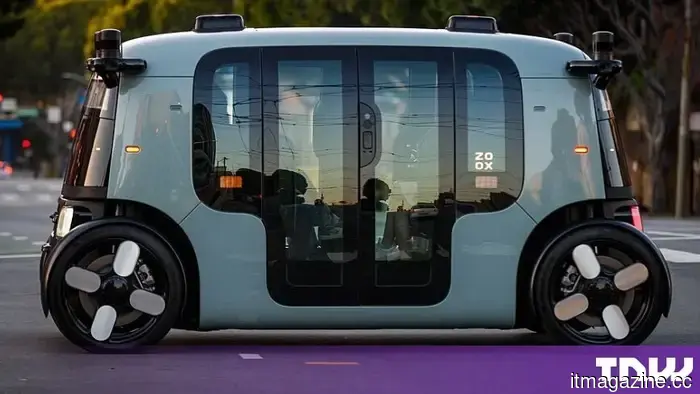
Zoox has demonstrated its safety protocols three weeks following the recall of all its robotaxis.
Zoox has shared the rationale behind its assertion of being safer than human drivers. The core of this claim is a single metric: the predicted rate of collision, injury, and fatality events, quantified in miles per event. This estimate combines risks associated with driving software, the vehicle itself, and fleet operations.
This metric acts as a gatekeeper. Prior to any release of safety-relevant software, modifications to hardware, or changes in operating procedures, Zoox reassesses the case to ensure the combined figure meets its safety target.
This target is grounded in human driving data. Zoox establishes its benchmark using crash sampling and fatality reporting systems from the NHTSA, as well as datasets from the Federal Highway Administration. They analyze this data by road speed and adjust it to correlate with the actual mix of roads their robotaxis operate on.
However, Zoox does not disclose the specific number. They determine their target by comparing to this benchmark and claim to aim for significant safety improvements over human drivers, but they do not specify what constitutes a significant improvement. They also refrain from sharing the current safety performance of their fleet.
The engineering details behind this approach are precise enough for scrutiny. Zoox identifies the hazard analyses it conducts, adheres to ISO 26262 with integrity ratings for the platform, and employs simulations that intentionally seek conditions under which collisions are most likely, later weighted by actual fleet exposure data.
Some aspects of their approach are quite distinctive. There is an independent collision checker that performs its own perception assessments and can override a trajectory planned by the main system. Zoox acknowledges that a probability-based metric cannot account for rare avoidance situations, thus it maintains a testing protocol where the robotaxi must at least perform as well as a competent human driver.
Moreover, remote personnel are integrated into the model rather than operating externally. TeleGuidance tacticians do not drive; they provide route guidance while the vehicle retains responsibility. The potential risks posed by possible errors from these staff or their tools are included in the same estimate.
Additionally, the framework allows for restrictions, pauses, or grounding of the fleet. For example, three weeks prior to their recent publication, Zoox recalled all 105 of its robotaxis after one failed to recognize heavy smoke and entered a fire scene in Las Vegas.
This incident marked the fourth software recall in approximately 13 months and followed regulatory demands for solutions to issues where Zoox vehicles interfered with first responders. As of March, the NHTSA had recorded 123 collisions involving Zoox vehicles operating in autonomous mode.
This analytical strategy is a necessity due to the limited mileage. Zoox has accumulated around three million autonomous miles, while Waymo surpassed one hundred million more than a year ago. Zoox now offers a paid service to safeguard its position as it works to bridge this gap.
Other articles
 Joshua Kushner's Thrive Capital Reveals $215 Million Investment in Amazon
Thrive Capital, led by Joshua Kushner, has purchased $215 million in Amazon shares just days after announcing the sale of a portion of its stake in OpenAI.
Joshua Kushner's Thrive Capital Reveals $215 Million Investment in Amazon
Thrive Capital, led by Joshua Kushner, has purchased $215 million in Amazon shares just days after announcing the sale of a portion of its stake in OpenAI.
 ASU's degree in content creation evaluates your follower count.
Arizona State's content creation program requires students to build an audience in order to graduate. Interestingly, the university's careers page does not mention the term influencer.
ASU's degree in content creation evaluates your follower count.
Arizona State's content creation program requires students to build an audience in order to graduate. Interestingly, the university's careers page does not mention the term influencer.
 ASU's degree in content creation evaluates your follower count.
Arizona State's degree in content creation requires students to build an audience in order to graduate. However, the university's careers page does not mention the term influencer at all.
ASU's degree in content creation evaluates your follower count.
Arizona State's degree in content creation requires students to build an audience in order to graduate. However, the university's careers page does not mention the term influencer at all.
 Thrive Capital, led by Joshua Kushner, reveals a $215 million investment in Amazon.
Joshua Kushner's Thrive Capital has acquired $215 million in Amazon shares, shortly after revealing its plans to sell a portion of its stake in OpenAI.
Thrive Capital, led by Joshua Kushner, reveals a $215 million investment in Amazon.
Joshua Kushner's Thrive Capital has acquired $215 million in Amazon shares, shortly after revealing its plans to sell a portion of its stake in OpenAI.
Zoox has demonstrated its safety protocols three weeks following the recall of all its robotaxis.
Zoox has unveiled the framework supporting its assertion of being safer than human drivers, three weeks following the recall of all 105 of its robotaxis due to a fire incident.