
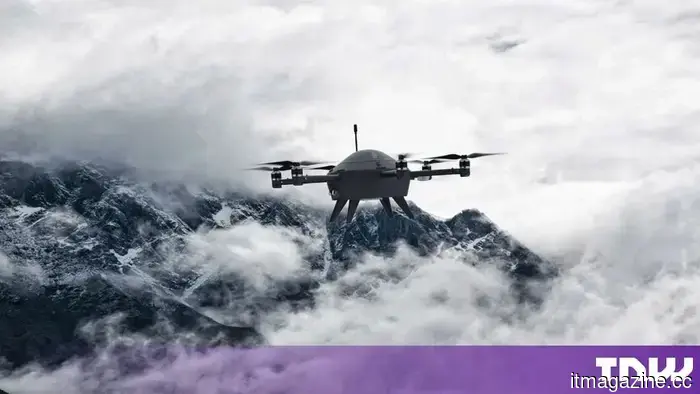
Weather drones are addressing the data gap that is essential for both military forces and traders.
The artificial intelligence weather boom has a hidden issue. Despite the discussions about models predicting storms days in advance, an AI forecaster's effectiveness relies on the quality of the observations it receives, which have recently diminished. Bloomberg reports that drones are being deployed to fill this gap, becoming essential sensors for both military operations and energy traders.
The problem lies in the lowest few kilometers of the atmosphere, where most weather events occur. For many years, this region was monitored using radiosondes—balloons equipped with instruments launched twice daily from various locations worldwide. As the frequency of these launches decreases, so does the available data, which comes at a particularly inopportune moment for an industry striving to create the most advanced forecasts available.
The appeal of AI meteorology is strong. Google DeepMind claims that its system is the most precise 10-day weather predictor globally. However, a model that relies on outdated readings still necessitates updated measurements to understand current atmospheric conditions. Without accurate ground truth, even the smartest neural network essentially resorts to guessing.
The decline in data collection is partially self-imposed. In the United States, personnel shortages following federal layoffs have led the National Weather Service to suspend or reduce launches from several upper-air stations through 2025, creating gaps in a dataset that forecasters had previously taken for granted.
This is where drones come into play. Companies like Switzerland's Meteomatics operate what they term Meteodrones, small unmanned aircraft explicitly designed to replace radiosondes. These drones ascend several kilometers, collecting data on temperature, humidity, pressure, and wind as they rise, then land to be reused.
The economics are also favorable. Weather balloons are single-use, drifting away and seldom retrieved, whereas drones gather data and return for additional flights, transforming sporadic coverage into a reliable source.
Moreover, the concept is shifting from experimentation to practical application. Meteomatics announced that it provided operational weather-drone data to the U.S. National Weather Service for the first time earlier this year, part of a broader NOAA initiative to integrate these aircraft into regular forecasting rather than treating them as mere experiments.
This is where financial incentives come into play. In energy and gas markets, prices fluctuate based on wind, solar generation, and temperature; thus, a more accurate forecast in the short term provides a competitive trading advantage. Bloomberg indicates that energy traders are among the most enthusiastic consumers of enhanced low-altitude data, motivated purely by profitability.
The military's interest aligns with this reasoning. The same readings that aid a trader in energy positions also assist an army in determining optimal times for flights, offensive operations, and movements. Consequently, Bloomberg portrays drones as beneficial for both soldiers and traders.
This situation highlights an uncomfortable truth for those in AI weather forecasting. While Google DeepMind's newest forecasting model has outperformed competitors, and other challengers like Switzerland's Jua assert superiority over Microsoft and Google, the pursuit of better raw data is arguably of greater significance and much less glamorous.
For Europe, there's a strategic advantage within this narrative. Meteomatics, a European company, is supplying the tools necessary for a data-driven transformation in American forecasting, showcasing a rare scenario where the continent is exporting technology rather than importing it, even as prominent AI models continue to originate from Silicon Valley.
There's an interesting irony here. The future of weather forecasting was anticipated to be dominated by advanced software and extensive models trained on years of data. Instead, it may depend more on who can deploy the most sensors into the atmosphere, as well as who controls the data they collect. The entity that succeeds in this regard can either make profits or gain military advantages, a substantial reward for a fleet of drones undertaking the critical yet unglamorous work that algorithms require.
Other articles
 Thrive Capital's inaugural investor letter reveals how entirely OpenAI has come to shape its identity.
A Thrive Capital fund has grown to approximately $3.7 billion thanks to investments in OpenAI and SpaceX, as disclosed in Joshua Kushner’s initial formal investor letter. Additionally, the firm is discreetly divesting a portion of its OpenAI holdings.
Thrive Capital's inaugural investor letter reveals how entirely OpenAI has come to shape its identity.
A Thrive Capital fund has grown to approximately $3.7 billion thanks to investments in OpenAI and SpaceX, as disclosed in Joshua Kushner’s initial formal investor letter. Additionally, the firm is discreetly divesting a portion of its OpenAI holdings.
 A teenager from Massachusetts faces charges for the murder of his mother and brother, with prosecutors citing ChatGPT as a point of reference.
Prosecutors claim that a 17-year-old in Acton, Massachusetts utilized ChatGPT to delve into “fantasy stories” centered around murdering his family, marking the latest instance of an AI chatbot being connected to a violent crime.
A teenager from Massachusetts faces charges for the murder of his mother and brother, with prosecutors citing ChatGPT as a point of reference.
Prosecutors claim that a 17-year-old in Acton, Massachusetts utilized ChatGPT to delve into “fantasy stories” centered around murdering his family, marking the latest instance of an AI chatbot being connected to a violent crime.
 Lightspeed is divesting its stake in OpenAI to a fund that it will also manage.
Lightspeed is looking to raise $600 million for a continuation fund that includes OpenAI, Anthropic, and three additional companies. It will sell the assets and manage the fund that acquires them.
Lightspeed is divesting its stake in OpenAI to a fund that it will also manage.
Lightspeed is looking to raise $600 million for a continuation fund that includes OpenAI, Anthropic, and three additional companies. It will sell the assets and manage the fund that acquires them.
 Thrive Capital's initial investor letter illustrates how fully OpenAI has come to characterize the firm.
According to Joshua Kushner's inaugural formal investor letter, a Thrive Capital fund has grown to approximately $3.7 billion due to investments in OpenAI and SpaceX, and the firm is discreetly offloading a portion of its stake in OpenAI.
Thrive Capital's initial investor letter illustrates how fully OpenAI has come to characterize the firm.
According to Joshua Kushner's inaugural formal investor letter, a Thrive Capital fund has grown to approximately $3.7 billion due to investments in OpenAI and SpaceX, and the firm is discreetly offloading a portion of its stake in OpenAI.
 Meta deleted 756,000 accounts in Australia. The company's actual request is for Apple to handle the verification.
Meta's recent update regarding the social media ban in Australia concludes with a request for policy changes: verify age just once at the operating system or app store level, rather than requiring verification on each individual platform.
Meta deleted 756,000 accounts in Australia. The company's actual request is for Apple to handle the verification.
Meta's recent update regarding the social media ban in Australia concludes with a request for policy changes: verify age just once at the operating system or app store level, rather than requiring verification on each individual platform.
 A teenager from Massachusetts is facing charges for the murders of his mother and brother, with prosecutors highlighting the involvement of ChatGPT.
Prosecutors allege that a 17-year-old from Acton, Massachusetts utilized ChatGPT to investigate “fantasy stories” involving the murder of his family, marking the latest incident linking an AI chatbot to a violent crime.
A teenager from Massachusetts is facing charges for the murders of his mother and brother, with prosecutors highlighting the involvement of ChatGPT.
Prosecutors allege that a 17-year-old from Acton, Massachusetts utilized ChatGPT to investigate “fantasy stories” involving the murder of his family, marking the latest incident linking an AI chatbot to a violent crime.
Weather drones are addressing the data gap that is essential for both military forces and traders.
With the decrease in weather-balloon launches, drones are filling a low-altitude data void that enhances predictions for energy traders and military operations, while also subtly contributing to the growth of AI in weather forecasting.