
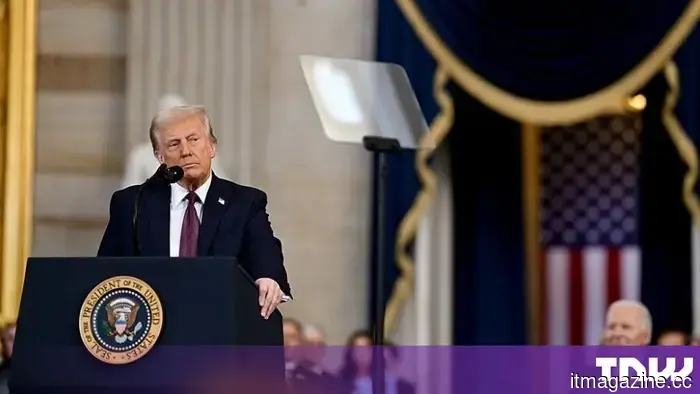
Trump's tariffs on drones hit 100%, while Europe's are limited to 15%.
Donald Trump signed the proclamation on August 13, titled Adjusting Imports of Unmanned Aircraft Systems and Unmanned Aircraft Systems Components into the United States. This action is based on Section 232 of the Trade Expansion Act of 1962, which involves national security, and Section 604 of the Trade Act of 1974.
The rates and definitions of sensitive items
Starting September 3, two tiers will be implemented. The 100% tariff applies to drones weighing over 25kg, drones equipped with thermal imaging, their docking stations, and a list of crucial components. Everything else will be subject to a 25% tariff, encompassing drones weighing 25kg or less and additional components specified in the annexes. The weight criterion is significant, distinguishing military-grade equipment from that used by filmmakers and surveyors, placing them in different tiers. A third category is also anticipated, where additional components will incur a 25% tariff starting on February 9, 2027, reflecting a 180-day delay.
The proclamation allows for further adjustments. The Secretary of Commerce may "subject additional UAS components to the tariffs… on a rolling basis."
What Europe actually receives
For European countries, the important aspect is the allied cap. EU member states, Japan, South Korea, Taiwan, Switzerland, and Liechtenstein will face a maximum tariff of 15%, while the United Kingdom will have a maximum of 10%. This cap is conditional and applies when "substantially all the critical components and technology are certified… to be products of" approved nations. This certification process is integral; a drone assembled in Europe but using Chinese motors and batteries may not qualify. Furthermore, its wording encompasses technology and software in addition to physical parts.
The proclamation explicitly mentions this dependency, stating that U.S. manufacturers rely on foreign sources for crucial components such as motors and batteries.
The rationale presented in the document
The Secretary of Commerce conducted the Section 232 investigation, concluding that drones and their components "are being imported into the United States in such quantities… as to threaten to impair national security." The reasoning can be summarized in three main points: drones are vital for military operations, the level of imports creates strategic vulnerabilities, and domestic capacity does not satisfy national security requirements. A fourth point addresses data security, as the proclamation indicates that foreign drones present an information technology security risk by transmitting data to foreign governments.
The accompanying fact sheet is titled Securing American Drone Dominance and identifies drones as "a key technology in modern armed conflict."
The exemptions that shape the policy
Two mechanisms mitigate the impact for approved suppliers. Companies included on the Department of War’s Blue UAS Cleared List, the Blue UAS Framework, or the FCC Conditional Approval List will have a 180-day grace period before the tariffs apply to their listed products. The second mechanism is an onshoring program, allowing approved companies to import covered products without duties while they establish U.S. manufacturing facilities. This approval process involves oversight from the Department of War and Homeland Security, with non-compliance risking the loss of tariff benefits.
The FCC is establishing similar boundaries
The definitions in this context align closely with another initiative. The FCC has proposed retroactively banning DJI drones it had previously approved, classifying lidar and thermal cameras as military-grade. Its list includes thermal imaging, docking stations, swarming, aerosol dispersal, and drones over 55 pounds, which equates to 25kg, the same threshold defined in the proclamation. The two measures are also interconnected; being on the FCC Conditional Approval List is one pathway to the 180-day delay.
Comments on the FCC proposal are due by September 2, a day before the tariffs take effect. It's crucial to note the overlap: one measure imposes taxes at the border, while the other could revoke operational authorization on American airwaves.
Which European companies are affected
According to Euronews, three companies are highlighted: France's Parrot, which manufactures the ANAFI series; Germany's Quantum Systems, valued over €1bn; and Portugal's Tekever, valued over €1.1bn. However, none of these is the primary target. The proclamation focuses on curbing Chinese supply, with DJI being the dominant player in the global market. European manufacturers will still have to contend with tariffs of 15% or 10%, provided they meet certification requirements. Coverage on Quantum Systems has previously appeared concerning drone swarms and the sector's presence at the Berlin airshow. Despite this, European investment has continued; for instance, Cambridge Aerospace secured $300m at a valuation of $3.4bn for drone interceptors. The tariff influences business decisions for these companies, making selling in the U.S. subject to duties while incentivizing local production.
Market reaction
U.S. drone stock prices increased in premarket trading, with AeroVironment, Kratos Defense and Security, and Red Cat all experiencing gains, as reported by Forbes. Un
Other articles
 Five of the largest companies in Europe have recently acquired computing resources that Mistral has not developed.
ASML, Amadeus, Capgemini, Caisse des Dépôts, and CMA CGM are supporting the expansion of the Mistral data centre by purchasing multi-year computing units that are currently unavailable.
Five of the largest companies in Europe have recently acquired computing resources that Mistral has not developed.
ASML, Amadeus, Capgemini, Caisse des Dépôts, and CMA CGM are supporting the expansion of the Mistral data centre by purchasing multi-year computing units that are currently unavailable.
 Canva's supporters have reduced its valuation by $7.1 billion, while its internal valuator made an even larger cut.
Blackbird and Airtree reduced Canva's valuation to $34.9 billion, and Canva's internal assessment also dropped further, following a revenue downgrade due to AI expenses.
Canva's supporters have reduced its valuation by $7.1 billion, while its internal valuator made an even larger cut.
Blackbird and Airtree reduced Canva's valuation to $34.9 billion, and Canva's internal assessment also dropped further, following a revenue downgrade due to AI expenses.
 Tesla concluded Sweden's longest strike by purchasing out all of the remaining strikers.
The strike at Tesla Sweden concludes after 1,021 days. IF Metall reports that Tesla has bought out approximately 80 striking members, resulting in no one left to continue the strike.
Tesla concluded Sweden's longest strike by purchasing out all of the remaining strikers.
The strike at Tesla Sweden concludes after 1,021 days. IF Metall reports that Tesla has bought out approximately 80 striking members, resulting in no one left to continue the strike.
 SpaceX has finalized its $60 billion deal with Cursor, which made a purchase of a company just the day prior.
The acquisition of Cursor by SpaceX was finalized on 14 August. Cursor claims it now has access to the largest GPU fleet globally, along with more affordable models.
SpaceX has finalized its $60 billion deal with Cursor, which made a purchase of a company just the day prior.
The acquisition of Cursor by SpaceX was finalized on 14 August. Cursor claims it now has access to the largest GPU fleet globally, along with more affordable models.
 A judge has instructed Google to cease making it difficult to install competing app stores.
The compliance order from Epic v Google requires Google to eliminate the additional taps and warning screens that hinder the installation of competing Android app stores within a week.
A judge has instructed Google to cease making it difficult to install competing app stores.
The compliance order from Epic v Google requires Google to eliminate the additional taps and warning screens that hinder the installation of competing Android app stores within a week.
 SpaceX has finalized its $60 billion deal with Cursor, which had acquired a company the day prior.
The acquisition of Cursor by SpaceX was finalized on 14 August. Cursor claims to now have access to the world's largest fleet of GPUs, along with more affordable models.
SpaceX has finalized its $60 billion deal with Cursor, which had acquired a company the day prior.
The acquisition of Cursor by SpaceX was finalized on 14 August. Cursor claims to now have access to the world's largest fleet of GPUs, along with more affordable models.
Trump's tariffs on drones hit 100%, while Europe's are limited to 15%.
Trump's drone tariffs have been set at 100% for drones weighing over 25kg and for thermal imaging models. Starting from September 3, the EU will have a cap of 15% and the UK will have a cap of 10%.