
From Timers to Networks: Insights on Outdoor Automation Offered by Connected Irrigation
Watering lawns or gardens has often depended on scheduled timings that don’t necessarily reflect actual conditions. Connected irrigation systems aim to improve this by integrating timers with environmental sensors and central software.
How the Components Interconnect
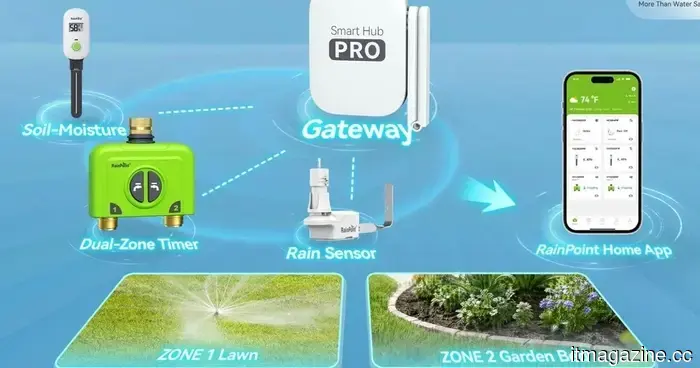
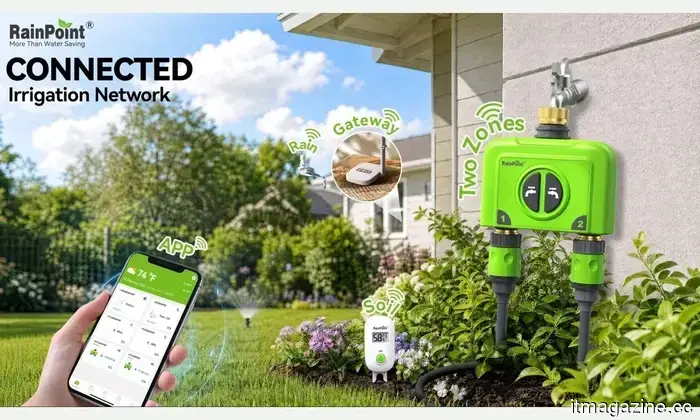
An example of this integration is seen in RainPoint’s smart garden system, which connects timers, environmental sensors, and software. The RainPoint Smart Irrigation Ecosystem uses a gateway to link a dual-zone smart water timer, soil-moisture sensor, and rain sensor through a user-friendly app. The gateway functions as the central hub for communication, enabling outdoor readings to influence the system’s watering parameters.
Once the gateway is connected to a home Wi-Fi network, the timer and sensors can be paired using the app. After setting up the necessary automation rules, data from the soil and rain sensors can adjust scheduled watering rather than relying solely on a fixed timetable.
Image used with permission by copyright holder
Managing Separate Watering Zones
The dual-outlet design allows different areas of a property, like a lawn and a vegetable garden, to operate on distinct schedules. This exemplifies a broader trend in connected-home systems, where a single interface manages zones with varying needs.
Soil-moisture and rain sensors supply critical data that enables users or set automation rules to modify, postpone, or halt scheduled watering when the soil is already saturated or when rain is detected. Smart garden technology also includes features such as watering history, manual overrides, alerts, and compatibility with voice assistants like Amazon Alexa and Google Assistant.
Challenges of Outdoor Technology
Connected devices for outdoor use encounter issues that indoor smart-home products may face less frequently. Factors such as wireless range, gateway location, exposure to weather, battery longevity, and consistent communication between components can influence performance. Sensors require occasional battery replacements, and firmware updates or app upgrades may be necessary with platform changes.
RainPoint showcased its irrigation ecosystem at CES 2026, where it received a TWICE Picks Award for integrating several irrigation components into one connected platform. However, the long-term effectiveness will rely on aspects such as reliable scheduling, sensor precision, and wireless performance across various properties and growing seasons.
Bringing Smart Home Technology Outdoors
Adopting a smart garden approach to irrigation signifies a larger evolution in consumer technology: automation is extending beyond indoor lighting, security, and climate control to gardens and outdoor areas. In these environments, connectivity may be less critical than the ability of multiple devices to consistently share useful information.
Homeowners considering this technology should take into account practical factors like the number of planting zones, distance between devices, local weather conditions, and Wi-Fi coverage. These elements will help assess whether a connected irrigation network significantly enhances functionality over a traditional timer.
Ultimately, the true measure of connected irrigation is not just the number of components linked but whether the resulting system allows for more responsive watering without imposing excessive setup and maintenance requirements. Smart garden initiatives demonstrate the potential for outdoor automation, while concerns about reliability, app support, and long-term feasibility remain key in evaluating its practical value.
Digital Trends collaborates with external contributors. All contributed content undergoes review by the Digital Trends editorial team.
Other articles
 The foldable iPhone Ultra may let down numerous enthusiastic customers.
Apple is facing supply issues that may restrict its foldable iPhone to an initial launch in the U.S., with other regions potentially experiencing months of delays.
The foldable iPhone Ultra may let down numerous enthusiastic customers.
Apple is facing supply issues that may restrict its foldable iPhone to an initial launch in the U.S., with other regions potentially experiencing months of delays.
 Sieving the Pixels: Identifying AI-Generated Content in 2026
The digital landscape is experiencing a surge of media created through synthetic means. Art, videos, music, and short films are now being generated by AI systems. Although early instances of AI-generated images were frequently identifiable due to various (and often humorous) anatomical mistakes, the newest models are yielding results that are much harder to distinguish. [...]
Sieving the Pixels: Identifying AI-Generated Content in 2026
The digital landscape is experiencing a surge of media created through synthetic means. Art, videos, music, and short films are now being generated by AI systems. Although early instances of AI-generated images were frequently identifiable due to various (and often humorous) anatomical mistakes, the newest models are yielding results that are much harder to distinguish. [...]
 Nvidia's GeForce Now concludes its beta phase on Linux, featuring enhanced cloud gaming performance.
Nvidia's GeForce NOW native Linux application has officially left beta after seven months, introducing quicker streaming, support for Chromebooks, and the addition of nine new cloud games.
Nvidia's GeForce Now concludes its beta phase on Linux, featuring enhanced cloud gaming performance.
Nvidia's GeForce NOW native Linux application has officially left beta after seven months, introducing quicker streaming, support for Chromebooks, and the addition of nine new cloud games.
 The Honor Robot Phone is now available for purchase, and it could be the most ambitious camera phone to date.
The Honor Robot Phone merges top-tier hardware with a 200MP camera attached to a motorized gimbal, features AI-driven subject tracking, and imaging technology created in collaboration with ARRI. It also carries a notably high price point.
The Honor Robot Phone is now available for purchase, and it could be the most ambitious camera phone to date.
The Honor Robot Phone merges top-tier hardware with a 200MP camera attached to a motorized gimbal, features AI-driven subject tracking, and imaging technology created in collaboration with ARRI. It also carries a notably high price point.
 Microsoft issued a warning of potential legal action, yet this researcher has still released a new Windows vulnerability.
A researcher targeted by Microsoft with potential legal action has unveiled a new zero-day vulnerability in Windows named ShieldBreak, and it remains unpatched.
Microsoft issued a warning of potential legal action, yet this researcher has still released a new Windows vulnerability.
A researcher targeted by Microsoft with potential legal action has unveiled a new zero-day vulnerability in Windows named ShieldBreak, and it remains unpatched.
 WhatsApp's newly introduced Scam Alert feature will identify scam messages while ensuring the privacy of your chats.
WhatsApp's newly introduced Scam Alert feature utilizes on-device AI to identify potentially fraudulent messages, ensuring that your private chats remain completely unread by Meta.
WhatsApp's newly introduced Scam Alert feature will identify scam messages while ensuring the privacy of your chats.
WhatsApp's newly introduced Scam Alert feature utilizes on-device AI to identify potentially fraudulent messages, ensuring that your private chats remain completely unread by Meta.
From Timers to Networks: Insights on Outdoor Automation Offered by Connected Irrigation
Watering a lawn or garden has typically depended on fixed schedules that may not accurately represent the current circumstances. Connected irrigation systems aim to overcome this challenge by integrating timers with environmental sensors and centralized software. An example of this is RainPoint’s smart garden system, which illustrates how manufacturers are linking timers and environmental components...