
From Timers to Networks: Insights on Outdoor Automation from Connected Irrigation
Watering a lawn or garden has conventionally depended on predetermined schedules that may not accurately reflect present conditions. Connected irrigation systems are working to overcome this issue by integrating timers with environmental sensors and centralized software.
How the Components Interconnect
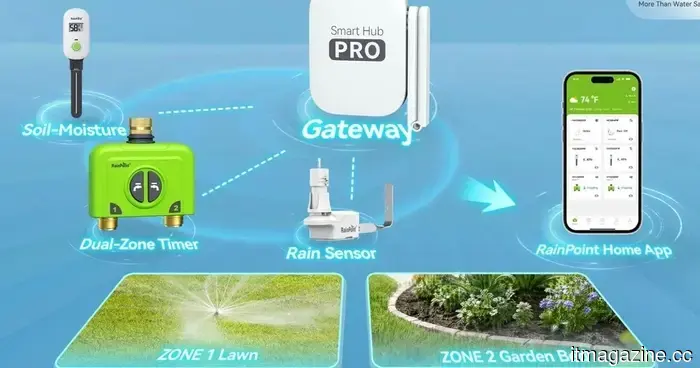
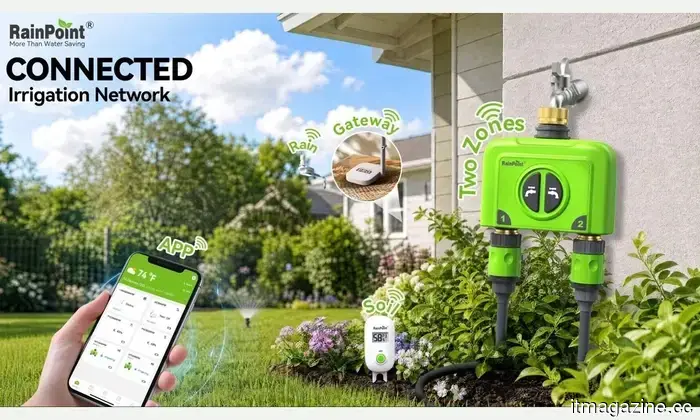
RainPoint’s smart garden system serves as an example of how manufacturers are linking timers, environmental sensors, and software. The RainPoint Smart Irrigation Ecosystem employs a gateway to connect a dual-zone smart water timer, a soil-moisture sensor, and a rain sensor through a user-friendly app. This gateway functions as the central communication hub, allowing outdoor readings to guide the system’s watering settings.
Once the gateway is connected to a home Wi-Fi network, the timer and sensors can be linked via the app. After configuring the appropriate automation rules, data from the soil and rain sensors can be utilized to modify scheduled watering rather than depending solely on a preset timetable.
Image used with permission by copyright holder
Coordinating Distinct Watering Areas
With its dual-outlet design, different sections of a property—such as a lawn and a vegetable garden—can operate on separate schedules. This reflects a broader trend in connected-home systems: managing areas with varying requirements using a single interface.
Soil-moisture and rain sensors provide essential information for users or automated rules to adjust, postpone, or halt scheduled watering when the soil is sufficiently moist or precipitation is detected. Additionally, smart garden technology offers features such as watering history, manual overrides, alerts, and compatibility with voice assistants like Amazon Alexa and Google Assistant.
Challenges of Outdoor Technology
Connected devices designed for outdoor use encounter challenges that indoor smart-home products face less frequently. Factors like wireless range, gateway positioning, exposure to the elements, battery life, and reliable communication among components can all impact functionality. Sensors require regular battery replacements, and firmware or app updates may be necessary with platform changes.
RainPoint unveiled its irrigation ecosystem at CES 2026, where it was recognized as a TWICE Picks Award winner for integrating multiple irrigation components into a single connected platform. However, its long-term effectiveness will hinge on aspects such as reliable scheduling, sensor precision, and wireless performance across various properties and growing seasons.
Expanding Smart Technology Outdoors
Adopting a smart garden approach to irrigation signifies a wider evolution in consumer technology: automation is branching out from indoor lighting, security, and climate control into gardens and other outdoor areas. In these environments, connectivity may be less crucial than the ability of multiple devices to consistently share valuable information.
For homeowners considering this type of technology, practical factors include the number of planting zones, the distance between devices, local weather conditions, and Wi-Fi coverage. These elements are key in assessing whether a connected irrigation system presents a significant advantage over a traditional timer.
The overarching evaluation for connected irrigation, therefore, is not merely how many components can be connected, but whether the resulting system enhances watering responsiveness without imposing excessive setup and maintenance burdens. Smart garden solutions demonstrate the potential of outdoor automation, while concerns regarding reliability, app support, and long-term ownership continue to be critical in evaluating its practical worth.
Digital Trends collaborates with external contributors. All contributor content undergoes review by the Digital Trends editorial team.
Other articles
 Databricks Secures $5 Billion Funding Round at a $190 Billion Valuation
Databricks has secured $5 billion at a valuation of $190 billion, with a revenue run rate exceeding $7 billion and a growth rate surpassing 80%, following comments from its CEO declaring 2026 as a poor year for an IPO.
Databricks Secures $5 Billion Funding Round at a $190 Billion Valuation
Databricks has secured $5 billion at a valuation of $190 billion, with a revenue run rate exceeding $7 billion and a growth rate surpassing 80%, following comments from its CEO declaring 2026 as a poor year for an IPO.
 Twitch will utilize your streams to train Amazon's AI unless you locate the setting.
Twitch has introduced a feature that allows users to prevent Amazon from training its AI using their streams. According to the company's product chief, this setting is disabled by default, as it's believed that no one would want to enable it.
Twitch will utilize your streams to train Amazon's AI unless you locate the setting.
Twitch has introduced a feature that allows users to prevent Amazon from training its AI using their streams. According to the company's product chief, this setting is disabled by default, as it's believed that no one would want to enable it.
 I have a weakness for vibrant phones, and Google is well aware of this.
The colors of Google’s Pixel 11 are vibrant, striking, and delightfully playful, and the accessories are also joining in on the excitement.
I have a weakness for vibrant phones, and Google is well aware of this.
The colors of Google’s Pixel 11 are vibrant, striking, and delightfully playful, and the accessories are also joining in on the excitement.
 The iPhone 18 might receive the necessary RAM enhancement it requires.
The standard iPhone 18 may feature 12GB of RAM instead of the earlier suggested 9GB, which could enable it to support a greater number of Apple’s on-device AI capabilities.
The iPhone 18 might receive the necessary RAM enhancement it requires.
The standard iPhone 18 may feature 12GB of RAM instead of the earlier suggested 9GB, which could enable it to support a greater number of Apple’s on-device AI capabilities.
 DeepSeek developed a competitor to Claude Code and subsequently raised its prices fourfold.
The DeepSeek price hike raises the V4-Pro to $3.96 per million tokens at its highest point, alongside a new open harness intended for Anthropic's Claude Code.
DeepSeek developed a competitor to Claude Code and subsequently raised its prices fourfold.
The DeepSeek price hike raises the V4-Pro to $3.96 per million tokens at its highest point, alongside a new open harness intended for Anthropic's Claude Code.
 Microsoft issued a warning of potential legal action, yet this researcher has still released a new Windows vulnerability.
A researcher targeted by Microsoft with potential legal action has unveiled a new zero-day vulnerability in Windows named ShieldBreak, and it remains unpatched.
Microsoft issued a warning of potential legal action, yet this researcher has still released a new Windows vulnerability.
A researcher targeted by Microsoft with potential legal action has unveiled a new zero-day vulnerability in Windows named ShieldBreak, and it remains unpatched.
From Timers to Networks: Insights on Outdoor Automation from Connected Irrigation
Watering a lawn or garden has historically depended on established schedules that may not accurately represent the existing conditions. Connected irrigation systems aim to overcome this drawback by integrating timers with environmental sensors and centralized software. A prime example of this is RainPoint’s smart garden system, which illustrates how manufacturers are linking timers and environmental...