
Crypto impersonation scams surged by 1,400% due to the enhancement of fraud through AI technology.
TL;DR: Chainalysis indicates that impersonation scams surged over 1,400% in 2025, with AI-driven operations yielding 4.5 times the revenue and operating 9 times more than non-AI methods. The cost to bypass KYC checks using deepfake technology is now around $20 and takes about 30 minutes, successfully bypassing standard liveness checks 58% of the time. Crypto accounts for 88% of all detected deepfake fraud globally. Law enforcement actions have resulted in $4.4 billion in frozen Tether and nearly 5,800 arrests across 97 countries, yet fraudulent identities can still clear checks.
Impersonation scams increased by over 1,400% year-on-year in 2025, per Chainalysis, with the average payment in these clusters rising by over 600%. The average crypto payment across all scam categories has jumped from $782 to $2,764.
The scalability of these attacks isn't driven by more people participating but by fewer individuals utilizing improved tools.
Fraud Previously Had a Staffing Limitation
Investment scams or romance fraud required staffing because a trained individual needed to interact with victims over a long period. These requirements limited how many operations could function simultaneously, and this limitation persisted for years.
Generative technology has eliminated this barrier without altering the fundamental deception. The scam remains consistent with those seen since the emergence of fake exchange support agents. What has changed is that the expensive operational aspect has become more affordable.
Economic Patterns Are Visible On-Chain
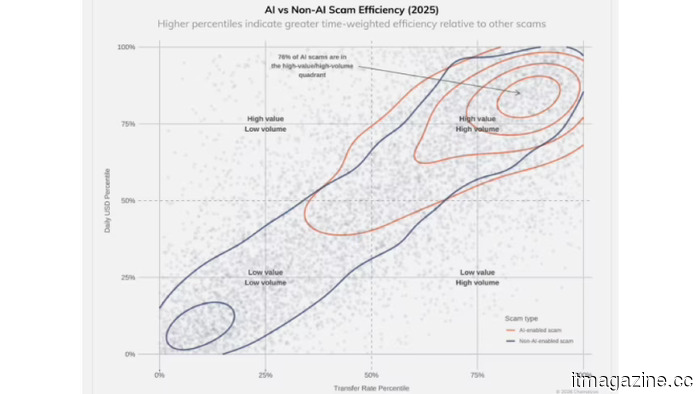
Chainalysis revealed that operations linked to AI tools generated an average of $3.2 million compared to $719,000 for those without such links, conducting an average of 35.1 transactions daily versus 3.89. This translates to about 4.5 times the revenue for approximately nine times the activity, allowing the same operation to reach and convert more victims. TRM Labs reported a nearly 500% rise in AI-enabled scam activity over the past year.
"In Web3, code is not necessarily the weakest link anymore," states Jimmy Su, Chief Security Officer at Binance. "As the security of smart contracts improves, attackers are focusing more on people, credentials, and governance within protocols. We witnessed this when Binance Security thwarted a $1.2 million governance attack on BrainTrust. Protecting a protocol now involves securing not just its code but also the individuals who control it, how that control is exercised, and the supporting infrastructure."
The Verification Systems Were Developed for a Different Type of Attack
Identity verification was designed to counter threats involving printed photographs, recorded videos, and basic physical spoofing techniques. This is why liveness checks still prompt users to perform actions like blinking or turning their heads. The threat level has evolved, but the verification prompts have not.
Research from Socure estimates that defeating current verification systems costs roughly $20 and takes about 30 minutes, with injection attacks that deliver synthetic video directly to the verification system bypassing standard liveness checks approximately 58% of the time. Socure and Zyphe, which it references, both provide detection solutions in this area.
"The crypto sector is witnessing a rise in impersonation scams that are becoming more sophisticated," mentions Lior Aizik, co-founder and COO of XBO. "Scammers have impersonated me personally, using fake profiles to reach out to industry insiders and request funds while falsely representing XBO. These scams leverage urgency and trust rather than technology."
This issue disproportionately affects the crypto sector. Binance Research notes that crypto constitutes 88% of all identified deepfake fraud cases globally, with North American losses exceeding $410 million in the first half of 2025, and around 80% of attacks against the exchange involve some form of KYC fraud.
Detection Is Automated; Recovery Is Not
There are two factors countering this increase in scams, and only one pertains to models.
The first is automated screening, which primarily increases throughput rather than certainty; Binance Research indicates up to a 100-fold efficiency improvement when AI is applied to KYC screening, with models for face attacks and liveness being updated with each new spoofing technique.
The second effective measure is much older: coordinated law enforcement efforts along with the ability to freeze assets post-factum. As of April 2026, Binance Research reports Tether’s total frozen funds exceed $4.4 billion, and the T3 Financial Crime Unit, a collaboration with TRON and TRM Labs, accounts for over $300 million in its first year of operations, including $19 million linked to the Bybit hack. These figures come from the exchange’s research rather than the issuers themselves.
Traditional law enforcement efforts have also adjusted accordingly. INTERPOL's Operation First Light 2026 covered 97 countries, resulting in close to 5,800 arrests and intercepting $293 million. Europol's Operation Endgame froze about $47 million, dismantled 326 servers and
Other articles
 Grok Bot aims to lighten your workload, not merely respond to your questions.
Grok Bot, along with SpaceXAI and Cursor's new AI agent application, logs into your current tools to independently carry out real tasks, only seeking approval when necessary.
Grok Bot aims to lighten your workload, not merely respond to your questions.
Grok Bot, along with SpaceXAI and Cursor's new AI agent application, logs into your current tools to independently carry out real tasks, only seeking approval when necessary.
 Grok Bot aims to alleviate your workload, rather than merely responding to your questions.
Grok Bot, along with SpaceXAI and Cursor's new AI agent application, connects to your current tools to independently carry out actual tasks, only seeking your approval when necessary.
Grok Bot aims to alleviate your workload, rather than merely responding to your questions.
Grok Bot, along with SpaceXAI and Cursor's new AI agent application, connects to your current tools to independently carry out actual tasks, only seeking your approval when necessary.
 Samsung Galaxy Z Fold 8 review: After spending weeks testing it, I find it hard to put this stunning device down.
The Galaxy Z Fold 8 is the most thrilling smartphone Samsung has produced in years. While it comes with a high price tag and involves significant trade-offs, it provides a wealth of practical appeal, dependability, and durability in a versatile design.
Samsung Galaxy Z Fold 8 review: After spending weeks testing it, I find it hard to put this stunning device down.
The Galaxy Z Fold 8 is the most thrilling smartphone Samsung has produced in years. While it comes with a high price tag and involves significant trade-offs, it provides a wealth of practical appeal, dependability, and durability in a versatile design.
 Sonos is set to hold a launch event in September and is intensifying its focus on home AI.
Tom Conrad believes that asking which AI model is the best is not the correct question concerning smart homes. The initial hardware from that strategy, the Sonos Ace Ultra, will be released in September.
Sonos is set to hold a launch event in September and is intensifying its focus on home AI.
Tom Conrad believes that asking which AI model is the best is not the correct question concerning smart homes. The initial hardware from that strategy, the Sonos Ace Ultra, will be released in September.
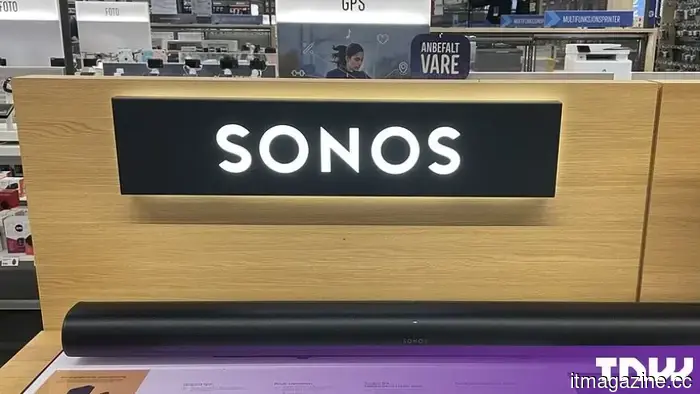 Sonos Schedules Launch Event for September and Expands Focus on Home AI.
Tom Conrad suggests that asking for the best AI model is not the right approach for smart homes. The initial hardware from that strategy, the Sonos Ace Ultra, will be released in September.
Sonos Schedules Launch Event for September and Expands Focus on Home AI.
Tom Conrad suggests that asking for the best AI model is not the right approach for smart homes. The initial hardware from that strategy, the Sonos Ace Ultra, will be released in September.
 Samsung Galaxy Z Fold 8 review: After weeks of testing it, I find it difficult to stop using this remarkable device.
The Galaxy Z Fold 8 is the most thrilling phone Samsung has released in years. Although it comes with a high price tag and involves significant trade-offs, it delivers a wealth of practical appeal, dependability, and durability within a flexible design.
Samsung Galaxy Z Fold 8 review: After weeks of testing it, I find it difficult to stop using this remarkable device.
The Galaxy Z Fold 8 is the most thrilling phone Samsung has released in years. Although it comes with a high price tag and involves significant trade-offs, it delivers a wealth of practical appeal, dependability, and durability within a flexible design.
Crypto impersonation scams surged by 1,400% due to the enhancement of fraud through AI technology.
Impersonation scams in cryptocurrency surged by over 1,400% compared to the previous year, with AI-related schemes generating 4.5 times the revenue while experiencing nine times the activity. Deepfake KYC fraud currently costs $20 and successfully bypasses liveness checks 58% of the time.