
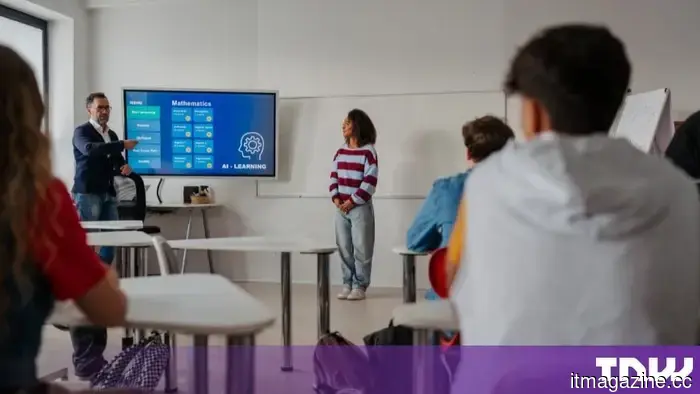
Fei-Fei Li: the genuine danger of AI in educational settings is that students may lose their desire to learn.
TL;DR: Fei-Fei Li argues that the main risk of AI in education is not cheating, but rather students losing their agency and motivation to learn. She cautions against outright bans on these tools, emphasizing that AI can be beneficial when students are already engaged. She discussed her views on the Huberman Lab podcast released on Monday.
Fei-Fei Li believes that schools are focusing on the wrong issues. She asserts that the true threat of AI in educational settings is not its potential for enabling cheating but its capacity to diminish students' desire to learn. She expressed this viewpoint on the science podcast Huberman Lab during an episode that aired on Monday.
“The worst possible outcome is that our younger generation's agency and intrinsic motivation to learn and live are taken away by tools,” stated Li, a Stanford computer science professor often referred to as the godmother of AI. “This should not be stripped away by either humans or machines.”
If misused, she warned, these tools could result in a generation that has not sufficiently “developed the brain.” She is equally concerned about the opposite extreme. “Both scenarios are worrying to me,” she added. “Either rejecting the tool or stripping away agency and motivation.”
The evidence surrounding this debate is still emerging. A report from Oxford University Press last year indicated that while students are quickly completing tasks, they are losing depth of understanding. Separately, MIT researcher Nataliya Kosmyna found that individuals using generative AI for essay writing performed worse over time compared to those who relied on Google or help from no tools at all.
That second finding has faced criticism. In December, four researchers published a formal response to Kosmyna’s study, questioning its sample size, EEG analysis, consistency in reporting, and transparency. They acknowledged the merit of the dataset but suggested that the findings could be interpreted more cautiously.
Vivienne Ming, chief scientist at the Possibility Institute, remarked to Business Insider earlier this year that most AI users she observed were using it to minimize their own thinking. This pattern, described by Wharton researchers as cognitive surrender, is also evident in workplace settings, where research indicates junior employees fail to learn debugging skills.
Li proposes a middle ground between banning the tools and completely embracing them. Reflecting on her struggles with organic chemistry as a premed student when teaching assistant availability was limited, she mentioned that she would have sought help from a chatbot frequently.
“I recognize when I’m struggling,” Li noted. “I have the desire to learn. I just need direction.”
This distinction, she argues, should influence how educational institutions integrate technology, viewing it as a means to encourage deeper learning rather than simply a tool to monitor for cheating. “Let’s find a way to preserve our children and students’ motivation and agency,” she urged, adding that if used effectively, it could enable future students to become “much smarter than us because they are superpowered.”
Other articles
 YouTube has just doubled the requirements for creators to begin earning money from ads.
YouTube is increasing its watch-time and Shorts-view thresholds for new creators aiming for ad revenue, significantly raising the bar for entry into its Partner Program starting in 2027.
YouTube has just doubled the requirements for creators to begin earning money from ads.
YouTube is increasing its watch-time and Shorts-view thresholds for new creators aiming for ad revenue, significantly raising the bar for entry into its Partner Program starting in 2027.
 IBM invests $240 million in affordable, open-source inference to compete with the hyperscalers.
IBM and Together AI have reached a $240 million agreement to establish an Nvidia Blackwell inference cluster on IBM Cloud, placing a bet on the financial advantages of open-source AI compared to its closed competitors.
IBM invests $240 million in affordable, open-source inference to compete with the hyperscalers.
IBM and Together AI have reached a $240 million agreement to establish an Nvidia Blackwell inference cluster on IBM Cloud, placing a bet on the financial advantages of open-source AI compared to its closed competitors.
 Apple Executive Behind the Launch of Apple Pay Is Retiring After 25 Years
Jennifer Bailey, who has been leading Apple Pay since its launch in 2014, will retire in October, marking yet another exit from Apple ahead of Cook's transition.
Apple Executive Behind the Launch of Apple Pay Is Retiring After 25 Years
Jennifer Bailey, who has been leading Apple Pay since its launch in 2014, will retire in October, marking yet another exit from Apple ahead of Cook's transition.
 An activist investor claims that the market has concluded that Lionsgate is a victim of AI. The investor is urging the studio to demonstrate otherwise or consider selling.
Anson Funds states that Lionsgate's stock declines whenever a new AI video model is released. The issue or solution may lie within its library of 20,000 titles.
An activist investor claims that the market has concluded that Lionsgate is a victim of AI. The investor is urging the studio to demonstrate otherwise or consider selling.
Anson Funds states that Lionsgate's stock declines whenever a new AI video model is released. The issue or solution may lie within its library of 20,000 titles.
 Meta and TikTok have reached an agreement to fact-check content related to the border following the tragedy in Ceuta.
Meta and TikTok have reached an agreement to verify misinformation regarding the Ceuta border in Spain, responding to pressure from the EU, following a July increase in incidents that resulted in nearly 100 fatalities.
Meta and TikTok have reached an agreement to fact-check content related to the border following the tragedy in Ceuta.
Meta and TikTok have reached an agreement to verify misinformation regarding the Ceuta border in Spain, responding to pressure from the EU, following a July increase in incidents that resulted in nearly 100 fatalities.
 IBM invests $240 million in affordable, open-source inference to compete with hyperscalers.
IBM and Together AI have reached a $240 million agreement to create an Nvidia Blackwell inference cluster on IBM Cloud, betting on the financial advantages of open-source AI compared to proprietary competitors.
IBM invests $240 million in affordable, open-source inference to compete with hyperscalers.
IBM and Together AI have reached a $240 million agreement to create an Nvidia Blackwell inference cluster on IBM Cloud, betting on the financial advantages of open-source AI compared to proprietary competitors.
Fei-Fei Li: the genuine danger of AI in educational settings is that students may lose their desire to learn.
The Stanford computer scientist warns that the real risk of AI in classrooms isn't about cheating; rather, it's that students may lose their autonomy and desire to learn altogether.