
Expanding beyond mobility: Unitree's GD01 marks a new stage in China's robotics competition.
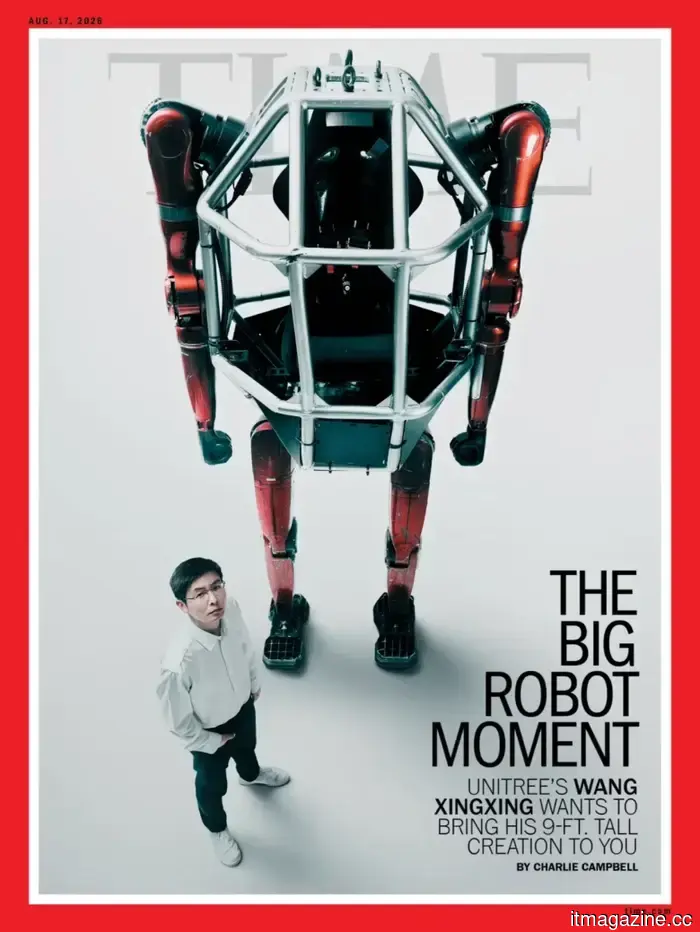
In 2026, Unitree Robotics once again positioned itself at the forefront of discussions in the robotics industry. Last month, Wang Xingxing, the founder and CEO of Unitree, featured alongside the company's GD01 manned mech on the cover of TIME magazine.
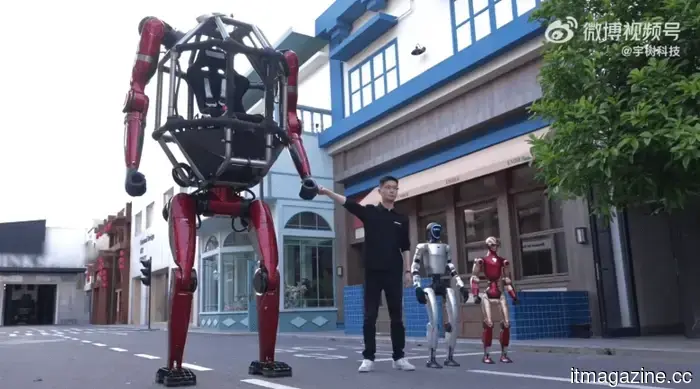
In the cover image, the GD01, standing nearly 2.7 meters tall, dominates the frame, while Wang appears to its right, resembling a footnote next to the towering machine. The headline reads: The Big Robot Moment.
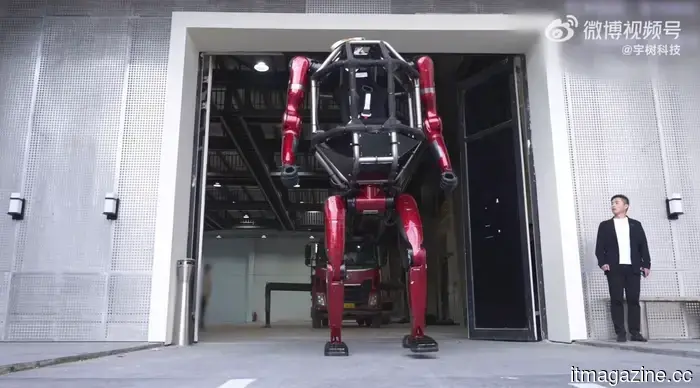
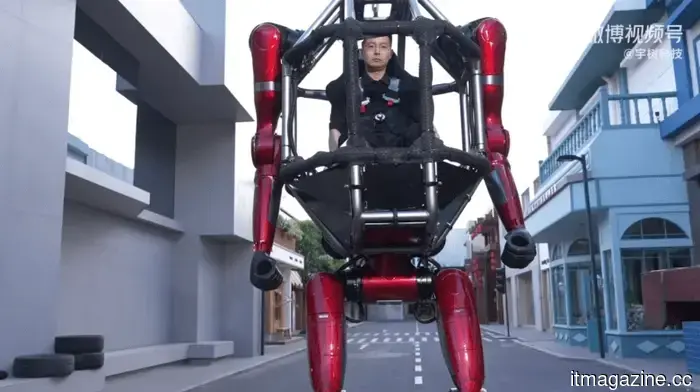
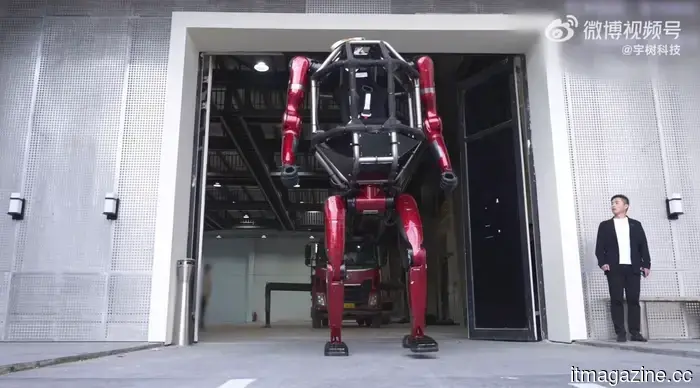
The GD01 is reportedly the world’s first mass-produced manned mech, weighing about half a ton and operated from a cockpit located in its torso. This machine can walk on two legs or switch to a four-legged gait, and its fists possess enough strength to break through walls. Its feet are attached to a carbon-fiber protective shell via robust mechanical hinges, and the formidable machine features striking red mechanical legs that enable steady movement.
Unlike Unitree’s previous robots, which primarily served research, education, and industrial applications, the GD01 aims to explore how robots can function in more intricate environments. This product integrates Unitree’s established knowledge in motion control, robotic design, and intelligent interaction, signaling a shift in robotics from machines with single purposes to more adaptable intelligent platforms.
Upon its unveiling, the GD01 elicited an almost unanimous reaction from the market: science fiction had become reality. However, from a broader standpoint, what truly makes the GD01 noteworthy is not just its resemblance to a cinematic mech but rather its implication for the industry's future—a transition from competing over the robots themselves to competing based on the capabilities of these robots.
In terms of product classification, the GD01 does not fit neatly into the categories of conventional industrial or consumer robots. Instead, it serves as a robotic platform intended to explore future intelligent mobility scenarios. By merging bipedal and quadrupedal movement with manned control, the GD01 can adapt its mode of locomotion to various environments, potentially enhancing its versatility in complex terrains and diverse situations.
Contrary to traditional automated systems that depend on fixed tracks or highly structured environments, the GD01 seeks to overcome limitations to robotic mobility, broadening the types of unstructured environments accessible to robots. Its prospective applications involve working in hazardous or specialized conditions, performing emergency rescues, conducting inspections, and facilitating transportation, as well as future scenarios involving intelligent mobility.
With enhanced motion control and intelligent interaction capabilities, the GD01 aims to tackle one of the key challenges of integrating robots into the real world: the ability to adjust to complex environments and execute more advanced tasks.
In recent years, China's robotics industry has experienced its initial period of rapid expansion. Quadruped and humanoid robots have consistently set new standards for mobility, evolving from simple actions like running and backflips to more intricate movements such as dancing.
Robots have progressively approached human physical capabilities, with Unitree emerging as a leading player throughout this period, developing expertise in motion control through a range of products, including the consumer-oriented Go series of robot dogs and the G1 and H-series humanoid robots. However, the mere ability to move is becoming a less significant competitive advantage.
As more companies enter the race for embodied intelligence, the competitive landscape is shifting. The central question is evolving from whether a robot can move to whether it can effectively perform useful tasks.
Future robots will need to operate in real-world settings such as logistics, manufacturing, inspection, and rescue, becoming intelligent machines that generate genuine economic value rather than merely showcasing technological potential.
The GD01 has emerged in this context, representing a new trajectory in robotic product development: a combination of sophisticated mechanical structures, enhanced mobility, and intelligent control systems to increase the variety of environments in which robots can operate.
Moreover, the GD01 reflects a transformation in how robotics firms compete. Previously, competition revolved around metrics such as the number of joints, movement speed, and hardware specifications. In the future, crucial differentiators are likely to be a robot's capacity to understand its surroundings, execute tasks, and harness the AI systems that support it.
While the GD01 may not achieve high sales volume, it could serve as a significant case study for understanding the technological trajectory of China's robotics industry. It signifies more than a singular robotic product; it indicates a broader industry trend: robots are moving out of laboratories and into practical applications.
The industry still faces considerable obstacles before robots can be integrated into daily life on a large scale. Challenges remain in terms of cost, safety standards, battery life, and the maturity of commercial applications. Lowering manufacturing costs, accumulating valuable data through extended operations, and establishing comprehensive safety standards are critical questions for the industry moving forward.
In the upcoming years, industrial production, operations in hazardous environments, and professional services are likely to remain among the most feasible areas for robotic deployment. Nevertheless, one thing becomes increasingly clear: the competition in robotics has transitioned into a new phase.
Over the last decade, the focus was on a
Другие статьи
 Bumble is allowing men to initiate contact, breaking the foundational rule it was established on.
Bumble will allow men to initiate messages first, changing the women-first policy that characterized the platform, as the number of paying users declines and the app invests in an AI-driven transformation.
Bumble is allowing men to initiate contact, breaking the foundational rule it was established on.
Bumble will allow men to initiate messages first, changing the women-first policy that characterized the platform, as the number of paying users declines and the app invests in an AI-driven transformation.
 Meta's smart glasses have been prohibited in courts throughout England and Wales.
HMCTS has prohibited Meta smart glasses in court buildings throughout England and Wales, seizing them upon entry, as organizations rush to establish guidelines for constantly active wearable cameras.
Meta's smart glasses have been prohibited in courts throughout England and Wales.
HMCTS has prohibited Meta smart glasses in court buildings throughout England and Wales, seizing them upon entry, as organizations rush to establish guidelines for constantly active wearable cameras.
 Bumble is allowing men to take the initiative, breaking the foundational rule it was established on.
Bumble will allow men to initiate conversations first, changing the women-first policy that characterized the app, as the number of paying users declines and the platform invests in an AI-driven redesign.
Bumble is allowing men to take the initiative, breaking the foundational rule it was established on.
Bumble will allow men to initiate conversations first, changing the women-first policy that characterized the app, as the number of paying users declines and the platform invests in an AI-driven redesign.
 Trump Media reports a quarterly loss of $238 million as its investment in bitcoin turns unfavorable.
Trump Media disclosed a second-quarter loss of $238.1 million, primarily due to cryptocurrency markdowns, with revenue amounting to only $1.67 million, as the parent company of Truth Social increasingly focuses on bitcoin.
Trump Media reports a quarterly loss of $238 million as its investment in bitcoin turns unfavorable.
Trump Media disclosed a second-quarter loss of $238.1 million, primarily due to cryptocurrency markdowns, with revenue amounting to only $1.67 million, as the parent company of Truth Social increasingly focuses on bitcoin.
 Beyond mobility: Unitree's GD01 marks the next stage in China's robotics competition.
In 2026, Unitree Robotics positioned itself back at the forefront of discussions within the robotics industry. Just last month, the founder and CEO of Unitree, Wang Xingxing,
Beyond mobility: Unitree's GD01 marks the next stage in China's robotics competition.
In 2026, Unitree Robotics positioned itself back at the forefront of discussions within the robotics industry. Just last month, the founder and CEO of Unitree, Wang Xingxing,
 Meta's smart glasses have been prohibited in courts throughout England and Wales.
HMCTS has prohibited the use of Meta smart glasses in court buildings across England and Wales, seizing them upon entry, as organizations rush to establish regulations for wearable cameras that are continuously active.
Meta's smart glasses have been prohibited in courts throughout England and Wales.
HMCTS has prohibited the use of Meta smart glasses in court buildings across England and Wales, seizing them upon entry, as organizations rush to establish regulations for wearable cameras that are continuously active.
Expanding beyond mobility: Unitree's GD01 marks a new stage in China's robotics competition.
In 2026, Unitree Robotics once more positioned itself at the forefront of discussions in the robotics industry. Last month, Wang Xingxing, the founder and CEO of Unitree,