
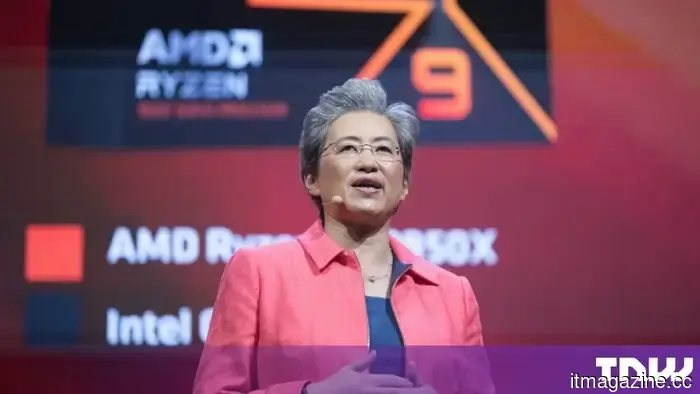
AMD's record-breaking quarter essentially wagers that openness will surpass Nvidia's competitive advantage.
AMD has achieved its most successful quarter to date, reporting a record revenue of $11.5 billion for the second quarter, reflecting a 50% increase compared to the previous year, driven by a surge in demand for AI hardware.
The data center segment was the primary growth engine, generating $6.7 billion, over twice last year’s earnings, and accounting for 58% of the company’s revenue, marking a significant indication that AMD is firmly establishing itself in a market previously dominated by Nvidia.
Following suit with the revenue, AMD reported adjusted earnings of $1.66 per share and a non-GAAP gross margin of 56%. The company projected around $13 billion for the upcoming quarter, representing an anticipated 41% increase. CEO Lisa Su described this performance as outstanding, noting that AI is propelling compute demand across various markets.
The rest of the business showed mixed results, with client chips increasing by 23% and embedded systems by 19%, while gaming saw a decrease of 31%. The forecast was a particularly strong indicator, with AMD expecting around $13 billion in the third quarter, representing a 13% increase in just one quarter—a jump that generally occurs when data center orders are being placed more quickly than the company is able to process them.
Nonetheless, comparisons to Nvidia highlight the scale of the challenge. Nvidia’s data center business is still several times larger, capturing the largest portion of AI accelerator spending, meaning that AMD's growth can be viewed as catching up rather than overtaking.
However, hardware is only part of the equation. Nvidia’s strength does not solely rest on its silicon; its significant advantage lies in CUDA, the software framework that many AI developers are familiar with and hesitant to leave. This is the barrier AMD is attempting to overcome. Their solution is ROCm, an open-source software stack presented as an alternative to the more exclusive nature of CUDA, targeting customers who wish to avoid being tied to a single vendor.
The strategy here is pragmatic rather than emotional. If AI infrastructure transitions towards open-source tools, CUDA's early advantage diminishes, allowing customers to move workloads across different chips without extensive rewriting. The challenge is existing habits; a decade's worth of tutorials, libraries, and trained professionals have all been built around CUDA, and replicating that ecosystem necessitates years of unnoticed effort, which is why AMD frames its approach as gradual progress rather than a single leap.
Signs suggest that this approach is gaining traction, as researchers have started deploying significant models on AMD hardware, including a large-scale AI model from Cambridge utilizing AMD instead of Nvidia—an important reference win for the company.
The next critical phase involves the hardware roadmap, as AMD is advancing its MI400 accelerators and Helios rack-scale systems to compete with Nvidia’s most compact configurations, and this strategy will only succeed if the open software evolves in tandem with the hardware.
Additionally, AMD has made a deal to provide Anthropic with two gigawatts of its Helios systems, a major customer that positions its next-generation MI450 accelerators against Nvidia’s top-tier offerings. However, such agreements have their risks; AMD’s data center growth is reliant on a small number of significant AI customers, and if any one of them reduces their budget, this could adversely impact revenue.
Meanwhile, Nvidia is not relinquishing its software advantages easily. The company has invested years in enhancing CUDA and integrating partners into its ecosystem, a strategy now being emulated by rivals such as Google as they develop their alternatives.
AMD has demonstrated its ability to sell chips, but the ongoing question is whether its openness can attract customers who habitually turn to CUDA. For the time being, momentum is substantial and the disparity is still considerable. AMD is narrowing the hardware gap while wagering that success hinges on software, a gamble that will require more than just one remarkable quarter to determine the outcome.
Other articles
 Disney sells its final significant cable interest to Hearst for $1.2 billion.
Disney has finalized a $1.2 billion agreement that grants Hearst complete control of A+E Global Media, the parent company of History and Lifetime, as Disney steps back from linear television.
Disney sells its final significant cable interest to Hearst for $1.2 billion.
Disney has finalized a $1.2 billion agreement that grants Hearst complete control of A+E Global Media, the parent company of History and Lifetime, as Disney steps back from linear television.
 Samsung challenges Dolby Vision 2 with the introduction of its new HDR format, which will be available on Prime Video this month.
Samsung's HDR10+ Advanced format is set to debut on Prime Video and 2026 televisions this month.
Samsung challenges Dolby Vision 2 with the introduction of its new HDR format, which will be available on Prime Video this month.
Samsung's HDR10+ Advanced format is set to debut on Prime Video and 2026 televisions this month.
 How to select an app development agency for your startup: a guide for founders
Chop Dawg, an app development firm based in Philadelphia and established in 2009, advocates for selecting a technical partner that emphasizes process, reliability, and long-term responsibility rather than opting for the quickest or most affordable choice.
How to select an app development agency for your startup: a guide for founders
Chop Dawg, an app development firm based in Philadelphia and established in 2009, advocates for selecting a technical partner that emphasizes process, reliability, and long-term responsibility rather than opting for the quickest or most affordable choice.
 Taiwan is looking into 17 Chinese companies for allegedly recruiting its semiconductor talent.
Taiwan’s Investigation Bureau has conducted searches at 64 locations and interrogated 114 individuals as part of an investigation into 17 Chinese companies suspected of unlawfully recruiting semiconductor professionals.
Taiwan is looking into 17 Chinese companies for allegedly recruiting its semiconductor talent.
Taiwan’s Investigation Bureau has conducted searches at 64 locations and interrogated 114 individuals as part of an investigation into 17 Chinese companies suspected of unlawfully recruiting semiconductor professionals.
 Lucid is reducing its budget by $1.4 billion and is wagering its future on robotaxis.
Lucid announced a cost-cutting strategy worth $1.4 billion in conjunction with a quarterly loss of $1.26 billion, focusing its recovery efforts on a robotaxi initiative in partnership with Uber and Nuro.
Lucid is reducing its budget by $1.4 billion and is wagering its future on robotaxis.
Lucid announced a cost-cutting strategy worth $1.4 billion in conjunction with a quarterly loss of $1.26 billion, focusing its recovery efforts on a robotaxi initiative in partnership with Uber and Nuro.
 X is challenging a Turkish court's decision to freeze Ekrem Imamoglu's campaign account.
A Turkish court has instructed X to limit the presidential campaign account of Ekrem Imamoglu, the imprisoned mayor of Istanbul. X has stated that it is adhering to this order while also contesting it in court.
X is challenging a Turkish court's decision to freeze Ekrem Imamoglu's campaign account.
A Turkish court has instructed X to limit the presidential campaign account of Ekrem Imamoglu, the imprisoned mayor of Istanbul. X has stated that it is adhering to this order while also contesting it in court.
AMD's record-breaking quarter essentially wagers that openness will surpass Nvidia's competitive advantage.
AMD reported a record revenue of $11.5 billion for Q2, with data-center sales more than doubling. However, its main strategy is to leverage an open software stack to challenge Nvidia’s dominance with CUDA.