

The notion of a student "AI revolt" is largely a myth, according to a survey.
The boos heard during last spring’s graduations indicated a student backlash against AI; however, the statistics tell a different story. At one Washington institution, the use of AI among business students has become commonplace, and the primary demand is not for prohibition but for education on it.
These insights come from a three-year study at American University’s Kogod School of Business, which was shared with Axios. The percentage of students utilizing AI at least 11 times a week increased from 6.2% in 2024 to 29% this year, according to the report. Over 80% had engaged with AI for coursework in the preceding six months.
Part of the trend is driven by the job market. The incidence of interviews featuring AI-related questions rose from 11.6% in 2024 to 42.6% this year. Students have taken note, with prompt engineering now the most sought-after skill, while coding has surged from under 4% to nearly 20% in just one year. This suggests a transition from casual use to a necessity in interviews.
The preference for tools varies by age group. Undergraduates tend to prefer ChatGPT, whereas graduate students are more inclined to use Claude. Although Perplexity was the top choice for raw usage, all surveyed students had complimentary access to Perplexity Pro through a campus arrangement, which inflates the figures. Accuracy is the most important factor when students select a tool.
Despite the increasing use of AI, students remain critical. Almost half of the Kogod students expressed concerns about academic integrity. A separate survey from Inside Higher Ed revealed that 40% feared AI was diminishing their capacity to think independently. The overall message is not one of outright rejection but rather a call for clearer guidelines.
A paradox exists within the data: brainstorming remains the most common application of AI, as it has been for the last three years. However, research from Wharton indicates that individuals produced a broader array of ideas when relying on their own cognition and web searches than when using ChatGPT. Thus, the most popular application may inadvertently limit creative thinking.
Educational institutions are navigating extreme responses. Initially, faculty attempted to create assignments that were “AI-proof,” according to Kogod’s interim dean Casey Evans, but ultimately abandoned that approach. The new tactic involves presenting a student’s work as an AI-generated C and guiding them toward achieving an A. Resistance to this method has been infrequent.
Conversely, some universities have taken a different stance, assigning AI the role of monitoring students during exams, while others, like Brown, have reverted to requiring in-person, handwritten papers. The battle between detection tools and cheating methods continues, leaving classrooms without a definitive solution.
While the Kogod data comes with a caveat, being self-reported from 483 students at a single institution, larger studies corroborate the trend: Inside Higher Ed found that 85% of students had utilized AI for their coursework, and Gallup reported a weekly usage rate of 57%. Although the boos at graduation were genuine, so is the adaptation process. Students entering a job market shaped by AI may not be enthusiastic about it, but they are gearing up for it.
Other articles
 Jeff Bezos has submitted documents to sell approximately $4 billion in Amazon shares following the stock reaching a valuation of $3 trillion.
Bezos submitted a request to sell 15 million shares of Amazon, valued at approximately $4 billion, using a pre-determined trading strategy, just days after the company reached a market capitalization of $3 trillion.
Jeff Bezos has submitted documents to sell approximately $4 billion in Amazon shares following the stock reaching a valuation of $3 trillion.
Bezos submitted a request to sell 15 million shares of Amazon, valued at approximately $4 billion, using a pre-determined trading strategy, just days after the company reached a market capitalization of $3 trillion.
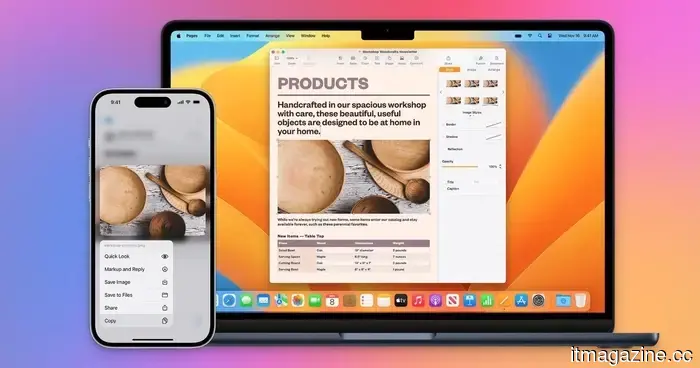 Apple will finally make the iPhone-to-Windows copy-paste process much easier.
Apple has consented to create a developer framework that may ultimately allow for smooth clipboard synchronization between iPhone and Windows, although the initial beta will be released sometime after fall 2027.
Apple will finally make the iPhone-to-Windows copy-paste process much easier.
Apple has consented to create a developer framework that may ultimately allow for smooth clipboard synchronization between iPhone and Windows, although the initial beta will be released sometime after fall 2027.
 RISION's compact new cameras transform your smartphone into a handy thermal imaging device.
RISION’s latest 24-gram USB-C cameras transform compatible phones, tablets, and computers into thermal inspection devices, with initial prices starting at $119 during the preorder phase.
RISION's compact new cameras transform your smartphone into a handy thermal imaging device.
RISION’s latest 24-gram USB-C cameras transform compatible phones, tablets, and computers into thermal inspection devices, with initial prices starting at $119 during the preorder phase.
 T-Mobile covers phone taxes as the memory shortage affects users.
T-Mobile will cover your phone's taxes and fees over a period of 36 months with no down payment required, attributing the increase in phone prices to a memory shortage caused by AI.
T-Mobile covers phone taxes as the memory shortage affects users.
T-Mobile will cover your phone's taxes and fees over a period of 36 months with no down payment required, attributing the increase in phone prices to a memory shortage caused by AI.
 Anthropic appoints a chief for global affairs to oversee AI diplomacy amid rising tensions with Trump.
Anthropic appointed Mariano-Florentino Cuellar as its inaugural chief global affairs officer as the AI firm addresses challenges related to a Pentagon blacklist and export control disputes.
Anthropic appoints a chief for global affairs to oversee AI diplomacy amid rising tensions with Trump.
Anthropic appointed Mariano-Florentino Cuellar as its inaugural chief global affairs officer as the AI firm addresses challenges related to a Pentagon blacklist and export control disputes.
 Zillow has laid off over 500 employees and hasn't confirmed whether AI was a factor in this decision.
Zillow eliminated over 500 positions, marking its largest round of layoffs this year, just one day prior to its earnings report. The company, which describes itself as "AI-native," has not disclosed whether AI was a factor in this decision.
Zillow has laid off over 500 employees and hasn't confirmed whether AI was a factor in this decision.
Zillow eliminated over 500 positions, marking its largest round of layoffs this year, just one day prior to its earnings report. The company, which describes itself as "AI-native," has not disclosed whether AI was a factor in this decision.
The notion of a student "AI revolt" is largely a myth, according to a survey.
A three-year survey by Kogod indicates that the use of AI in colleges has transitioned from being a novelty to a regular practice. Students are not dismissing AI; instead, they are seeking guidance on how to use it effectively.