
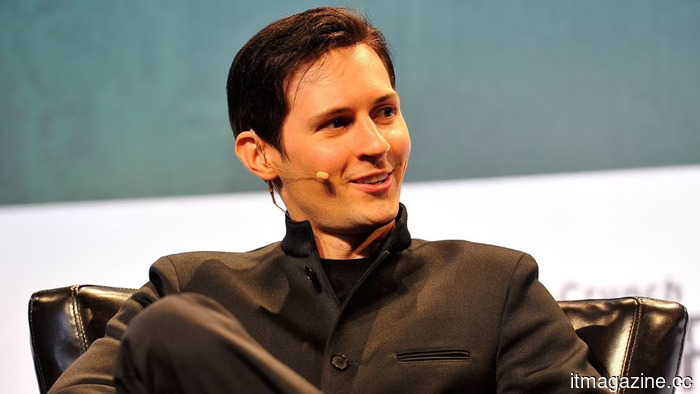
Russia has issued charges against Telegram's Durov for allegedly supporting terrorism and has placed him on a wanted list.
Russia’s FSB security service has accused Pavel Durov, the founder of Telegram, of aiding terrorism and has initiated proceedings to have him placed on an international wanted list. The allegations contend that Durov did not remove channels and bots that the agency claims were utilized to coordinate attacks and sabotage within Russia. This marks a significant escalation in an ongoing dispute. Durov is already facing a separate criminal case in France following his arrest in 2024 near Paris and now confronts prosecution in a country he abandoned over ten years ago. The language used by the FSB is quite harsh.
According to Part 1.1 of Article 205.1 of Russia’s criminal code, the FSB argues that Telegram’s refusal to eliminate channels related to “mass killings” and cyber fraud has resulted in “numerous human casualties,” including among women and children, along with billions of roubles in damages. Durov responded with disdain, describing the case as “a sad spectacle of a state afraid of its own people,” reiterating his claim that the Kremlin continuously creates “new pretexts” to justify limiting Telegram’s presence in Russia.
Telegram was even more direct regarding the underlying motive. The company stated that Moscow’s actual intent is to undermine the app and redirect users to MAX, a newly established state-supported messenger described as being “engineered for mass surveillance and censorship.” Encryption is central to the conflict, with a Russian official claiming that the platform’s encryption was compromised, allowing foreign intelligence to read messages from Russian soldiers; Telegram vehemently denied this claim, asserting that “no breaches of Telegram’s encryption have ever been found.”
The pressure has been increasing for several months. Russia imposed restrictions on Telegram in the summer of 2025 and initiated a criminal case against Durov in February. Just two days prior to the charges, Kremlin spokesperson Dmitry Peskov expressed dissatisfaction with Telegram’s representatives, stating they had “not been very active” in discussions.
The context for this is the ongoing war. Telegram is crucial for both sides in Ukraine, facilitating everything from official communications to battlefield footage, and it is heavily relied upon by Russian soldiers, reporters, and officials, just as it is for their adversaries. This widespread use is precisely what Moscow is now exploiting against the app. The FSB characterizes Telegram’s lenient content moderation as complicity in terrorism, a narrative that serves as justification for attempting to divert the public towards an app that the state can monitor.
Durov has experienced similar situations before; he left Russia in 2014 after refusing to surrender user data to security services. The government's two-year ban on Telegram instituted in 2018 was so ineffective that it was quietly rescinded. The framing of terrorism is not new either; Telegram’s lax moderation has frequently attracted accusations of being accommodating to terrorists, a criticism often voiced by both Western governments and Moscow. The company counters this by stating that it removes genuinely illegal content.
The implications of the wanted-list action are unclear in practical terms. Durov holds citizenship in France and the UAE, making extradition to Moscow unlikely, so the charge serves more as a message to Russians and to Telegram about the extent of state actions.
Despite the restrictions, the app has not lost its users. Telegram continues to be one of the most popular services in Russia, which sharpens the confrontation, as a crackdown that fails to displace users leaves the state seeking the individual who created the platform. For Durov, the legal landscape is now congested. He is involved in a criminal case in France, is wanted in Russia, and is managing a platform considered problematic by both governments, placing him in a challenging position for a founder who built his reputation on resisting state control.
Other articles
 The US government has recently placed foreign-made robots and power inverters on its blacklist.
The FCC has included foreign-made humanoid robots, quadrupeds, and power inverters in its Covered List due to national security issues. Here’s what this means for changes.
The US government has recently placed foreign-made robots and power inverters on its blacklist.
The FCC has included foreign-made humanoid robots, quadrupeds, and power inverters in its Covered List due to national security issues. Here’s what this means for changes.
 Instapaper has just undergone its most significant update in years, and it’s filled with exciting features.
Instapaper has revamped its website, redesigned its iOS app with Liquid Glass, and has finally introduced AI Voices for Android. Here’s what’s new.
Instapaper has just undergone its most significant update in years, and it’s filled with exciting features.
Instapaper has revamped its website, redesigned its iOS app with Liquid Glass, and has finally introduced AI Voices for Android. Here’s what’s new.
 I tested Dell’s stylish XPS 13, and it feels like a refreshing change in the realm of budget Windows laptops.
Dell’s latest XPS 13 features a sleek aluminum design, a vivid touchscreen, and an accessible price point, making it a viable alternative to the MacBook Neo for Windows users.
I tested Dell’s stylish XPS 13, and it feels like a refreshing change in the realm of budget Windows laptops.
Dell’s latest XPS 13 features a sleek aluminum design, a vivid touchscreen, and an accessible price point, making it a viable alternative to the MacBook Neo for Windows users.
 The Galaxy Z Fold 8, Fold 8 Ultra, and Flip 8 allow you to eliminate the poor quality webcam of your laptop.
Samsung's latest foldable devices offer support for USB webcam mode, a feature that was introduced with the Galaxy S26 series earlier this year.
The Galaxy Z Fold 8, Fold 8 Ultra, and Flip 8 allow you to eliminate the poor quality webcam of your laptop.
Samsung's latest foldable devices offer support for USB webcam mode, a feature that was introduced with the Galaxy S26 series earlier this year.
 A report reveals that Hugging Face is the platform hosting the AI that undresses individuals.
A European regulatory body discovered that 7 out of 9 leading image generation tools on Hugging Face could create images of a woman without clothing based on a simple prompt, and merely 3% of these tools incorporated any form of moderation.
A report reveals that Hugging Face is the platform hosting the AI that undresses individuals.
A European regulatory body discovered that 7 out of 9 leading image generation tools on Hugging Face could create images of a woman without clothing based on a simple prompt, and merely 3% of these tools incorporated any form of moderation.
 Instapaper has just undergone its most significant update in years, and it's filled with exciting features.
Instapaper has revamped its website, redesigned its iOS app with Liquid Glass, and has also introduced AI Voices for Android. Here are the updates.
Instapaper has just undergone its most significant update in years, and it's filled with exciting features.
Instapaper has revamped its website, redesigned its iOS app with Liquid Glass, and has also introduced AI Voices for Android. Here are the updates.
Russia has issued charges against Telegram's Durov for allegedly supporting terrorism and has placed him on a wanted list.
Russia's FSB has accused Telegram founder Pavel Durov of aiding terrorism and has begun the process to include him on an international wanted list. Telegram describes this as a pretext.