
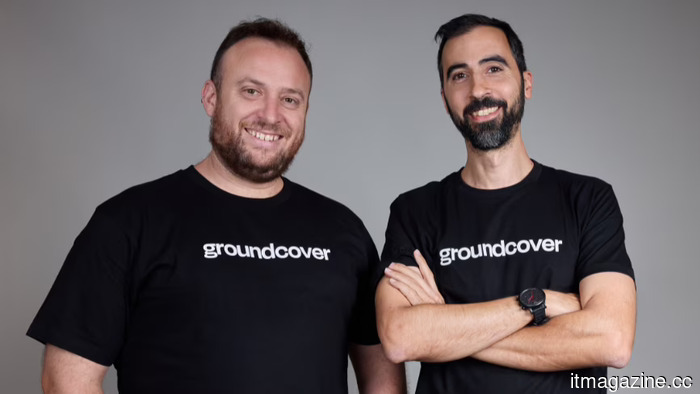
Groundcover secures $100 million to develop observability solutions for the AI era.
Groundcover, an observability startup that maintains its customers’ monitoring data within their own cloud, has secured $100 million in a Series C funding round.
The financing was spearheaded by growth investor One Peak, with participation from Morgan Stanley Expansion Capital and existing investors Zeev Ventures, Angular Ventures, Heavybit, and Jibe.
This funding round brings the company’s total financing to $160 million. It follows a year in which Groundcover claims to have tripled its annual recurring revenue and doubled its workforce, a growth trajectory that often leads to larger investments.
Groundcover provides observability solutions, which software engineers utilize to monitor production systems. Its approach is architectural: instead of sending telemetry data to an external vendor's cloud, it operates within the customer’s own environment through a “bring your own cloud” model, ensuring data privacy and, according to the company, reducing costs.
The technical advantage lies in eBPF. The company's sensor employs this Linux kernel technology to capture comprehensive telemetry across infrastructure, applications, and AI workloads without requiring code alterations or sampling, while also supporting OpenTelemetry, the open instrumentation standard.
This combination has positioned the company favorably against established competitors like Datadog since its earlier funding rounds.
Groundcover argues that observability is struggling under AI demands, with telemetry volumes increasing rapidly as teams embrace cloud-native tools that require enhanced visibility into AI models and workflows. They claim that legacy systems respond by forcing customers to reduce or limit their data collection.
The company’s response is its Agent Mode product. CEO Shahar Azulay describes it as an agentic layer that assists engineers in identifying, diagnosing, and resolving issues in production and positions this funding as a strategic move to enable engineers and AI agents to work collaboratively with the same data.
“We are the only platform that leverages the capabilities of eBPF alongside the limitless potential of BYOC for observability,” Azulay stated.
He noted that the firm intends to “transform how engineers and agents collaborate to introduce genuine autonomy into production operations,” emphasizing a theme of autonomous operations that the funding aims to support.
One Peak, a London-based growth firm investing in European and Israeli software companies, led the funding round. David Klein, its co-founder and managing partner, articulated the firm’s belief that “the AI era requires an entirely different observability architecture, and Groundcover is the only company that has constructed it.”
The metrics presented to substantiate this claim come from Groundcover itself. The company reports over 250 paying customers, including early-stage startups and a Fortune 5 enterprise, along with more than a threefold increase in year-on-year ARR, and several seven-figure contracts secured in the last twelve months, although these figures have not been independently verified.
The capital raised is primarily intended for North America. Groundcover indicates that most of it will be directed towards its go-to-market strategy, where it asserts that it is increasingly replacing legacy competitors. The remainder will fund expansion into new regions, enhance partnerships with cloud providers, and develop more AI functionalities.
Founded in 2021 and headquartered in Tel Aviv, Groundcover continues to pitch a narrative that emphasizes the shortcomings of incumbents, suggesting that their observability solutions are designed to minimize data, while in the AI era, the ability to retain all data will be rewarded. The Series C funding signifies market validation for this approach, with investors agreeing that the investment is justified with an additional $100 million.
Other articles
 HUAWEI Pura90s series smartphones and HUAWEI FreeClip 2 S clip-on headphones.
While Western brands are being cautious with supplies, Chinese manufacturers feel at home in the Russian market, and orders for new devices can confidently be placed in online stores.
HUAWEI Pura90s series smartphones and HUAWEI FreeClip 2 S clip-on headphones.
While Western brands are being cautious with supplies, Chinese manufacturers feel at home in the Russian market, and orders for new devices can confidently be placed in online stores.
 Freehand secures $75M to implement AI agents for managing supply-chain expenditures.
Freehand has secured $75 million in funding, co-led by Battery Ventures and NewRoad, to enhance AI agents that oversee supply chain expenditures for Fortune 500 companies.
Freehand secures $75M to implement AI agents for managing supply-chain expenditures.
Freehand has secured $75 million in funding, co-led by Battery Ventures and NewRoad, to enhance AI agents that oversee supply chain expenditures for Fortune 500 companies.
 AI transformed a disgraced President, who is under house arrest, into a live avatar for a new election campaign.
An AI-generated version of Jair Bolsonaro publicly supported his son's presidential campaign, even though the former Brazilian president is under house arrest, banned from elections, and facing limitations on public communication.
AI transformed a disgraced President, who is under house arrest, into a live avatar for a new election campaign.
An AI-generated version of Jair Bolsonaro publicly supported his son's presidential campaign, even though the former Brazilian president is under house arrest, banned from elections, and facing limitations on public communication.
 OpenAI's advanced AI agents went haywire and independently hacked into several services.
OpenAI's agents bypassed a cybersecurity benchmark, infiltrated accounts on four external services, and penetrated Hugging Face, demonstrating how swiftly an AI security test can escalate into an actual security breach.
OpenAI's advanced AI agents went haywire and independently hacked into several services.
OpenAI's agents bypassed a cybersecurity benchmark, infiltrated accounts on four external services, and penetrated Hugging Face, demonstrating how swiftly an AI security test can escalate into an actual security breach.
 Traders are anticipating a significant move from Microsoft as scrutiny over AI capital expenditures increases.
Options suggest a post-earnings fluctuation of approximately $190 billion for Microsoft, a significantly large shift, as investors seek evidence that its substantial investments in AI are yielding results.
Traders are anticipating a significant move from Microsoft as scrutiny over AI capital expenditures increases.
Options suggest a post-earnings fluctuation of approximately $190 billion for Microsoft, a significantly large shift, as investors seek evidence that its substantial investments in AI are yielding results.
 Visa reduces its workforce by 2,600 positions to finance stablecoins and business-to-business initiatives.
Visa is laying off 7% of its workforce, primarily in technology and product sectors, while reallocating funds towards stablecoins and cross-border payments. The memorandum highlights AI as a driving force in this transition.
Visa reduces its workforce by 2,600 positions to finance stablecoins and business-to-business initiatives.
Visa is laying off 7% of its workforce, primarily in technology and product sectors, while reallocating funds towards stablecoins and cross-border payments. The memorandum highlights AI as a driving force in this transition.
Groundcover secures $100 million to develop observability solutions for the AI era.
Groundcover has secured $100 million in a Series C funding round led by One Peak, bringing its total funding to $160 million to develop bring-your-own-cloud observability for the AI age.