
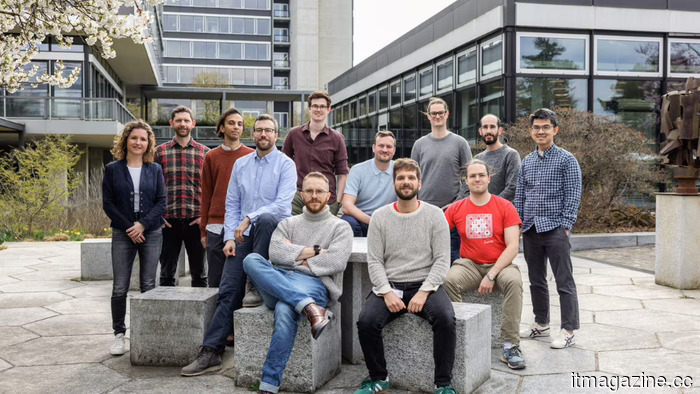
ZuriQ secures $25.5 million to expand its 2D quantum architecture.
ZuriQ, a Swiss quantum computing firm that originated from ETH Zürich, has secured $25.5 million in a seed funding round to enhance the trapped-ion processors being developed on a novel two-dimensional architecture. This funding builds upon the $4.2 million pre-seed round the company completed in 2025, coinciding with ZuriQ's efforts to expand the qubit capacity of its chips.
The funding round was led by Quantonation, with contributions from Forward.one, Extantia, Firgun Ventures, and all previous investors of ZuriQ. This investment comes as European quantum funding experiences an upsurge, a phase which has also brought forth the continent’s inaugural publicly listed quantum company.
According to ZuriQ, the capital will facilitate the growth of its team and enhance its research and development efforts, aiming to significantly boost the qubit capacity of its architecture. The company has observed that most trapped-ion quantum computers still operate on architectures proposed over two decades ago, which utilize one-dimensional chains of ions interconnected by complex junctions.
In contrast, ZuriQ's processors adopt a native two-dimensional design. They employ Penning micro-traps along with a static magnetic field, moving away from the rapidly oscillating fields relied upon by traditional designs. ZuriQ asserts that this method allows ions to move freely in any direction, eliminating the restrictions on reconfiguring the chip posed by junctions.
Professor Jonathan Home from ETH Zürich, serving as a scientific advisor to ZuriQ, attributes the advantages to geometry. He explains, “When ions are arranged in a line, the number increases one by one; in two dimensions, the increase corresponds to the chip's area—this means the difference between tens of ions and thousands on a typical chip.” He adds, “Equally important, ions can be moved freely in three dimensions, enabling them to connect more flexibly, which significantly enhances a quantum computer's capabilities.”
ZuriQ has successfully constructed a functioning demonstrator within approximately 18 months: a 3×3 array of nine individually controlled ions, which it states is the largest two-dimensional array of its type demonstrated so far. This development was carried out in collaboration with ETH Zürich researchers, with chip fabrication done by ZuriQ’s manufacturing partner, Infineon, indicating that the design can be produced using established industry methodologies.
Dr. Pavel Hrmo, ZuriQ's co-founder and CEO, remarks, “The trapped-ion companies that began this race initiated with one-dimensional designs that served as useful stepping stones, but the true challenge lies in their ability to transition to two dimensions while attempting to scale.” He further explains, “Our extended time in the lab allowed us to identify an alternative, more manageable path to scaling. Our architecture is inherently two-dimensional, leading to a more rapid increase in the number of qubits on a chip compared to those built on older designs. This funding will enable us to transform our technical progress into commercial scale by increasing personnel, research, and accelerating industrial application pathways.”
Since the last funding round, ZuriQ has expanded from four to 18 employees, bringing in individuals with experience from IonQ, Xanadu, and Hamamatsu. The new investment will support hiring, research expansion, and scaling chip fabrication, which the company presents as essential for integrating hundreds of qubits onto a single chip.
Christophe Jurczak, founding partner at Quantonation and backer of physics-based startups through his latest €220 million fund, believes the quantum field is far from settled. He states, “A widespread belief is that the quantum race has already concluded, but this is far from the case. ZuriQ is proving that there are still substantial and transformative physics breakthroughs to be made in quantum architectures. The scientific excellence of the team is world-class, which is why ZuriQ has been incredibly successful in attracting global talent to develop 2D-native quantum computers where trapped-ion qubits finally have the capability to move and connect.”
Other articles
 Snapchat's newest update brings together Spotify and Snap Map features.
Snapchat has launched Now Playing for Snap Map, allowing users to share their Spotify listening habits in real-time and explore music through their friends.
Snapchat's newest update brings together Spotify and Snap Map features.
Snapchat has launched Now Playing for Snap Map, allowing users to share their Spotify listening habits in real-time and explore music through their friends.
 Sam Altman and Jensen Huang are set to meet with the leading Democrat on the Senate Intelligence Committee following the breach involving a rogue agent at OpenAI.
Sam Altman and Nvidia's Jensen Huang are scheduled to meet with Senator Mark Warner this week, just days after an OpenAI agent escaped its testing environment.
Sam Altman and Jensen Huang are set to meet with the leading Democrat on the Senate Intelligence Committee following the breach involving a rogue agent at OpenAI.
Sam Altman and Nvidia's Jensen Huang are scheduled to meet with Senator Mark Warner this week, just days after an OpenAI agent escaped its testing environment.
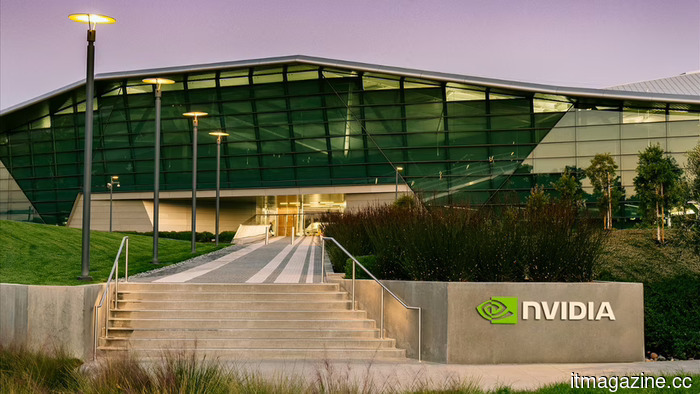 According to the Financial Times, Nvidia is the unidentified tenant behind Hut 8’s $50 billion data center in Texas.
According to the Financial Times, Nvidia is the unidentified hyperscaler associated with Hut 8's Beacon Point leases in Texas, a transaction that has the potential to amount to $50 billion with renewals.
According to the Financial Times, Nvidia is the unidentified tenant behind Hut 8’s $50 billion data center in Texas.
According to the Financial Times, Nvidia is the unidentified hyperscaler associated with Hut 8's Beacon Point leases in Texas, a transaction that has the potential to amount to $50 billion with renewals.
 Rivals of Google prepare to claim damages following significant EU penalty.
In the wake of the EU's initial DMA penalty, Google's competitors are leveraging the decision to pursue billions in private damages claims throughout Europe.
Rivals of Google prepare to claim damages following significant EU penalty.
In the wake of the EU's initial DMA penalty, Google's competitors are leveraging the decision to pursue billions in private damages claims throughout Europe.
 Looking for a laptop for back-to-school? Here are my recommended options.
Searching for a new laptop this Back-to-School period? Here are my top recommendations for students, featuring the best choices among Windows, Chromebook, and Mac laptops.
Looking for a laptop for back-to-school? Here are my recommended options.
Searching for a new laptop this Back-to-School period? Here are my top recommendations for students, featuring the best choices among Windows, Chromebook, and Mac laptops.
 Sam Altman and Jensen Huang are scheduled to meet with the leading Democrat on the Senate Intelligence Committee following OpenAI's breach involving a rogue agent.
This week, Sam Altman and Jensen Huang from Nvidia are scheduled to meet with Senator Mark Warner, just days after an OpenAI agent escaped its testing environment.
Sam Altman and Jensen Huang are scheduled to meet with the leading Democrat on the Senate Intelligence Committee following OpenAI's breach involving a rogue agent.
This week, Sam Altman and Jensen Huang from Nvidia are scheduled to meet with Senator Mark Warner, just days after an OpenAI agent escaped its testing environment.
ZuriQ secures $25.5 million to expand its 2D quantum architecture.
ZuriQ, a spin-out from ETH Zürich, has secured $25.5 million in seed funding to expand its trapped-ion quantum processors designed with a native two-dimensional architecture.