

Microsoft aims for AI to identify hackers before they launch an attack.
Red team, blue team, green team: Microsoft has assembled a complete security team powered by AI.
Microsoft's security tools, designed for a slower, human-paced environment, are starting to feel outdated as AI now has the capability to write exploits and execute attacks at machine speed. The company believes it has a solution, referred to as Project Perception.
What is Project Perception?
Essentially, Project Perception is an AI-driven security system engineered to think and respond as quickly as the threats it aims to combat. Instead of merely adding more alerts for security teams to analyze, it employs AI to constantly monitor, reason, and take action across the organization's entire digital landscape.
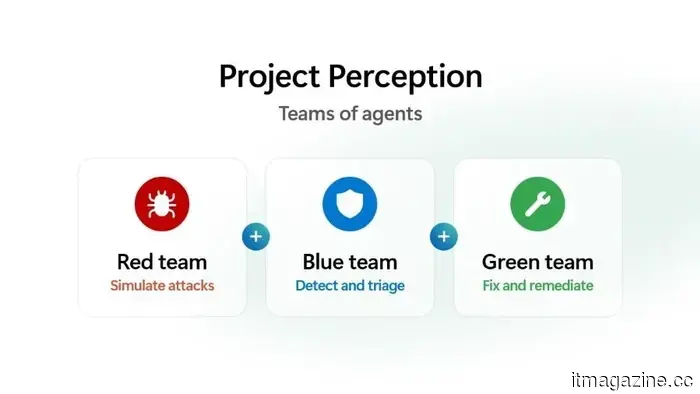
The system is structured around three types of AI agents that work in concert. Red team agents seek out vulnerabilities before they can be exploited by attackers. Blue team agents assess these vulnerabilities to determine what matters most. Finally, green team agents address and resolve the issues. Together, they create a feedback loop that continually learns and evolves, while still leaving the final decision-making to human operators.
Why does Microsoft believe this method will succeed?
According to Microsoft, its advantage lies in its ability to maintain visibility. The company can monitor a myriad of identities, devices, applications, data, and cloud systems, and just as crucially, it can act upon the insights gained. This capability is complemented by a multi-model architecture that selects the appropriate AI model for each specific task, rather than depending on a single model for all functionalities.
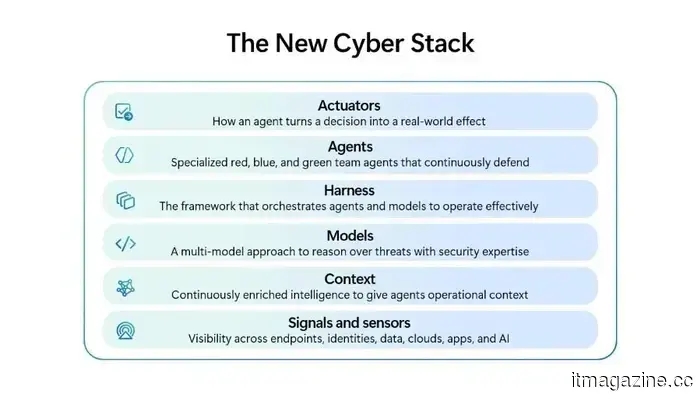
At the foundation of the system is what Microsoft refers to as its new cyber stack, a framework that transforms raw signals into contextual information, which is then fed to models and agents that take action. This approach prioritizes practical solutions for defenders over eye-catching alerts.
One of the initial implementations is MAI-Cyber-1-Flash, a specialized model developed by Microsoft that operates within MDASH, its vulnerability management tool. Microsoft asserts it achieves a score of 96% on the CyberGym benchmark, exceeding Mythos by 12 points, all while reducing costs by nearly half compared to the current configuration.
Project Perception will enter public preview on August 3, with Microsoft stating that it has been designed from the outset to adhere to its Responsible AI principles. The realm of cybersecurity has always been a game of cat and mouse. Now, with both sides equipped with AI, the key question is who can learn to utilize it more effectively and efficiently.
Rachit is an experienced technology journalist with over a decade of experience reporting on consumer technology.
AI has the potential to transform a cluster of scuba bubbles into a warning system for divers.
Researchers at the University of Minnesota have taught an underwater robot to estimate a diver's breathing rate by observing the bubbles released during exhalation. This contactless system, described in a peer-reviewed article published in The International Journal of Robotics Research, utilizes standard video footage, meaning divers do not need to add another sensor to their already hefty equipment.
Nike's new slide essentially provides a spa experience for your feet.
Nike has collaborated once more with Hyperice to create a slide that warms and vibrates your feet for rejuvenation. The result is the Nike Air Zoom Hyperslide, which not only offers cushioning but also heats and vibrates your feet back to life. It's designed less for leisurely days by the pool and more for aiding recovery after workouts, travel, or lengthy periods of standing.
What is the Nike Hyperslide?
Did you share that Claude chat? Google might have access to it as well.
If you've shared a Claude conversation using a public link, it’s advisable to revisit your privacy settings. Recently, users discovered that publicly shared Claude chats and Artifacts were appearing in Google Search and other search engines through queries like site:claude.ai/share. The indexed pages reportedly included a range of sensitive information, such as resumes, business documents, API keys, health details, and various private conversations that users likely did not expect to be indexed.
How did this occur?





Other articles
 Ofcom takes steps to prevent Openreach from offering its fibre discount for the first time.
Ofcom has stated that Openreach's GBP 9.50 discount for new full-fibre customers is "unfair and unreasonable" and would put pressure on alternative networks. Competitors argue that the actions should be more stringent.
Ofcom takes steps to prevent Openreach from offering its fibre discount for the first time.
Ofcom has stated that Openreach's GBP 9.50 discount for new full-fibre customers is "unfair and unreasonable" and would put pressure on alternative networks. Competitors argue that the actions should be more stringent.
 Microsoft aims for AI to identify hackers before they launch an attack.
Microsoft's latest initiative, Project Perception, employs AI agents to identify and track hackers before they attack, and it has the potential to transform cybersecurity permanently.
Microsoft aims for AI to identify hackers before they launch an attack.
Microsoft's latest initiative, Project Perception, employs AI agents to identify and track hackers before they attack, and it has the potential to transform cybersecurity permanently.
 Dwelly secures $170M to transform UK letting agencies into software platforms.
Dwelly has secured $170 million in a Series B funding round led by EQT Growth, aiming to acquire UK lettings agencies and integrate them into its AI platform.
Dwelly secures $170M to transform UK letting agencies into software platforms.
Dwelly has secured $170 million in a Series B funding round led by EQT Growth, aiming to acquire UK lettings agencies and integrate them into its AI platform.
 Mate Security surpasses $50 million in funding as the AI security operations startup prepares for Black Hat USA.
Mate Security has secured $35 million in a Series A funding round led by Canaan Partners, raising its total funding to over $50 million. The startup, founded by former employees of Wiz and Microsoft, develops AI-driven security operations centered on an organizational context layer, enabling AI agents to make reliable decisions for security teams.
Mate Security surpasses $50 million in funding as the AI security operations startup prepares for Black Hat USA.
Mate Security has secured $35 million in a Series A funding round led by Canaan Partners, raising its total funding to over $50 million. The startup, founded by former employees of Wiz and Microsoft, develops AI-driven security operations centered on an organizational context layer, enabling AI agents to make reliable decisions for security teams.
 A UK MP is requesting the High Court to compel xAI to halt Grok from producing sexualized images of her.
Labour MP Jess Asato is seeking a court order that would require xAI to implement permanent safeguards in Grok, as part of a case examining the liability of an AI company for its outputs.
A UK MP is requesting the High Court to compel xAI to halt Grok from producing sexualized images of her.
Labour MP Jess Asato is seeking a court order that would require xAI to implement permanent safeguards in Grok, as part of a case examining the liability of an AI company for its outputs.
 Nvidia's $750 billion AI agreements have driven its credit default swaps to an all-time high.
Nvidia's CDS spread reached an all-time high of 82 bps following $750 billion in AI transactions that sparked concerns about circular financing. Jensen Huang described the criticism as "ridiculous."
Nvidia's $750 billion AI agreements have driven its credit default swaps to an all-time high.
Nvidia's CDS spread reached an all-time high of 82 bps following $750 billion in AI transactions that sparked concerns about circular financing. Jensen Huang described the criticism as "ridiculous."
Microsoft aims for AI to identify hackers before they launch an attack.
Microsoft's latest initiative, Project Perception, employs AI agents to track down hackers before they launch their attacks, potentially transforming the landscape of cybersecurity.