
China has imposed a $765 million fine on Trip.com for exploiting its dominant position in the hotel booking market.
China has imposed a $765 million fine on Trip.com for compelling hotel partners to enter exclusive agreements and controlling their pricing. The State Administration for Market Regulation (SAMR) determined that Trip.com, the country's largest online travel platform, misused its dominant position in the market. The regulator found that Trip.com utilized its algorithms, platform rules, and technology to prevent hotel operators from advertising on rival platforms and to dictate the rates they could charge. The fine, totaling around five billion yuan, consists of seized profits, a separate monetary penalty, and a directive to refund hotel security deposits.
The investigation into Trip.com began in January following complaints that the company was pressuring hotel partners into exclusive contracts and requiring them to list their lowest online prices only on its platform. The regulator discovered that these practices had been ongoing since 2020, as Trip.com leveraged its control of approximately 56% of China's online travel market to pressure operators reliant on its visibility and bookings. In a statement on its official WeChat account, Trip.com expressed acceptance of the ruling and commitment to implementing rectification measures.
This fine marks the largest antitrust penalty imposed by SAMR on a single Chinese tech firm since it fined Alibaba 18 billion yuan in 2021 for similar anti-competitive behavior. The Alibaba case established a framework for Beijing's broader crackdown on monopolies, and Trip.com's fine indicates that regulatory enforcement remains robust, even as China shifts its approach toward more measured oversight rather than sweeping crackdowns.
The situation reflects regulators' worries that intense competition among online travel platforms is squeezing hotel operators' profit margins, contributing to deflationary pressures in parts of the Chinese economy. Beijing is revising its e-commerce laws to tighten oversight of platform companies, with recent draft amendments proposing enhanced regulatory capabilities regarding algorithms, traffic management, and pricing. The penalty against Trip.com aligns with this new regulatory framework.
Founded in 1999, Trip.com, which operates under brands such as Ctrip and Skyscanner, has become the world’s largest online booking platform by transaction volume. Its market dominance has given it influence over hotel partners, but that same power has made it a target for regulators as Beijing seeks to combat perceived monopolistic practices in the tech sector. The company has been instructed to create a comprehensive rectification plan, though the details of those changes remain undisclosed.
Other articles
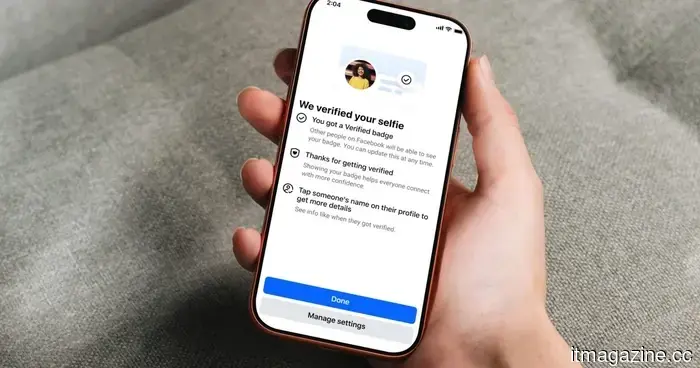 Facebook is introducing a complimentary verified badge to assist in identifying genuine users.
Facebook is introducing a complimentary Verified badge based on selfies, allowing you to confirm that a genuine person is behind a profile before you engage, chat, or make a purchase.
Facebook is introducing a complimentary verified badge to assist in identifying genuine users.
Facebook is introducing a complimentary Verified badge based on selfies, allowing you to confirm that a genuine person is behind a profile before you engage, chat, or make a purchase.
 Samsung and Broadcom have entered into a $200 billion agreement covering memory, foundry, and packaging technologies.
Samsung has entered into a Memorandum of Understanding (MOU) with Broadcom valued at over $200 billion, covering memory, foundry, and advanced packaging for AI chips through the year 2030.
Samsung and Broadcom have entered into a $200 billion agreement covering memory, foundry, and packaging technologies.
Samsung has entered into a Memorandum of Understanding (MOU) with Broadcom valued at over $200 billion, covering memory, foundry, and advanced packaging for AI chips through the year 2030.
 Waymo will terminate its exclusivity agreement with Uber in Austin and Atlanta, launching its own application in January 2028.
Waymo is set to introduce its own app in Austin and Atlanta in January 2028, which will conclude its exclusivity with Uber, allowing both companies to explore competing strategies in the robotaxi market.
Waymo will terminate its exclusivity agreement with Uber in Austin and Atlanta, launching its own application in January 2028.
Waymo is set to introduce its own app in Austin and Atlanta in January 2028, which will conclude its exclusivity with Uber, allowing both companies to explore competing strategies in the robotaxi market.
 Samsung and Broadcom have finalized a $200 billion agreement covering memory, foundry, and packaging services.
Samsung has entered into a memorandum of understanding (MOU) with Broadcom valued at over $200 billion, covering memory, foundry services, and advanced packaging for AI chips until 2030.
Samsung and Broadcom have finalized a $200 billion agreement covering memory, foundry, and packaging services.
Samsung has entered into a memorandum of understanding (MOU) with Broadcom valued at over $200 billion, covering memory, foundry services, and advanced packaging for AI chips until 2030.
 OpenAI experiences another outage with ChatGPT, Codex, and APIs all going down simultaneously.
OpenAI's status page indicated increased error rates in its APIs, ChatGPT, and Codex on Saturday, marking the most recent in a series of outages throughout July.
OpenAI experiences another outage with ChatGPT, Codex, and APIs all going down simultaneously.
OpenAI's status page indicated increased error rates in its APIs, ChatGPT, and Codex on Saturday, marking the most recent in a series of outages throughout July.
 Nvidia allocates $1 billion to Naver and finalizes a $500 billion agreement with SK Group.
Nvidia is investing $1 billion in Naver's AI data center and establishing a $500 billion commercial partnership with SK Group during the visit to Korea by US representatives.
Nvidia allocates $1 billion to Naver and finalizes a $500 billion agreement with SK Group.
Nvidia is investing $1 billion in Naver's AI data center and establishing a $500 billion commercial partnership with SK Group during the visit to Korea by US representatives.
China has imposed a $765 million fine on Trip.com for exploiting its dominant position in the hotel booking market.
China has imposed a fine of $765 million on Trip.com Group after the State Administration for Market Regulation (SAMR) determined that the travel platform had misused its market power by placing restrictions on hotel operators.