
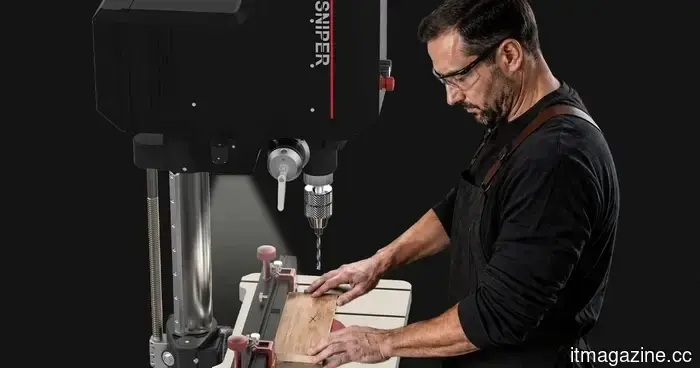
The Drill Press Has Finally Become Intelligent, and This is Only the Start.
Image Credit: Harvey Industries Image used with permission by copyright holder
For nearly a century, the drill press stood as the most persistently unchanged tool in workshops. CNC routers evolved into digital models. Laser cutters acquired sophisticated software. Even the table saw adopted intelligent blade-detection features. In contrast, the drill press has remained a cast-iron column with a chuck on top, unchanged since 1925.
However, this is beginning to evolve, and the transition is occurring more rapidly than many woodworkers anticipated.
A Long-Awaited Change
The power-tool industry has been integrating advanced technology for years, primarily at the motor and interface levels. Variable-speed drives, digital readouts, preset memories, and automatic depth stops were introduced in phases. These enhancements contributed to more consistent tools and easier production runs. Despite these meaningful upgrades, one aspect of the process still relied solely on the operator: aligning the drill bit precisely on the mark.
Alignment has always been an unrecognized labor cost in the drilling process. It involves marking the board, lowering the bit, adjusting, and checking until everything aligns properly. For a shelf with a 30-hole pattern, this routine can take an entire afternoon. The monotony of the task compounds small errors that may be difficult to detect until a shelf is unstable or a joint fails to close properly.
Intelligent features have permeated much of the workshop but have yet to reach the drill press.
The Impact of Embedded Computer Vision
The next wave of workshop tool development is bringing intelligence closer to the task at hand, integrating it directly into the tools instead of relying on phone apps or add-ons. Computer vision, once exclusive to high-end industrial equipment, has become affordable enough to incorporate into tools designed for small shops and serious hobbyists.
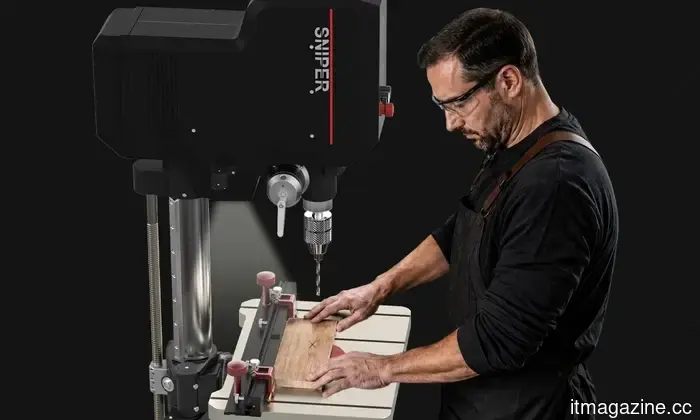
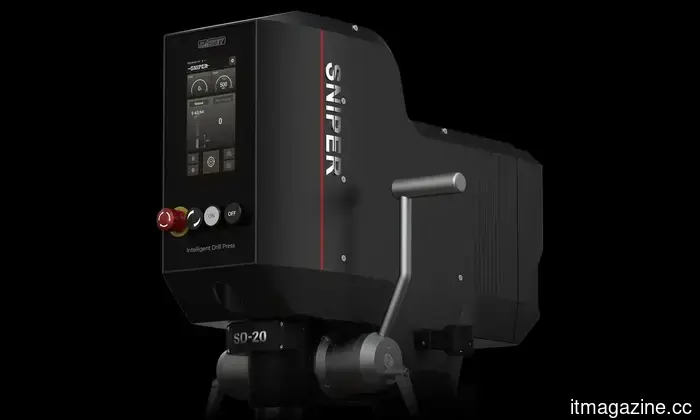
Harvey Industries is one of the companies driving this innovation. Their new Intelligent Drill Press, named Sniper, is equipped with a downward-facing camera array, a neural network, and a dual-axis robotic servo platform that identifies a pencil mark on the workpiece and positions the spindle directly above it with no need for operator adjustment. The positioning accuracy is rated at about 0.004 inches, achieving shop-grade CNC precision within a space suitable for a one-car garage.
The neural network can perform tasks a standard camera cannot, such as differentiating a valid target mark from sawdust, shadows, or the unique patterns in figured wood. Such pattern recognition once required controlled industrial settings.
The International Federation of Robotics has highlighted that decreasing costs of computer vision and AI technologies are facilitating this transformative capability shift. Machine intelligence that was previously confined to factory environments is now being integrated into smaller-scale professional and consumer-oriented tools.
Image Credit: Harvey Industries Image used with permission by copyright holder
Evolving Safety Features through Software
Integrated vision technology is also transforming power tool safety. Over time, this shift may prove to be more significant than any productivity improvements.
Traditional safety mechanisms in power tools have relied on physical features such as guards, kill switches, and friction brakes. While effective, once a tool is released, its safety features are generally permanent.
Vision-based systems offer a new perspective. The same camera array that tracks a pencil mark can also oversee the operator's hands. Harvey’s implementation, known as the Proactive Safety Protection System, swiftly cuts spindle power and halts movement if a hand enters a risky zone. This interruption occurs at the hardware level, ensuring rapid response times regardless of software demands.
The broader implication shifts to a philosophical one. Safety systems embedded in software and firmware can be updated after the tool is already in use. A machine that is sold in 2026 could be significantly safer by 2028 without any hardware modifications. This evolution in tool ownership resembles the ongoing development cycles found in consumer electronics, where today’s product may not be the same in two years.
Future Prospects for Workshops
Harvey Industries’ Sniper represents just one example within a wider trend. Mobile apps now identify knots and grain irregularities before cutting. CNC routers communicate seamlessly with design software. Table saws can differentiate between wood and flesh in mere milliseconds. The convergence of computer vision and servo motion control in workshop tools is progressing at a speed that would have seemed far-fetched a decade ago.
Professional cabinet shops recognize the benefits regarding production costs. Hobbyists now have greater access to achieving consistent results. In both cases, machines are taking on the tasks of positioning, monitoring, and correcting every cut while the operator retains full control over the actual drilling.
Harvey Industries intends to launch Sniper this summer, targeting the custom-shop and advanced-hobbyist markets, which is where most groundbreaking tools typically begin before broader technology adoption occurs.
It took around a hundred years for the drill press to evolve. The next decade of workshop tools will likely experience a much quicker transformation.
Digital Trends partners with external contributors, and all content from contributors is reviewed by the Digital Trends editorial team.
Other articles
 The most recent leak regarding the Pixel 11 series provides the clearest glimpse of Google's upcoming flagship device.
A new leak has disclosed all the color choices for the Pixel 11 series, providing an unmistakable preview ahead of Google's launch in August.
The most recent leak regarding the Pixel 11 series provides the clearest glimpse of Google's upcoming flagship device.
A new leak has disclosed all the color choices for the Pixel 11 series, providing an unmistakable preview ahead of Google's launch in August.
 Oracle secures a Pentagon software contract valued at as much as $7 billion.
Oracle has secured a contract with the US Department of War valued at up to $6.99 billion to streamline the military's Oracle licenses, with a base amount of $3.31 billion over five years.
Oracle secures a Pentagon software contract valued at as much as $7 billion.
Oracle has secured a contract with the US Department of War valued at up to $6.99 billion to streamline the military's Oracle licenses, with a base amount of $3.31 billion over five years.
 Vietnam intends for individuals under 16 to maintain their accounts but refrain from posting on them.
A proposed decree from Vietnam's culture ministry would allow individuals under 16 to have accounts but would prohibit them from posting, commenting, or reacting.
Vietnam intends for individuals under 16 to maintain their accounts but refrain from posting on them.
A proposed decree from Vietnam's culture ministry would allow individuals under 16 to have accounts but would prohibit them from posting, commenting, or reacting.
-Samsungs-flip-phone-is-cheaper-but-is-it-better?.jpg) Galaxy Z Flip 8 vs. Motorola Razr Ultra (2026): Samsung’s flip phone comes at a lower price, but does it outperform the competition?
One emphasizes AI capabilities, software assistance, and value, while the other concentrates on high-end hardware.
Galaxy Z Flip 8 vs. Motorola Razr Ultra (2026): Samsung’s flip phone comes at a lower price, but does it outperform the competition?
One emphasizes AI capabilities, software assistance, and value, while the other concentrates on high-end hardware.
 Geekbench now allows you to see how a phone will manage your mundane daily tasks.
Geekbench 7 introduces new CPU and GPU tests, an enhanced multi-core benchmark, CUDA support, and larger data sets, all available for personal use at no cost starting today.
Geekbench now allows you to see how a phone will manage your mundane daily tasks.
Geekbench 7 introduces new CPU and GPU tests, an enhanced multi-core benchmark, CUDA support, and larger data sets, all available for personal use at no cost starting today.
 Genesis AI is in discussions to secure approximately $500 million for its intelligent robotic technology.
Genesis AI, a physical-AI startup, is said to be negotiating to secure approximately $500 million at a valuation of $3 billion, following its $105 million seed funding from a year ago.
Genesis AI is in discussions to secure approximately $500 million for its intelligent robotic technology.
Genesis AI, a physical-AI startup, is said to be negotiating to secure approximately $500 million at a valuation of $3 billion, following its $105 million seed funding from a year ago.
The Drill Press Has Finally Become Intelligent, and This is Only the Start.
Photo Courtesy: Harvey Industries