
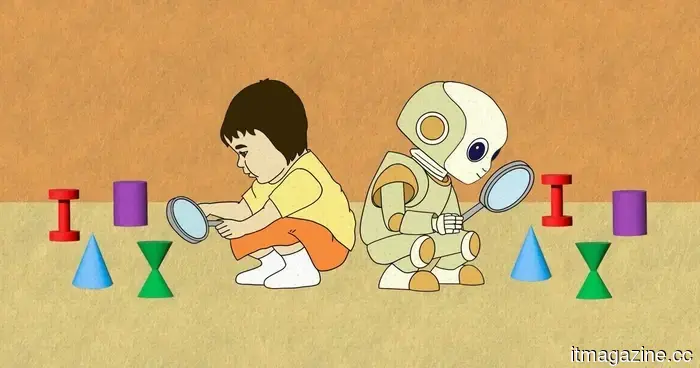
Researchers created robots with curiosity similar to that of toddlers, resulting in them acquiring language at twice the speed.
Grant a robot curiosity, and it begins to learn language (and misbehave) much like a toddler.
Researchers at the Okinawa Institute of Science and Technology (OIST) have been exploring how children rapidly acquire language for decades, and a recent study may have uncovered a key factor: curiosity.
The team created a virtual robot equipped with a brain-like neural network and let it explore a simulated 3D environment filled with shapes, colors, and simple commands such as “push left magenta dumbbell.”
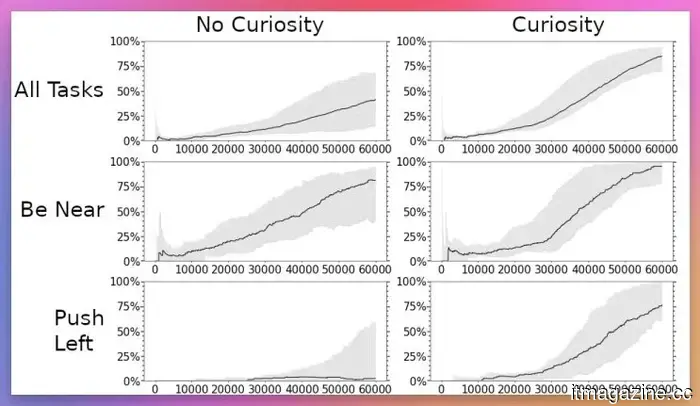
Some robots were only rewarded for accurately completing tasks, while others received additional rewards for their curiosity, essentially giving them a small internal reward whenever they encountered something that challenged their existing understanding.
What role does curiosity play in a robot's language learning?
The curious robots significantly outperformed their uninterested counterparts, achieving a meaningful understanding of language in about half the time, according to the study published in Science Advances.
The study's author, Theodore Tinker, likened this to trying white chocolate for the first time even though one enjoys dark chocolate; taking that risk expands your overall knowledge of chocolate.
The experiment became even more intriguing midway through the training process. The curious robots began to knock things over and experiment with unintended actions, essentially engaging in play. This behavior was not programmed; it emerged spontaneously.
Do robots truly make the same errors as toddlers?
The robots also exhibited a familiar pattern seen in how children learn language. Children often initially use certain verb forms correctly, but then apply grammatical rules too broadly, making mistakes with verbs they had previously mastered, before ultimately identifying exceptions and correcting themselves. The robots displayed a similar U-shaped decline in performance.
This stands in contrast to how current chatbots learn. Large language models, like ChatGPT, are trained on extensive datasets and generate the statistically probable next word. In contrast, this robot’s neural network functions more akin to ours, focusing on accuracy while striving to maintain its beliefs, only altering them when confronted with enough surprise to warrant adjustment.
While this does not imply that robots comprehend language as humans do, it suggests that curiosity combined with diverse experiences may significantly contribute to how toddlers decode language with minimal foundational knowledge.




Other articles
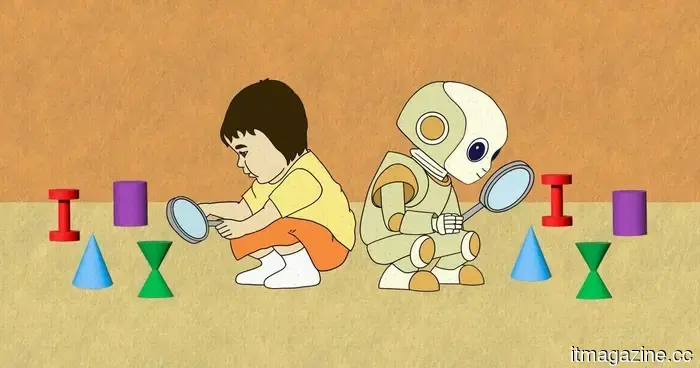 Researchers instilled curiosity in robots similar to that of toddlers, which allowed them to acquire language at double the speed.
Researchers at OIST endowed a virtual robot with curiosity, resulting in it learning language at twice the speed, complete with playful detours and the grammatical errors typical of toddlers.
Researchers instilled curiosity in robots similar to that of toddlers, which allowed them to acquire language at double the speed.
Researchers at OIST endowed a virtual robot with curiosity, resulting in it learning language at twice the speed, complete with playful detours and the grammatical errors typical of toddlers.
 US legislation would allow the Department of Homeland Security to disable 'rogue' AI models.
The bipartisan AI Kill Switch Act would require leading AI companies to create a shutdown switch, giving the Department of Homeland Security the authority to activate it, following the incident where OpenAI's model compromised Hugging Face.
US legislation would allow the Department of Homeland Security to disable 'rogue' AI models.
The bipartisan AI Kill Switch Act would require leading AI companies to create a shutdown switch, giving the Department of Homeland Security the authority to activate it, following the incident where OpenAI's model compromised Hugging Face.
 Microsoft replaces OpenAI and eliminates the SMS login option.
Microsoft is substituting OpenAI's image models in PowerPoint and Bing to reduce expenses by 85%, and is discontinuing SMS logins due to the increased effectiveness of phishing facilitated by AI.
Microsoft replaces OpenAI and eliminates the SMS login option.
Microsoft is substituting OpenAI's image models in PowerPoint and Bing to reduce expenses by 85%, and is discontinuing SMS logins due to the increased effectiveness of phishing facilitated by AI.
 Instagram prohibits videos of harassment recorded with Meta glasses.
Instagram will eliminate videos recorded with Meta's smart glasses that are used to harass individuals, following instances where "pickup artist" accounts misused them as "pervert glasses." Two accounts have been removed.
Instagram prohibits videos of harassment recorded with Meta glasses.
Instagram will eliminate videos recorded with Meta's smart glasses that are used to harass individuals, following instances where "pickup artist" accounts misused them as "pervert glasses." Two accounts have been removed.
 The EU has accused TikTok of not adequately safeguarding children's privacy in accordance with the DSA.
Brussels claims that TikTok allowed minors’ accounts to be accessible to strangers, according to initial findings from the DSA, which could result in a penalty of up to 6% of global revenue.
The EU has accused TikTok of not adequately safeguarding children's privacy in accordance with the DSA.
Brussels claims that TikTok allowed minors’ accounts to be accessible to strangers, according to initial findings from the DSA, which could result in a penalty of up to 6% of global revenue.
 A pastor from Florida inquired with ChatGPT about his well-being, and it almost led to a life-threatening situation.
A pastor in Florida is taking legal action against OpenAI, claiming that ChatGPT minimized his symptoms as trivial for several weeks. Subsequently, he experienced a nearly fatal blood clot, which doctors attribute to the guidance he received from the chatbot.
A pastor from Florida inquired with ChatGPT about his well-being, and it almost led to a life-threatening situation.
A pastor in Florida is taking legal action against OpenAI, claiming that ChatGPT minimized his symptoms as trivial for several weeks. Subsequently, he experienced a nearly fatal blood clot, which doctors attribute to the guidance he received from the chatbot.
Researchers created robots with curiosity similar to that of toddlers, resulting in them acquiring language at twice the speed.
Researchers at OIST equipped a virtual robot with curiosity, allowing it to learn language at double the speed, complete with playful detours and the grammatical mistakes typical of toddlers.