
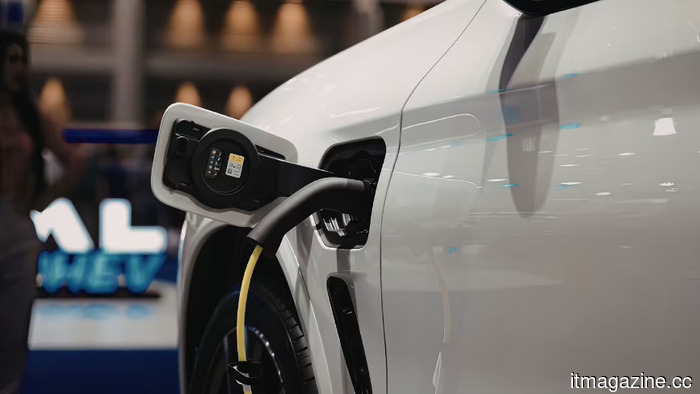
In June, electric vehicle sales in Europe skyrocketed by almost 40 percent, with market share exceeding 25 percent.
European battery-electric vehicle (BEV) registrations reached 275,060 units in June, marking an approximate 40 percent increase and pushing the market share beyond 25 percent, while first-half sales exceeded 1,240,000 units. According to the E-Mobility Europe bulletin from New AutoMotive, BEV registrations across 17 European markets surged nearly 40 percent in June 2026 compared to the same month last year. This milestone represented the first time EVs constituted over 25 percent of all new car sales in those markets. Additionally, it capped off the strongest first half on record with more than 1,240,000 battery-electric vehicles registered from January to June, reflecting a growth of over one-third from the same timeframe in 2025.
This acceleration builds on the momentum that started earlier this year when rising oil prices, exceeding $100 a barrel, led to a significant shift toward electric vehicles, with March registrations soaring by 51 percent across 14 major markets. The June data indicates that this momentum has persisted even as fuel prices have somewhat declined.
Germany led the volume with 84,057 battery-electric registrations in June, resulting in EVs representing over 28 percent of new car sales in Europe’s largest automotive market. For the first half of the year, German EV registrations climbed to 367,388, reflecting an increase of nearly 50 percent compared to the same period last year. France showed even stronger proportional growth, registering 55,831 EVs in June, translating to a record share of nearly 30 percent, with first-half volumes rising more than 60 percent year over year.
The data demonstrated a continent advancing at significantly varied rates. Norway has largely completed its transition, with EVs making up over 96 percent of new sales in June and nearly 98 percent for the first half, although growth has stagnated due to the near-total displacement of combustion engines. Ireland surpassed the 50 percent mark for the first time in June, while Belgium, Denmark, Portugal, Finland, Spain, Slovenia, and Czechia also achieved record sales months.
However, not all markets participated in this growth. The Netherlands experienced a nearly 20 percent drop in first-half registrations, attributed to front-loaded purchases made ahead of tax incentive changes at the end of 2025, while Sweden saw a decline of nearly 11 percent. Although Italy nearly doubled its EV registrations, it still represented less than seven percent of total sales, highlighting the country’s limited charging infrastructure and its diesel-dominant vehicle fleet.
The growth trend is influenced by several interconnected factors, including stricter EU CO2 fleet targets reaching through 2027 and the emergence of competitively priced vehicles from Chinese manufacturers. BYD is in the process of establishing its first European factory in Hungary and is investigating a second production site, indicating that Chinese manufacturers view the demand for EVs in Europe as a structural trend rather than a temporary one. Competitive pressure is mounting as Tesla and BYD compete for global EV leadership, with traditional European automakers and new entrants from China both striving to capture the expanding market.
The central question for Europe’s automotive sector has shifted from whether electric vehicles will dominate new car sales to who will manufacture them and in which locations. At the present rate, battery-electric vehicles are poised to make up more than a third of new car sales in Europe before the end of 2027, a benchmark that appeared years away as recently as early 2025.
Other articles
 Meta escapes a second trial concerning social media addiction as the teenage plaintiff withdraws the lawsuit.
A teenager in Florida dropped his addiction lawsuit against Meta just days before the trial, following settlements with YouTube, TikTok, and Snap, which left Meta as the only defendant.
Monday.com is reducing its workforce by 20 percent as it shifts towards an AI-focused work platform.
Monday.com plans to cut approximately 620 jobs and simplify its management hierarchy as the project management firm pursues what it refers to as the AI Work Platform.
Meta escapes a second trial concerning social media addiction as the teenage plaintiff withdraws the lawsuit.
A teenager in Florida dropped his addiction lawsuit against Meta just days before the trial, following settlements with YouTube, TikTok, and Snap, which left Meta as the only defendant.
Monday.com is reducing its workforce by 20 percent as it shifts towards an AI-focused work platform.
Monday.com plans to cut approximately 620 jobs and simplify its management hierarchy as the project management firm pursues what it refers to as the AI Work Platform.
 AI companies are acquiring vintage books to ensure clean training data.
The broker ISBNdb is offering pre-2022 print books for AI labs as the final clean training data. Scanning these books involves discretely destroying them.
AI companies are acquiring vintage books to ensure clean training data.
The broker ISBNdb is offering pre-2022 print books for AI labs as the final clean training data. Scanning these books involves discretely destroying them.
 Meta has appointed Assaf Keren, formerly of Qualtrics and PayPal, as its new chief information security officer.
Meta has appointed cybersecurity expert Assaf Keren as its new Chief Information Security Officer, succeeding Guy Rosen, who is leaving after 13 years but will remain for a transition phase.
Meta has appointed Assaf Keren, formerly of Qualtrics and PayPal, as its new chief information security officer.
Meta has appointed cybersecurity expert Assaf Keren as its new Chief Information Security Officer, succeeding Guy Rosen, who is leaving after 13 years but will remain for a transition phase.
 Jack Dorsey's Block is challenging Slack by introducing Buzz.
Block’s Buzz is a free and open-source alternative to Slack, where both humans and AI agents collaborate in the same workspace, with each agent having its own portable identity.
Jack Dorsey's Block is challenging Slack by introducing Buzz.
Block’s Buzz is a free and open-source alternative to Slack, where both humans and AI agents collaborate in the same workspace, with each agent having its own portable identity.
 AI companies are purchasing vintage books to acquire clean training data.
Broker ISBNdb is offering pre-2022 print books from AI labs as the final source of slop-free training data. The process of scanning these books involves quietly destroying them.
AI companies are purchasing vintage books to acquire clean training data.
Broker ISBNdb is offering pre-2022 print books from AI labs as the final source of slop-free training data. The process of scanning these books involves quietly destroying them.
In June, electric vehicle sales in Europe skyrocketed by almost 40 percent, with market share exceeding 25 percent.
In June, battery-electric vehicle registrations reached 275,060 in 17 European countries, leading to first-half sales surpassing 1,240,000 and a market share exceeding 25 percent.