
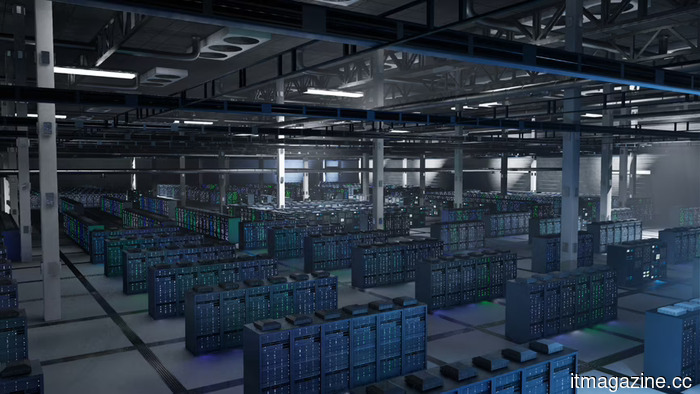
Americans are more opposed to AI data centers than to any other type of building.
Americans are enthusiastic about the AI boom, but they prefer it not to be located in their neighborhoods. A recent poll indicates that most U.S. residents do not want to live near an AI data center, despite the fact that these facilities often fund local schools.
According to a survey conducted by Ipsos and commissioned by Redfin in May, over half of Americans, specifically 53%, oppose the establishment of an AI data center in their area, while only about a third, 34%, support such an initiative. This makes data centers less welcome than any other type of structure surveyed by Redfin; for example, 39% oppose new apartment buildings, and 32% are against mixed-use developments.
Opposition tends to be more pronounced among older demographics. Approximately 65% of baby boomers and 60% of Generation X individuals oppose having a nearby data center, compared to only 42% of Generation Z and 43% of millennials.
The reasons for this resistance are practical and widespread. Data centers place a strain on local power and water supplies, generate noise, and introduce large industrial buildings into residential settings. Additionally, there is a general apprehension regarding the technology itself. Nearly 58% of residents expressed concerns to Redfin that AI could lead to job losses and make housing less affordable.
This sentiment is already influencing policy decisions. New York has recently become the first state in the U.S. to put a halt on new data centers, and grassroots opposition has gained momentum across the nation.
In contrast, a different story emerges in areas hosting the highest number of data centers. Loudoun County in northern Virginia is home to 176 data centers, more than twice as many as any other U.S. county. Its neighbor, Prince William County, ranks third nationally with 77 centers.
Both counties impose taxes on the computer equipment housed within these facilities, resulting in significant revenue influx. In Loudoun, this equipment has become the largest source of personal property tax revenue. Over a span of 15 years, revenue per resident in Loudoun has increased by approximately 639%, while it has surged by 349% in Prince William, compared to just 91% in nearby Fairfax County.
Schools have benefited from this increase. Education spending per resident grew by 77% in Loudoun, reaching $2,955, and by 82% in Prince William, totaling $1,589. Teacher salaries in Loudoun rose about 40%, reaching around $83,000, outpacing salaries in Fairfax.
For now, homeowners have enjoyed lower costs due to this financial windfall. Prince William cut its real property tax rate from $1.12 per $100 of value in 2022 to $0.92 in 2025. Loudoun has also lowered its tax rate, although increasing home values have offset some of those reductions.
As Redfin economist Yingqi Xu noted, “That revenue can help fund growing budgets without putting the same pressure on residential real estate taxes.” However, she also cautioned that this does not automatically translate to increased public spending on a one-to-one basis. Redfin agent Matt Ferris mentioned that his clients are more concerned about the disruptions caused by data centers than about the tax benefits.
These two findings create a complex scenario. While the backlash against data centers is genuine and increasing, the financial arguments are why some towns continue to approve their establishment. Virginia has also implemented a statewide tax on the electricity consumed by these locations. Whether the trade-off between increased strain and noise versus improved funding for schools and lower homeowner taxes is worth it ultimately depends on the specific location and proximity to the data centers.
Другие статьи
 IBM lowers its full-year revenue forecast following a 42 percent decline in mainframe demand in the second quarter.
IBM has revised its revenue growth outlook to a range of four to five percent, down from over five percent, following a 42 percent decline in mainframe sales during the second quarter.
IBM lowers its full-year revenue forecast following a 42 percent decline in mainframe demand in the second quarter.
IBM has revised its revenue growth outlook to a range of four to five percent, down from over five percent, following a 42 percent decline in mainframe sales during the second quarter.
 NEURA is constructing gyms to prepare robots for real-world applications.
NEURA Robotics is launching a network of 'gyms' where robots can train in real-world conditions. Their belief is that the main limitation of Physical AI lies in experience rather than intelligence.
NEURA is constructing gyms to prepare robots for real-world applications.
NEURA Robotics is launching a network of 'gyms' where robots can train in real-world conditions. Their belief is that the main limitation of Physical AI lies in experience rather than intelligence.
 AI companies are purchasing vintage books to acquire clean training data.
Broker ISBNdb is offering pre-2022 print books from AI labs as the final source of slop-free training data. The process of scanning these books involves quietly destroying them.
AI companies are purchasing vintage books to acquire clean training data.
Broker ISBNdb is offering pre-2022 print books from AI labs as the final source of slop-free training data. The process of scanning these books involves quietly destroying them.
 Meta has appointed Assaf Keren, formerly of Qualtrics and PayPal, as its new chief information security officer.
Meta has appointed cybersecurity expert Assaf Keren as its new Chief Information Security Officer, succeeding Guy Rosen, who is leaving after 13 years but will remain for a transition phase.
Cisco's small open-weight AI detects bugs, outperforming Gemini.
Cisco’s open-weight Antares models identify code bugs on your machines. The company asserts that they outperform Gemini and GPT-class systems, being faster and significantly more cost-effective.
Meta has appointed Assaf Keren, formerly of Qualtrics and PayPal, as its new chief information security officer.
Meta has appointed cybersecurity expert Assaf Keren as its new Chief Information Security Officer, succeeding Guy Rosen, who is leaving after 13 years but will remain for a transition phase.
Cisco's small open-weight AI detects bugs, outperforming Gemini.
Cisco’s open-weight Antares models identify code bugs on your machines. The company asserts that they outperform Gemini and GPT-class systems, being faster and significantly more cost-effective.
 In June, electric vehicle sales in Europe jumped by nearly 40 percent, with their market share exceeding 25 percent.
In June, battery-electric vehicle registrations reached 275,060 in 17 European markets, leading to first-half sales exceeding 1,240,000 and a market share surpassing 25 percent.
In June, electric vehicle sales in Europe jumped by nearly 40 percent, with their market share exceeding 25 percent.
In June, battery-electric vehicle registrations reached 275,060 in 17 European markets, leading to first-half sales exceeding 1,240,000 and a market share surpassing 25 percent.
Americans are more opposed to AI data centers than to any other type of building.
A Redfin survey reveals that 53% of Americans are against having an AI data center in their vicinity, more than any other type of construction. However, in Virginia, they are discreetly financing educational institutions.