

An FCC proposal might put an end to anonymous burner phones in the United States.
The US telecommunications regulator is seeking identification checks before individuals can purchase a phone. Privacy advocates argue that this proposal would eliminate anonymous burner phones and link every American's identity to a phone number.
In the near future, it may become impossible to buy a phone in the US without providing personal identification. A proposal from the Federal Communications Commission (FCC) would mandate that providers conduct identity verifications before activating a line, according to Fortune.
The FCC approved this plan, labeled FCC 26-27, on April 30, as part of its ongoing efforts against robocalls. It follows a “know your customer” model similar to that used by banks to vet account holders.
What the proposal entails
The new regulations would require providers to gather a customer’s name, address, government-issued ID number, and a secondary phone number prior to activating or renewing service. This would apply to traditional carriers, mobile networks, and internet-calling (VoIP) services.
Critics argue that the plan effectively ends the anonymous prepaid phone, commonly referred to as a burner. The FCC presents the regulation as a measure against robocalls, stating that the collected data could also aid in investigating “fraud, espionage, or influence operations that threaten national security.”
Pushback from privacy groups
The reaction has been strong. Sydney Saubestre of the Center for Democracy and Technology described the proposal as “misguided and counterproductive.” She asserted that it would “deny access to the most vulnerable, remove anonymity from those who require it most, and do little to halt the sophisticated scam operations it claims to address,” according to Fortune.
The Electronic Frontier Foundation and the ACLU expressed similar concerns in a joint statement, labeling it “a data collection regime that harms ordinary, law-abiding Americans.” They highlighted that the FTC has determined that most illegal robocalls originate from abroad and noted that fewer than half of US telecoms have fully implemented existing call-authentication measures.
Who would be affected
The groups caution that this rule would disproportionately impact those least capable of meeting its requirements. Approximately 15 million adults in the US do not possess a driver’s license, and 2.6 million lack any form of government-issued photo ID. Additionally, the draft does not recognize PO boxes or mail-forwarding addresses, which are often used by unhoused individuals and survivors of domestic violence.
There are also safety concerns. An anonymous line serves as a vital resource for those escaping abusive situations, according to the filing. Furthermore, the risk associated with consolidating all this data in one location is notable; AT&T revealed in 2024 that hackers accessed call and text records connected to 109 million accounts, while Comcast’s Xfinity reported a breach affecting approximately 36 million users.
Support for the proposal
Not everyone is opposed to the plan. Some groups, including banking organizations represented by the Bank Policy Institute, have voiced their support, citing fraud and scam losses nearing $200 billion in 2024. The comment period closed on June 25, with responses due by July 27.
This debate is part of broader discussions occurring globally, relating to age-verification laws and online safety regulations. Privacy advocates are increasingly warning that ID checks designed to address one issue can gradually undermine online anonymity, a concern resembling surveillance battles in other regions.
Other articles
 From Bitcoin trading to financial super apps: Binance turns 9.
CoinDesk Research outlines the evolution of cryptocurrency exchanges in five phases, as Binance celebrates nine years and 316 million users by implementing a super-app strategy.
From Bitcoin trading to financial super apps: Binance turns 9.
CoinDesk Research outlines the evolution of cryptocurrency exchanges in five phases, as Binance celebrates nine years and 316 million users by implementing a super-app strategy.
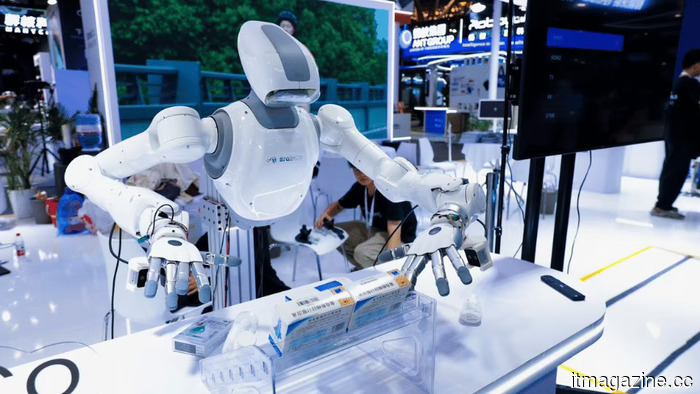 BrainCo introduces a brain-to-robot platform at WAIC.
China's BrainCo introduced a brain-to-robot system at WAIC that allows individuals to control robots solely through their thoughts, using an EEG headset, in less than 200 milliseconds.
BrainCo introduces a brain-to-robot platform at WAIC.
China's BrainCo introduced a brain-to-robot system at WAIC that allows individuals to control robots solely through their thoughts, using an EEG headset, in less than 200 milliseconds.
 The new robot vacuum cleans in a new way.
It seems our floors will soon be cleaner than a politician's conscience before elections. The TROUVER brand has decided to shake things up and is bringing three brand new dirt-killing robots to Russia. In fact, these guys have been roaming the global market under the MOVA brand for quite some time. Now it's our turn.
The new robot vacuum cleans in a new way.
It seems our floors will soon be cleaner than a politician's conscience before elections. The TROUVER brand has decided to shake things up and is bringing three brand new dirt-killing robots to Russia. In fact, these guys have been roaming the global market under the MOVA brand for quite some time. Now it's our turn.
 Mick Jagger claims that AI is acceptable for musicians, as long as it doesn't mimic his voice.
Mick Jagger supports AI as a creative resource but firmly opposes software that replicates the Rolling Stones, coinciding with the band's release of Foreign Tongues.
Mick Jagger claims that AI is acceptable for musicians, as long as it doesn't mimic his voice.
Mick Jagger supports AI as a creative resource but firmly opposes software that replicates the Rolling Stones, coinciding with the band's release of Foreign Tongues.
 a16z heads a $20M seed funding round for the AI agent startup Runta.
a16z has spearheaded a $20M seed investment in Runta, which is reconstructing AI agent infrastructure to enable companies to operate agents securely using sandboxes and guardrails.
a16z heads a $20M seed funding round for the AI agent startup Runta.
a16z has spearheaded a $20M seed investment in Runta, which is reconstructing AI agent infrastructure to enable companies to operate agents securely using sandboxes and guardrails.
 DeepMind introduces an AI biosecurity initiative.
Google DeepMind and Isomorphic Labs have initiated an AI biosecurity program aimed at assisting governments in preventing, detecting, and responding to biological threats.
DeepMind introduces an AI biosecurity initiative.
Google DeepMind and Isomorphic Labs have initiated an AI biosecurity program aimed at assisting governments in preventing, detecting, and responding to biological threats.
An FCC proposal might put an end to anonymous burner phones in the United States.
A newly proposed FCC know-your-customer initiative would mandate identity verification for purchasing a phone, effectively putting an end to anonymous burner phones. Privacy advocates label this move as misdirected.