

Vint Cerf aims to provide AI agents with a distinct identity.
Before long, the internet will be populated with AI agents acting on our behalf. Currently, there isn't a dependable way to identify who is behind these agents. Vint Cerf, one of the pioneers of the internet, aims to address this issue.
Cerf co-created TCP/IP, the protocol that enables different independent systems on the internet to communicate. He recently departed from Google after 20 years and is now joining the advisory council of Innovation Labs, a group working on establishing an open identity layer for AI agents, as announced by the company.
The missing layer
The issue is straightforward. Most of today's AI agents operate within a single company's system. However, companies want these agents to navigate the open web and interact directly with one another. Currently, there is no standardized way to verify ownership of an agent or who is responsible for its actions.
Innovation Labs, a division of Identity Digital that manages domain-name registries, proposes a solution called DNSid. This would provide each agent with a permanent identity linked to an existing domain name, supported by cryptographic validation. The design has already been submitted to the primary standards organization for the internet.
Why Cerf joined
Cerf sees this as a significant architectural challenge for the internet. He stated to TechCrunch that the critical question revolves around “what authorities they have, where they have derived those authorities, and who is accountable.”
He anticipates a complicated process. “It’s going to be an intriguing and, at times, perhaps frustrating period,” he noted. Competing standards have already begun to emerge. Cerf believes that, similar to TCP/IP, success will depend not on politics, but on functionality.
Keeping it open
The proposal emphasizes that no single technology giant should control the standard. Innovation Labs asserts that it will not retain the registration information. “There’s a lot of resistance to a hyperscaler creating a standard and managing proprietary data,” interim head Allie Kline mentioned to TechCrunch. The organization claims it is currently testing the system with several unnamed cloud providers.
An agent-shaped internet
The urgency is increasing as agents are rapidly proliferating, from Amazon’s updated Alexa to various enterprise tools, and they are already creating issues. Researchers have manipulated them into exposing confidential code and even executing a ransomware attack. Regulators are also responding, with new rules for agents in China and Delaware contemplating a legal identity for agents.
Cerf is uncertain whether an internet dominated by agents is unavoidable, but he believes efforts will be made to create it regardless. “We are inherently lazy beings,” he remarked. If an agent can handle a task for us, we will allow it to.
Other articles
 Microsoft's notable Patch Tuesday: AI identified the issues.
Microsoft's Patch Tuesday in July addressed a record high of 622 vulnerabilities, attributing the increase to AI-driven detection. Two of these flaws had already been exploited in the wild.
Microsoft's notable Patch Tuesday: AI identified the issues.
Microsoft's Patch Tuesday in July addressed a record high of 622 vulnerabilities, attributing the increase to AI-driven detection. Two of these flaws had already been exploited in the wild.
 This stylish Chinese electric vehicle combines supercar aesthetics with three artificial intelligence systems.
Xpeng’s L03, designed for a global market, features three proprietary AI chips, seamless integration with Google Maps, two powertrain options, and ample towing and cargo capacity suitable for genuine road trips.
This stylish Chinese electric vehicle combines supercar aesthetics with three artificial intelligence systems.
Xpeng’s L03, designed for a global market, features three proprietary AI chips, seamless integration with Google Maps, two powertrain options, and ample towing and cargo capacity suitable for genuine road trips.
 Anthropic and Blackstone introduce Ode, a firm focused on AI implementation.
Anthropic and Blackstone have unveiled Ode, a $1.5 billion AI implementation company that believes the next big opportunity in AI lies in deployment rather than in developing superior models.
Anthropic and Blackstone introduce Ode, a firm focused on AI implementation.
Anthropic and Blackstone have unveiled Ode, a $1.5 billion AI implementation company that believes the next big opportunity in AI lies in deployment rather than in developing superior models.
 Apple's Back to School promotion for 2026 offers savings of up to $150 on a new Mac or iPad.
Apple's Back to School promotion for 2026 offers gift cards valued up to $150, but the least expensive Mac and iPad are excluded from this offer.
Apple's Back to School promotion for 2026 offers savings of up to $150 on a new Mac or iPad.
Apple's Back to School promotion for 2026 offers gift cards valued up to $150, but the least expensive Mac and iPad are excluded from this offer.
 HTC's smart glasses are reportedly set to arrive in the US, although the company has not officially confirmed this.
Amazon temporarily posted a listing for HTC's VIVE Eagle smart glasses, indicating a US release on September 1 for $499, but later took down the pages before HTC verified the launch beyond Taiwan.
HTC's smart glasses are reportedly set to arrive in the US, although the company has not officially confirmed this.
Amazon temporarily posted a listing for HTC's VIVE Eagle smart glasses, indicating a US release on September 1 for $499, but later took down the pages before HTC verified the launch beyond Taiwan.
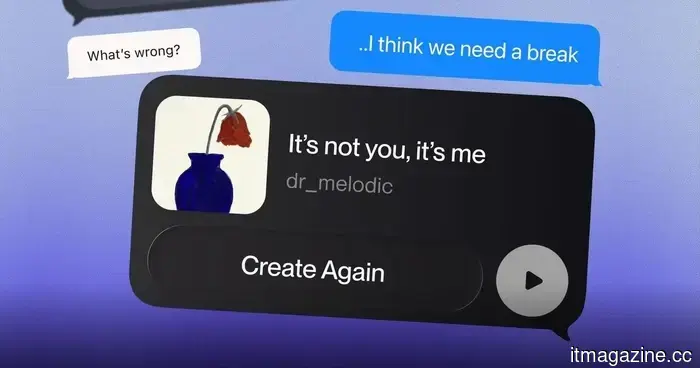 You can now create songs within your iMessage conversations.
Suno's newest iOS update allows users to create 30-second songs using typed prompts, voice messages, and recordings within iMessage.
You can now create songs within your iMessage conversations.
Suno's newest iOS update allows users to create 30-second songs using typed prompts, voice messages, and recordings within iMessage.
Vint Cerf aims to provide AI agents with a distinct identity.
Vint Cerf, one of the pioneers of the internet, is participating in a project aimed at creating a lasting identity framework for AI agents, ensuring that the web can identify the individuals behind them.