
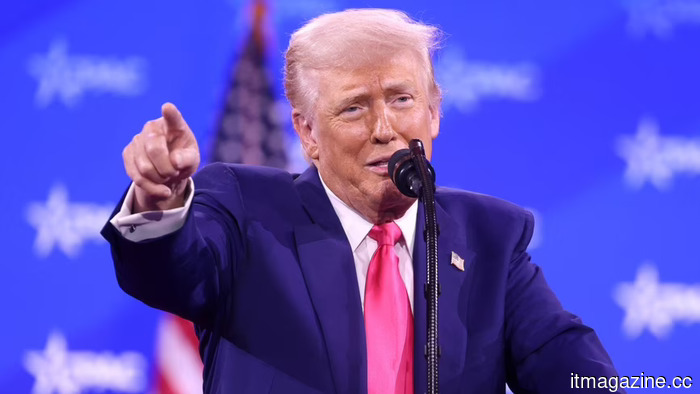
Trump describes the halt on New York's data center as a "terrible decision." Hochul remains steadfast.
Kathy Hochul enacted the executive order on Tuesday, with Donald Trump urging her to rescind it by Wednesday. The order puts a year-long halt on the construction of new data centers that require 50 megawatts or more, making New York the first state in the US to slow down developments supporting the AI surge. During this period, state officials will create a Generic Environmental Impact Statement, and the freeze will end once those standards are established.
Trump expressed his disapproval on Truth Social, labeling it a “terrible decision” that could lead to investment, tax revenue, and jobs being transferred to states eager for them. He argued that data centers are “one of the biggest Driving Forces in the Future for Jobs” and referred to them as “Money Machines” for the states that accommodate them. He suggested that projects would now relocate to Texas, Florida, Alabama, and Arizona, where “Both the Taxes and the Jobs amount to LIQUID GOLD!” He urged New York to change its direction “IMMEDIATELY,” cautioning against losing AI leadership to “China, and other countries.”
On the same day, Hochul responded on X, borrowing Trump's phrase. She stated, “If data centers are really ‘LIQUID GOLD’, then New Yorkers deserve more than scraps.” She explained, “We hit pause because the communities powering AI should share in its success,” adding, “Maybe that’s a novel concept in Washington. We call it doing our job.” Her justification for the order centers on utility costs, water issues, and how the expenses of these facilities impact the host towns while the benefits primarily go elsewhere.
A Georgia Tech study released last week highlighted that the advantages from data centers are unevenly shared, with metropolitan areas reaping most of the rewards as rural communities host the facilities and face increased electricity expenses. The financial stakes are significant; US data center lease commitments exceeded $850 billion in the first quarter of 2026, a record high. In this context, a one-year pause in one state appears minor, yet the response has been outsized.
Bill Ackman echoed Trump's concerns about China, stating, “China is not putting moratoriums on data centers.” He emphasized, “The race for super intelligence needs to be won by the USA or our country and democracy will be at risk.” Similarly, Anthony Pompliano criticized the policy as “about as dumb of a public policy as you could come up with.” However, Alexandria Ocasio-Cortez took a different stance, thanking Hochul and asserting that a moratorium allows lawmakers time to formulate robust protections, ensuring AI "benefits all of us, not just a powerful few."
Notably, much of the discussion is less focused on New York and more on its implications for other governors, particularly as it coincides with a broader federal initiative aimed at preempting state AI regulations through a DOJ litigation task force and efforts for a national standard. This federal campaign has struggled, with the Senate voting 99 to 1 to eliminate the preemption provision.
Additionally, there is an ironic twist: the administration's own executive order on preemption designated data center zoning authority as a state matter, closely aligning with Hochul's actions. Furthermore, she is not as isolated as the framing suggests; local opposition has delayed or halted at least 75 US data center projects valued at approximately $130 billion in the first quarter alone, with no requirement for gubernatorial involvement. Denmark has also paused grid connections.
In summary, New York is the first state to embed this resistance within an executive order but is not the sole location to challenge it. The order remains in effect. Trump lacks a means to overturn it, Hochul has shown no intention to rescind it, and the timeline for the Generic Environmental Impact Statement remains uncertain.
Other articles
 Applied Computing secures $20 million to develop a foundational model for the refinery.
The London-based startup reports that its plants utilize less than 8% of the data they gather. Its Orbital model integrates time series, physics, and language. KBR spearheaded the $20 million funding round.
Applied Computing secures $20 million to develop a foundational model for the refinery.
The London-based startup reports that its plants utilize less than 8% of the data they gather. Its Orbital model integrates time series, physics, and language. KBR spearheaded the $20 million funding round.
 Ofcom launches an investigation into TikTok regarding child safety.
Ofcom is looking into whether TikTok is capable of identifying child users and if it effectively prevents harmful content from reaching them. Penalties could amount to 10% of the company's global revenue.
Ofcom launches an investigation into TikTok regarding child safety.
Ofcom is looking into whether TikTok is capable of identifying child users and if it effectively prevents harmful content from reaching them. Penalties could amount to 10% of the company's global revenue.
 xAI's initial lawsuit against a user examines accountability for the content generated by Grok.
xAI has filed a lawsuit against a man from South Carolina for reportedly using Grok to create child sexual abuse material, marking the first case of its kind, while also contending with lawsuits that claim the opposite.
xAI's initial lawsuit against a user examines accountability for the content generated by Grok.
xAI has filed a lawsuit against a man from South Carolina for reportedly using Grok to create child sexual abuse material, marking the first case of its kind, while also contending with lawsuits that claim the opposite.
 Nvidia partners with Japan's robotics industry for its open world models.
FANUC, Yaskawa, Kawasaki, and 19 other companies plan to become part of Nvidia's Cosmos Coalition. No financial commitments or binding agreements have been revealed.
Nvidia partners with Japan's robotics industry for its open world models.
FANUC, Yaskawa, Kawasaki, and 19 other companies plan to become part of Nvidia's Cosmos Coalition. No financial commitments or binding agreements have been revealed.
 An F1 aerodynamicist has secured $55 million in funding to train factory robots by utilizing videos of individuals performing household tasks.
Microagi secured $55 million in funding, with Hummingbird at the forefront. Its data division compensates 20,000 individuals across 15 nations to record themselves while working. Robots lack internet access for learning.
An F1 aerodynamicist has secured $55 million in funding to train factory robots by utilizing videos of individuals performing household tasks.
Microagi secured $55 million in funding, with Hummingbird at the forefront. Its data division compensates 20,000 individuals across 15 nations to record themselves while working. Robots lack internet access for learning.
 5 Questions Every CIO Must Consider Before Introducing Another Software Tool
In 2023, the typical tech stack comprised 291 applications, resulting in significant software expenditures. By 2026, numerous enterprise tech stacks have evolved to be even more intricate as companies keep integrating AI features into their processes. As vibe coding becomes more widespread and the number of SaaS platforms increases, how can a leader determine which [...]
5 Questions Every CIO Must Consider Before Introducing Another Software Tool
In 2023, the typical tech stack comprised 291 applications, resulting in significant software expenditures. By 2026, numerous enterprise tech stacks have evolved to be even more intricate as companies keep integrating AI features into their processes. As vibe coding becomes more widespread and the number of SaaS platforms increases, how can a leader determine which [...]
Trump describes the halt on New York's data center as a "terrible decision." Hochul remains steadfast.
The day after New York became the first state to halt large data centers, Trump called for an immediate reversal of that decision. Hochul responded within hours.