
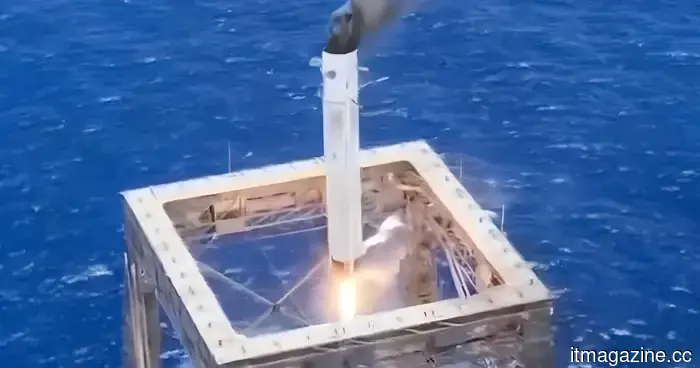
China's response to SpaceX's reusable rockets involves literally capturing boosters in a net.
SpaceX captures boosters using legs, while China recently utilized a net.
SpaceX’s approach to recovering a rocket booster typically involves landing legs, a highly controlled vertical landing, and either a concrete platform or a drone ship.
China recently achieved a similar feat, albeit through a different method, testing it on July 10.
A significant milestone for China's space program! The Long March-10B successfully undertook its first flight and recovered its first stage via a sea-based net, marking the country's inaugural controlled rocket recovery and a significant stride toward reusable launch capabilities.… pic.twitter.com/FWuQXLltaD— Mao Ning 毛宁 (@SpoxCHN_MaoNing) July 10, 2026
So, what exactly did China accomplish?
On July 10, 2026, at 12:15 PM local time, China launched the Long March 10B from the Wenchang Spacecraft Launch Site in Hainan Province.
Approximately six minutes post-launch, the rocket's first stage detached and initiated a controlled descent, which the cable net system on a specially designed recovery vessel, named Linghangzhe, captured.
No landing legs, no touchdowns, just a net on a ship—this represents a world first. No other space program has successfully captured an orbital-class booster in this manner, highlighting its significance. The China Aerospace Science and Technology Corporation confirmed that the primary mission was successful, with the satellite payload reaching its designated orbit (via Ars Technica).
For context, the Long March 10B is a two-stage medium-lift rocket with the capacity to transport approximately 16 metric tons into low-Earth orbit, slightly less than the Falcon 9’s capability.
The first stage is powered by seven YF-100K engines, which run on kerosene and liquid oxygen, while the second stage is propelled by a single methane-fueled YF-219 engine. China intends to reuse the recovered booster before the end of 2026, which is essentially the whole point.
Why does any of this matter beyond the headline?
Because reusability is the primary reason SpaceX can launch at approximately double the frequency of all Chinese rockets combined.
This disparity in launch cadence allows SpaceX to dominate commercial launch contracts. US Space Force officials have expressed explicit concerns about what will happen when China narrows this gap.
Though the recovery of the Chinese rocket doesn't immediately close the gap, it is the first credible indication that China is on a similar trajectory, and it may catch up quite rapidly. Whether through a net or legs, the end goal remains the same: reusable rockets.
For over five years, Shikhar has consistently simplified advancements in consumer tech and communicated them effectively.
Dimming the sun might sound extreme, yet a new study on El Niño presents a surprisingly credible case for it.
A natural test case, Australia’s worst wildfire season to date, suggests that the idea merits serious consideration. When I first encountered "scientists propose dimming the sun," I was skeptical—it sounded like a plot from a sci-fi movie inspired by climate documentaries. However, a new study published on July 8, 2026, in the journal Science Advances, appears to present a genuinely compelling argument.
Currently, a Super El Niño is developing in the Pacific, anticipated to be the most severe in decades, which could lead to increased floods, wildfires, and extreme heat events globally. Researchers at UC San Diego's Scripps Institution of Oceanography, led by climate scientists Kate Ricke and Jessica Wan, are now recommending one of the most intriguing solutions I’ve encountered.
You can now explore space and peer into a black hole at this VR exhibit.
The Smithsonian's new VR exhibit, Starstruck, allows visitors to wander through the vast universe, drifting past dying stars and witnessing the origin point of the universe for as little as $18 per person.
Unlike typical planetarium shows that require you to remain seated and look upwards, the Smithsonian's exhibit offers a different experience, enabling visitors to journey through the cosmos for a physical sense of its vastness.
A $29 ticket takes you to the edge of the galaxy.
Scientists caution that Elon Musk’s orbital data centers could obstruct observations from Earth’s largest telescopes.
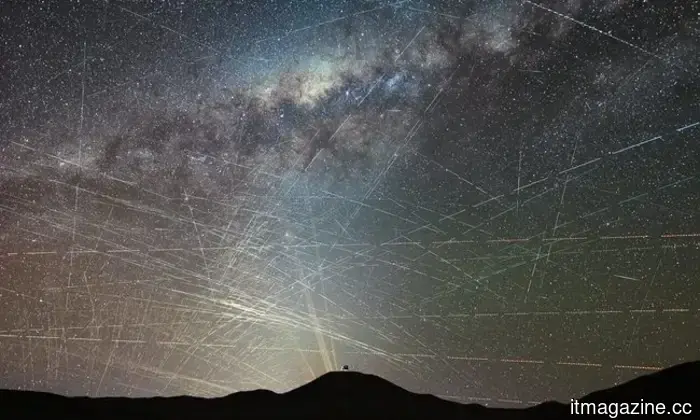
A recent study by the European Southern Observatory (ESO) suggests that millions of satellites could render parts of the night sky nearly unusable for astronomical observations.
While the push to provide worldwide satellite internet has enabled faster connectivity for millions, the ESO warns that the rapid expansion of satellite mega-constellations could significantly hinder observations from some of the world's most powerful telescopes.
Astronomers are stating that the night sky is nearing its limits.



Other articles
 Amazon's reduction of 57,000 positions and the impact on those who remain.
Desperate job searches lasting over a year confront laid-off Amazon employees, while those who remain take on the increased workload. The human toll of the technology sector's reductions.
Amazon's reduction of 57,000 positions and the impact on those who remain.
Desperate job searches lasting over a year confront laid-off Amazon employees, while those who remain take on the increased workload. The human toll of the technology sector's reductions.
 The top 6 scar creams that enhance modern consumer beauty technology.
A comprehensive guide to the top six scar creams that utilize cutting-edge beauty technology, including ultrasonic infusion devices, LED facial wands, smart home sensors, and AI-enhanced skin monitoring applications.
The top 6 scar creams that enhance modern consumer beauty technology.
A comprehensive guide to the top six scar creams that utilize cutting-edge beauty technology, including ultrasonic infusion devices, LED facial wands, smart home sensors, and AI-enhanced skin monitoring applications.
 The founder of Zhipu advocates for open frontier AI.
Tang Jie states that the security of AI arises from transparency rather than obstacles, especially as Beijing considers limiting foreign access to China's top open models.
The founder of Zhipu advocates for open frontier AI.
Tang Jie states that the security of AI arises from transparency rather than obstacles, especially as Beijing considers limiting foreign access to China's top open models.
 The competition in AI is no longer focused on having the largest model.
Businesses are selecting AI models based on the specific task, cost, and control rather than their ranking on benchmarks. The concept of 'good enough' is outperforming 'best', and the expenses highlight the reasoning behind this choice.
China's BrainCo is wagering that brain technology will come from a headband rather than surgical methods.
BrainCo detects brain activity via the scalp rather than utilizing implants. This makes it simpler to expand compared to Neuralink, while also presenting greater challenges for regulation.
China's coding tools are experiencing growth as Claude Code faces scrutiny.
Beijing has identified Claude Code as a security vulnerability. This development is beneficial for ByteDance's Trae, Alibaba's Qoder, Tencent's CodeBuddy, and Zhipu's ZCode.
The competition in AI is no longer focused on having the largest model.
Businesses are selecting AI models based on the specific task, cost, and control rather than their ranking on benchmarks. The concept of 'good enough' is outperforming 'best', and the expenses highlight the reasoning behind this choice.
China's BrainCo is wagering that brain technology will come from a headband rather than surgical methods.
BrainCo detects brain activity via the scalp rather than utilizing implants. This makes it simpler to expand compared to Neuralink, while also presenting greater challenges for regulation.
China's coding tools are experiencing growth as Claude Code faces scrutiny.
Beijing has identified Claude Code as a security vulnerability. This development is beneficial for ByteDance's Trae, Alibaba's Qoder, Tencent's CodeBuddy, and Zhipu's ZCode.
China's response to SpaceX's reusable rockets involves literally capturing boosters in a net.
China is the only other entity to have retrieved an orbital rocket booster, utilizing a cable net aboard a ship rather than employing landing legs.