
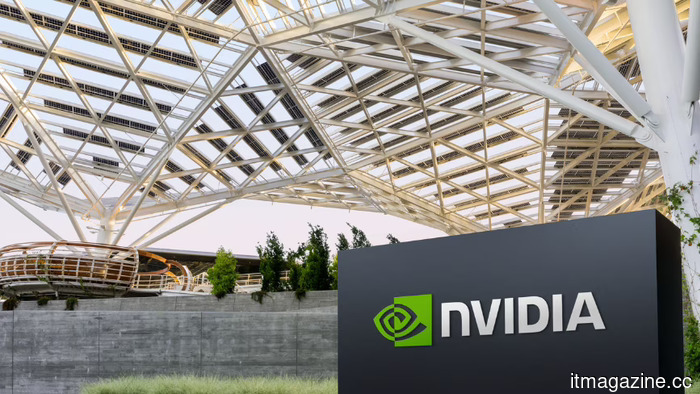
Nvidia's Kyber AI rack has been postponed until 2028.
Nvidia's upcoming flagship AI machine has encountered a setback, with a single circuit board being the main issue. The Kyber rack, designed to accommodate its 2027 Rubin Ultra chips, has been pushed back to 2028.
Research firm SemiAnalysis highlighted this delay, which was reported by CNBC. The Kyber is not a chip; it is a server cabinet that houses 144 of Nvidia's most powerful GPUs in one unit, enabling them to function as a single massive computer. This high density is crucial for training and running the largest AI models.
One board, one significant issue
The delay is rooted in a less glamorous aspect. The Kyber installs its chips in vertical trays to maximize capacity and reduce latency. At the core is a multi-layer circuit board known as the PCB midplane. According to SemiAnalysis, this board "remains challenging from a manufacturability standpoint." Simply put, Nvidia is not yet able to produce it at scale.
The repercussions extend beyond this issue. A larger system, the NVL576, connects eight racks via optical cables and is likely facing delays or limited production. Nvidia has not provided any comments.
No alternative plan
Nvidia did have a contingency plan, intending to combine two current-generation racks to achieve similar performance. However, cloud customers disliked this approach, criticizing the "odd design and heavy operational burden," which led Nvidia to abandon the idea.
This situation creates a gap. SemiAnalysis indicates that Nvidia currently has “no proven solution” for scaling up its most advanced Rubin Ultra systems. For a company that typically releases a new architecture each year, failing to progress is unusual.
An opportunity for competitors
The timing is advantageous for competitors. Google and AMD have already secured projects with leading AI labs using their own chips. A stumble at the top end creates a unique technical opportunity for them, according to SemiAnalysis. This situation also contributes to the current unease in the AI chip market, as Asian technology and circuit-board stocks fell following the news, as noted by Bloomberg.
Nonetheless, this setback does not impact Nvidia's short-term dominance. Its existing Rubin systems are in full production, with shipments set to begin this autumn to eight cloud partners, including AWS, Microsoft Azure, and Google Cloud. SemiAnalysis even anticipates Nvidia's data center compute revenue to exceed Wall Street projections by 20 percent in the latter half of its 2027 financial year. Nvidia's stock remained relatively stable.
The real challenge
The underlying issue is manufacturing. Nvidia's annual release schedule is clashing with the capacity limitations of its suppliers. This includes everything from advanced circuit boards to the memory that powers each GPU.
The factories producing these racks are already operating at full capacity. Competitors creating their own custom silicon believe that the production pace, rather than the design itself, is where Nvidia is most vulnerable.
For once, the toughest aspect of the AI boom isn't the chip itself, but the enclosure surrounding it.
Other articles
 The Washington Post forecasted technological advancements 50 years ago, and the accuracy of those predictions is quite humbling.
The Washington Post revisited a 1976 article that predicted life in 2026, highlighting the accuracy of its forecasts concerning smartphones, solar energy, gene editing, and various other technological advancements.
The Washington Post forecasted technological advancements 50 years ago, and the accuracy of those predictions is quite humbling.
The Washington Post revisited a 1976 article that predicted life in 2026, highlighting the accuracy of its forecasts concerning smartphones, solar energy, gene editing, and various other technological advancements.
 Samsung is on track for an 18-fold increase in profits due to a surge in demand for AI memory.
Analysts predict that Samsung will announce an operating profit of approximately 86 trillion won for Q2, which is about 18 times higher than last year, due to a rise in AI memory prices.
Samsung is on track for an 18-fold increase in profits due to a surge in demand for AI memory.
Analysts predict that Samsung will announce an operating profit of approximately 86 trillion won for Q2, which is about 18 times higher than last year, due to a rise in AI memory prices.
 China's Biren has secured $892 million in funding to compete against Nvidia.
Shanghai Biren is issuing HK$7 billion (approximately $892 million) in new shares to ramp up the mass production of its upcoming GPUs, as U.S. restrictions on Nvidia provide a chance for China's chip manufacturers.
China's Biren has secured $892 million in funding to compete against Nvidia.
Shanghai Biren is issuing HK$7 billion (approximately $892 million) in new shares to ramp up the mass production of its upcoming GPUs, as U.S. restrictions on Nvidia provide a chance for China's chip manufacturers.
 Nvidia's Kyber AI rack has been postponed to 2028.
According to SemiAnalysis, Nvidia's Kyber rack for its 2027 Rubin Ultra chips has been delayed to 2028 due to difficulties in manufacturing the circuit board, creating an opportunity for competitors.
Nvidia's Kyber AI rack has been postponed to 2028.
According to SemiAnalysis, Nvidia's Kyber rack for its 2027 Rubin Ultra chips has been delayed to 2028 due to difficulties in manufacturing the circuit board, creating an opportunity for competitors.
 Is the ‘SaaSpocalypse’ just a myth? The actual expense of AI-generated software.
AI has greatly simplified and reduced the costs of developing software in-house, prompting many executives to reevaluate SaaS subscriptions with a focus on cutting expenses.
Is the ‘SaaSpocalypse’ just a myth? The actual expense of AI-generated software.
AI has greatly simplified and reduced the costs of developing software in-house, prompting many executives to reevaluate SaaS subscriptions with a focus on cutting expenses.
 Novartis acquires UK biotech Myricx for as much as $1.5 billion to pursue a new class of cancer drugs.
Novartis will provide an initial payment of $1.1 billion and potential milestone payments of up to $400 million for Myricx Bio, a UK-based company working on an innovative payload for antibody-drug conjugates.
Novartis acquires UK biotech Myricx for as much as $1.5 billion to pursue a new class of cancer drugs.
Novartis will provide an initial payment of $1.1 billion and potential milestone payments of up to $400 million for Myricx Bio, a UK-based company working on an innovative payload for antibody-drug conjugates.
Nvidia's Kyber AI rack has been postponed until 2028.
According to SemiAnalysis, Nvidia's Kyber rack designed for its 2027 Rubin Ultra chips has been delayed until 2028 due to difficulties in constructing the circuit board, providing competitors with an opportunity.