
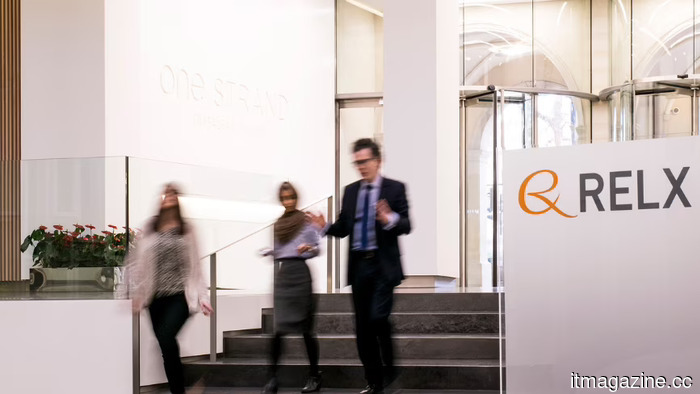
RELX announces an additional £100M buyback as its 2026 repurchase program continues.
RELX may not create headlines like a semiconductor manufacturer or an AI lab, but that is by design. The company offers data, analytics, and the predictable certainty of recurring revenue, consistently returning profits to shareholders in a regular manner. This week marked the latest occurrence of that regularity.
The firm announced a £100m share buyback set for July, which is part of its plan to allocate around £2.25bn for repurchases by 2026.
The stated objective is a traditional one: to reduce the company's capital by keeping the repurchased shares in treasury. The initiative is carried out by independent financial firms under the standard UK and EU market-abuse regulations, ensuring the company remains distant from the trading process itself.
This July tranche follows a series of earlier buybacks this year, including a £200m program that was in effect during the first half of June. Individually, these buybacks do not make waves in the market.
When viewed collectively, however, they illustrate how RELX perceives itself: as a cash-generating enterprise with surplus capital beyond what is necessary for growth, opting to return the excess rather than accumulate it.
This approach is easier to maintain when the core business is thriving, which has been the case for RELX. The company covers various sectors, including scientific publishing via Elsevier, legal data through LexisNexis, risk and analytics, along with its exhibitions division. The segments that provide proprietary data for professional workflows have shown resilience and are now well-positioned to benefit from the AI trend.
Possessing large, structured, and difficult-to-replicate datasets is advantageous, especially in an environment where software companies are increasingly in need of such assets.
However, the journey hasn't been entirely without bumps. RELX experienced its most significant one-day share drop since 1988 when Anthropic introduced its Claude assistant for legal contract review. Some analysts viewed this reaction as exaggerated, considering that LexisNexis's exclusive archives still provide a substantial competitive advantage.
In response, LexisNexis incorporated Anthropic’s legal functionalities into its Protégé AI suite, showcasing a strategy of integration rather than opposition.
This context is important when interpreting the buybacks. By returning £2.25bn to shareholders within a single year, RELX is expressing confidence that its unique data will retain its value, even as generative AI transforms the software built upon it. The buybacks serve as a monetary affirmation that its competitive edge is secure.
For shareholders, the impact is straightforward. Buybacks reduce the number of shares available, which increases earnings per share and, assuming other factors remain unchanged, bolsters share price. While this may not be as flashy as a major acquisition, it is a more dependable use of capital—something RELX has consistently favored.
The July buyback program will follow the same independent execution as previous efforts throughout the month. Its lack of drama conveys the message: RELX is a company that thrives on predictability, and a £100m buyback in July perfectly reflects the type of routine update it prefers to communicate.
Other articles
 Rocket Lab acquires Iridium for $8 billion in an attempt to establish itself as a more compact version of Starlink.
Rocket Lab will acquire Iridium for $54 per share, marking an approximately $8 billion transaction that transforms the launch company into a vertically integrated space operator.
Rocket Lab acquires Iridium for $8 billion in an attempt to establish itself as a more compact version of Starlink.
Rocket Lab will acquire Iridium for $54 per share, marking an approximately $8 billion transaction that transforms the launch company into a vertically integrated space operator.
 As a severe heatwave affects Europe, Rome relies on a bracelet to monitor its elderly population.
Rome has distributed approximately 700 elderly residents a bracelet that monitors heart rate, sleep patterns, and falls, along with daily check-in calls from social workers, amid an unprecedented heatwave.
As a severe heatwave affects Europe, Rome relies on a bracelet to monitor its elderly population.
Rome has distributed approximately 700 elderly residents a bracelet that monitors heart rate, sleep patterns, and falls, along with daily check-in calls from social workers, amid an unprecedented heatwave.
 Google Cloud will offer specialized AI models designed for scientific purposes.
Google Cloud will provide SandboxAQ's extensive quantitative models for drug discovery, materials science, and chip manufacturing, along with Gemini for Science.
Google Cloud will offer specialized AI models designed for scientific purposes.
Google Cloud will provide SandboxAQ's extensive quantitative models for drug discovery, materials science, and chip manufacturing, along with Gemini for Science.
 As a severe heatwave envelops Europe, Rome utilizes a bracelet to monitor its senior citizens.
Rome has provided approximately 700 elderly residents with a bracelet that monitors heart rate, sleep, and falls, supported by daily calls from social workers, amid an unprecedented heatwave.
As a severe heatwave envelops Europe, Rome utilizes a bracelet to monitor its senior citizens.
Rome has provided approximately 700 elderly residents with a bracelet that monitors heart rate, sleep, and falls, supported by daily calls from social workers, amid an unprecedented heatwave.
 Former Tesla Optimus engineer resolves trade secret litigation and secures $11 million to develop robotic hands.
Proception's founder, Jay Li, has resolved the Tesla trade secret lawsuit and secured $11 million in funding from First Round Capital to deliver dexterous robotic hands to companies working with humanoids.
Former Tesla Optimus engineer resolves trade secret litigation and secures $11 million to develop robotic hands.
Proception's founder, Jay Li, has resolved the Tesla trade secret lawsuit and secured $11 million in funding from First Round Capital to deliver dexterous robotic hands to companies working with humanoids.
 A former Tesla Optimus engineer has resolved a trade secret lawsuit and secured $11 million to develop robotic hands.
Proception's founder, Jay Li, has reached a settlement in a lawsuit regarding Tesla's trade secrets and has secured $11 million from First Round Capital to deliver dexterous robotic hands to companies focused on humanoid robotics.
A former Tesla Optimus engineer has resolved a trade secret lawsuit and secured $11 million to develop robotic hands.
Proception's founder, Jay Li, has reached a settlement in a lawsuit regarding Tesla's trade secrets and has secured $11 million from First Round Capital to deliver dexterous robotic hands to companies focused on humanoid robotics.
RELX announces an additional £100M buyback as its 2026 repurchase program continues.
RELX is set to initiate a £100m share buyback in July, marking the most recent phase of a £2.25bn plan, as the data company continues to distribute cash to its shareholders.