
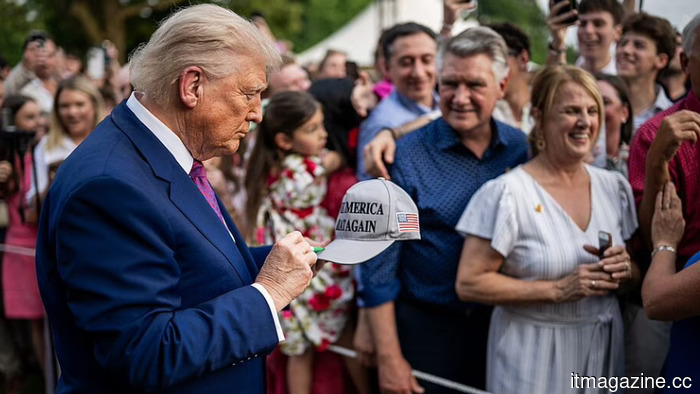
Silicon Valley financed efforts to eliminate AI regulations, and now it seeks to reinstate those rules.
Executives in the AI sector who heavily supported Trump’s deregulation efforts are now calling for a more formal regulatory framework following a series of chaotic export controls and restrictions on models. According to a report by Politico on Friday, leaders at leading AI firms indicated that the administration's inconsistent oversight of models is more detrimental than the proposals made by the Biden administration.
The change in attitude has occurred swiftly. Trump began his second term after receiving substantial donations from Silicon Valley billionaires who warned that Biden’s AI safety initiatives would stifle US innovation. During his first year, he concentrated on preventing states from regulating the technology, issuing a voluntary executive order on June 2 that asked companies to submit models for a 30-day review prior to their release.
However, this voluntary framework was quickly overshadowed by events. The White House imposed export controls on Anthropic’s Mythos 5 and Fable 5 models on June 12, following security concerns raised by Amazon’s CEO with the Treasury Secretary. Recently, the administration pressured OpenAI to limit the rollout of its latest model, Sol, to around 20 government-approved partners, marking the first instance of a US company launching a frontier model under government-managed access.
One senior AI executive, speaking anonymously to Politico, described the outcome as “a de facto European-style licensing regime.” Paul Lekas, global public policy head at the Software and Information Industry Association, which represents major AI firms, emphasized a “real need for a formal process” and expressed the industry's desire to prevent model releases from relying on “an ad hoc process and a one-off license.”
Industry representatives expressed hesitance to advocate for clarity from the White House. “It feels like they’re walking on eggshells a little bit,” remarked an AI policy adviser who collaborates with significant frontier labs. Companies are concerned that aggressive lobbying efforts might provoke export controls or other forms of regulatory backlash.
Saif Khan, a former senior adviser on critical and emerging technology at the Commerce Department under Biden, characterized the Trump administration's approach as an overreaction stemming from earlier dismissiveness. He noted that due to previous disregard for risks, there had been insufficient preparatory work and expert hiring, leading to an "opaque, almost vibes-based" outcome.
Khan asserted that the administration’s actions effectively create “an almost complete moratorium on new releases,” which may “seriously impact companies’ bottom lines,” describing the situation as more harmful than anything Biden had proposed. The Biden administration's final rule would have instituted export controls on chips and AI model weights for specific countries, but it never sought to prevent domestic releases.
Dean Ball, a former Trump administration official who drafted the White House AI Action Plan and is set to join OpenAI as head of strategic futures on July 6, acknowledged the existing tension. He stated that while the administration's concerns are “100 percent legitimate,” they might be overreacting to those concerns. Ball expressed relief that the White House is now prioritizing AI safety, even if the implementation is flawed.
On Friday, the administration partially lifted the export ban on Anthropic, permitting Mythos 5 to be shared with over 100 approved companies, although Fable 5 remains blocked without a clear explanation from the government. An OpenAI executive informed Politico that the industry anticipates the administration will soon finalize its June 2 executive order, replacing the current restrictions with the original voluntary vetting framework.
Lekas remarked that the tech industry is coordinating a “push for an actual framework” on advanced AI regulations, urging Washington to formalize it, either via executive order or legislation. He cautioned that without a consensus among AI companies on a standardized safety approach, they will continue to face unpredictable treatment.
White House spokesperson Liz Huston defended the president's record, highlighting accelerated permits for AI infrastructure and the executive order aimed at curbing state-level regulation. “President Trump has clearly and repeatedly articulated his goal: ensure continued American dominance in AI,” Huston stated.
Other articles
 Trustpilot is integrating its reviews within Shopify stores as AI-driven search transforms online retail.
Trustpilot collaborated with Shopify to enable merchants to showcase and handle reviews directly within their stores, as AI-driven clicks increased by 1,490 percent.
Trustpilot is integrating its reviews within Shopify stores as AI-driven search transforms online retail.
Trustpilot collaborated with Shopify to enable merchants to showcase and handle reviews directly within their stores, as AI-driven clicks increased by 1,490 percent.
 The FBI reports that Russian spies are now deceiving Signal users into giving up their backup recovery key.
The FBI has cautioned that Russian intelligence hackers are using phishing tactics to target Signal users in order to obtain their backup recovery key, which would grant the attackers complete access to their message history.
The FBI reports that Russian spies are now deceiving Signal users into giving up their backup recovery key.
The FBI has cautioned that Russian intelligence hackers are using phishing tactics to target Signal users in order to obtain their backup recovery key, which would grant the attackers complete access to their message history.
 Trustpilot is integrating its reviews within Shopify stores as artificial intelligence transforms the online shopping experience.
Trustpilot collaborated with Shopify to enable merchants to showcase and manage reviews directly within their stores, as AI-driven clicks increased by 1,490 percent.
Trustpilot is integrating its reviews within Shopify stores as artificial intelligence transforms the online shopping experience.
Trustpilot collaborated with Shopify to enable merchants to showcase and manage reviews directly within their stores, as AI-driven clicks increased by 1,490 percent.
 The Steam Machine hasn't even launched yet, but the resale frenzy has already started.
Valve's anti-scalper reservation system seems to be hindering resellers, though it hasn't completely eliminated them. Steam Machine listings are already surfacing on the internet.
The Steam Machine hasn't even launched yet, but the resale frenzy has already started.
Valve's anti-scalper reservation system seems to be hindering resellers, though it hasn't completely eliminated them. Steam Machine listings are already surfacing on the internet.
 Cloudflare's engineering personnel increased by 45% following a reduction of 1,100 jobs, and its CEO has developed a framework to determine which roles will endure in the age of AI.
Cloudflare CEO Matthew Prince states that AI removes "measurers," leaving only builders and sellers, while BNP Paribas reports a 45 percent increase in engineering activity.
Cloudflare's engineering personnel increased by 45% following a reduction of 1,100 jobs, and its CEO has developed a framework to determine which roles will endure in the age of AI.
Cloudflare CEO Matthew Prince states that AI removes "measurers," leaving only builders and sellers, while BNP Paribas reports a 45 percent increase in engineering activity.
.jpg) Three lesser-known Apple TV shows to check out this weekend (June 26-28)
From a discontinued mystery comedy to a celebrated historical drama, these three Apple TV+ series warrant much more recognition than they received.
Three lesser-known Apple TV shows to check out this weekend (June 26-28)
From a discontinued mystery comedy to a celebrated historical drama, these three Apple TV+ series warrant much more recognition than they received.
Silicon Valley financed efforts to eliminate AI regulations, and now it seeks to reinstate those rules.
According to Politico, AI leaders who supported Trump's deregulation efforts now describe his improvised crackdown as more severe than anything proposed by Biden.