
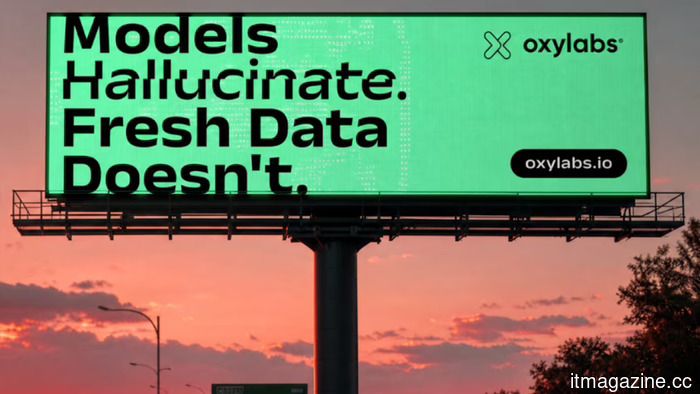
AI will not be driven solely by improved models, according to Oxylabs CEO Vytautas Savickas.
**TL;DR** Vytautas Savickas, CEO of Oxylabs, believes that the key transition in AI is shifting from model performance to infrastructure reliability. As AI enters an agentic phase, it requires new web data, browser automation, and real-time access to function effectively in the real world. The companies that succeed in AI will create trustworthy systems rather than solely focusing on developing larger models.
As many engineers, founders, and researchers gather for the AI Engineer World’s Fair in San Francisco, discussions revolve around advanced models and autonomous agents. However, Savickas contends that the most significant industry shift is occurring elsewhere. He says, "For the past three years, AI has largely centered on developing better models. The upcoming phase revolves around the surrounding systems, infrastructure, and live data that enable AI to function in reality."
This change alters the requirements for AI systems. They can no longer solely depend on information gathered during training; they increasingly rely on up-to-date data, live searches, browser interactions, and consistent access to the ever-evolving web. Mr. Savickas notes, "Knowledge isn’t static. A model disconnected from fresh information is already out of touch with the present world. The more AI is involved in real-world decisions, the more crucial it is to remain connected to reality."
**AI is becoming an infrastructure issue.** According to Mr. Savickas, each significant advance in AI has transformed the underlying infrastructure. He describes the initial phase as focusing on training foundational models that required vast amounts of varied public data. The following phase introduced retrieval-augmented generation (RAG), which meant AI needed not just to understand the past but also to grasp recent changes.
Now, we are entering the agentic phase where AI systems begin to search, compare, verify, purchase, monitor, and execute tasks for users. He asserts that each development demands a different type of infrastructure. "People often view AI purely as a modeling issue, but it increasingly presents itself as an infrastructure challenge."
Public web data has evolved from being used only for training to becoming essential for AI operations. "The web was designed for billions of users, and we are now expecting it to facilitate billions of AI-driven interactions. This changes what infrastructure must accomplish."
**Building for AI before its rise.** Long before foundational models became popular, Oxylabs developed the infrastructure necessary for enterprises to consistently access and utilize public web information at scale. Mr. Savickas states, "It might seem that AI created this market suddenly, but in truth, AI merely highlighted this existing challenge at a new magnitude." For years, businesses have relied on dynamic information across various sectors such as ecommerce, cybersecurity, travel, finance, and market intelligence, and AI has broadened these demands almost universally.
Today, Oxylabs caters to over 15,000 clients globally, holds more than 160 patents, and possesses one of the largest infrastructures for accessing public web data.
**Intelligence alone won’t decide AI victors.** The current discussions surrounding AI still largely focus on model performance. However, Mr. Savickas believes this conversation is shifting. "Cutting-edge models will keep improving, but for many practical applications, quality alone isn’t the key differentiator. Increasingly, the quality of AI systems' connections to the external world will matter more."
This evolution also impacts his perspective on hallucinations. "A model isn’t inventing falsehoods solely due to a lack of intelligence; often, it is attempting to make decisions based on outdated, incomplete, or unverifiable data." Attendees at the AI Engineer World’s Fair might come across Oxylabs' message throughout San Francisco: "Models Hallucinate. Fresh Data Doesn’t." Mr. Savickas explains, "It’s straightforward but encapsulates a crucial truth. AI needs reality as much as reasoning." He argues that this realization will ultimately reshape competition within the AI sector. "The companies that succeed in AI won’t necessarily create the largest models; they’ll develop the systems that users trust the most."
**AI agents transform everything.** The emergence of AI agents is shifting engineers' approaches to infrastructure. Reasoning is just one aspect of the challenge. AI systems must increasingly be able to navigate websites, authenticate, verify information, compare options, and perform tasks reliably. Mr. Savickas comments, "Today’s discourse centers around creating AI agents, but soon people will question why those agents fail.” Often, he suggests, the issue won’t lie with the model but with the infrastructure connecting it to reality. He believes this is where much innovation in AI is currently taking place. "Latency, reliability, and browser automation are vital. While they might not grab headlines, they are crucial for determining whether AI functions effectively."
**Increasing hype, unchanged engineering challenges.** The rapid advancement of AI has led to a new wave of companies focused on browser automation, agent frameworks, and web access technologies. Mr.
Other articles
 Apple seeks US permission to purchase chips from CXMT as memory prices surge by four times.
According to the FT, Apple is requesting US government permission to acquire memory chips from CXMT, a Chinese producer that is included on the Pentagon's military blacklist.
Apple seeks US permission to purchase chips from CXMT as memory prices surge by four times.
According to the FT, Apple is requesting US government permission to acquire memory chips from CXMT, a Chinese producer that is included on the Pentagon's military blacklist.
 The US has authorized Anthropic to reinstate Mythos 5 access for reliable cybersecurity defenders.
Commerce Secretary Lutnick has authorized Anthropic to redeploy Mythos 5 to trusted cyber defenders; however, Fable 5 continues to be under government restrictions.
The US has authorized Anthropic to reinstate Mythos 5 access for reliable cybersecurity defenders.
Commerce Secretary Lutnick has authorized Anthropic to redeploy Mythos 5 to trusted cyber defenders; however, Fable 5 continues to be under government restrictions.
 The iPhone 18 may receive a slight increase in RAM, but it will only be a small amount intended for handling AI tasks in iOS 27.
A recent report suggests that the iPhone 18 might feature 9GB of RAM to enhance support for Apple Intelligence in iOS 27, while the Pro models may continue to have 12GB.
The iPhone 18 may receive a slight increase in RAM, but it will only be a small amount intended for handling AI tasks in iOS 27.
A recent report suggests that the iPhone 18 might feature 9GB of RAM to enhance support for Apple Intelligence in iOS 27, while the Pro models may continue to have 12GB.
 FTC approves Musk's purchase of the SpaceX alumni startup, Mesh Optical Technologies.
The FTC expedited the antitrust approval for Musk's acquisition of Mesh Optical, a startup created by former SpaceX engineers that develops optical transceivers for data centers.
FTC approves Musk's purchase of the SpaceX alumni startup, Mesh Optical Technologies.
The FTC expedited the antitrust approval for Musk's acquisition of Mesh Optical, a startup created by former SpaceX engineers that develops optical transceivers for data centers.
AI will not be driven solely by improved models, according to Oxylabs CEO Vytautas Savickas.
Vytautas Savickas, the CEO of Oxylabs, believes that the next phase of AI focuses on infrastructure, real-time data, and dependable web access, rather than merely on larger models, since the agentic era necessitates new underpinnings.