
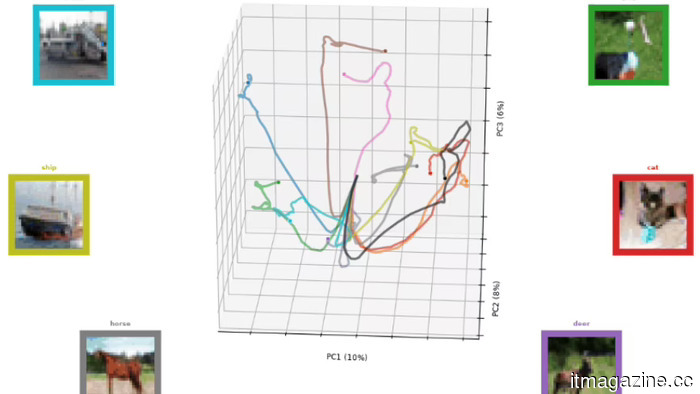
Unconventional AI has launched its inaugural model, which is based on an oscillator architecture that has the potential to reduce AI power consumption by a factor of 1000.
TL;DR: Unconventional AI has introduced Un-0, an image generation model utilizing a simulated oscillator architecture that founder Naveen Rao claims could reduce AI power consumption by 1000 times.
Unconventional AI, a startup established by former Databricks AI head Naveen Rao, has launched its inaugural AI model, Un-0, an image generation system based on a novel type of computing architecture. According to a related research paper, the model achieves results similar to top-tier diffusion models like Stable Diffusion. However, it operates on a software simulation of hardware that is not yet available.
The company is developing a computer architecture that uses oscillators instead of the digital logic that is foundational to nearly all modern computing. Instead of processing data via transistors performing binary functions, Unconventional employs coupled ring oscillators in a network fabric, encoding and processing data through the oscillators' physical properties. Rao informed TechCrunch that this method could potentially decrease power usage by up to a thousand times compared to traditional chips.
This assertion is aspirational. U.S. utilities are expected to invest close to one and a half trillion dollars by 2030 on infrastructure primarily driven by the demands of AI data centers, making any technology that could significantly alleviate this burden highly valuable. However, Unconventional has yet to create a physical chip, and the claimed improvement exists only as a theoretical estimate.
What Un-0 does show is that the architecture can mimic the functions of standard AI systems. The research team successfully built a fully operational image generation model using a software simulation of the oscillator architecture, with results comparable to existing diffusion models. "This is the 'hello world' of a new type of computer," Rao explained to TechCrunch.
Rao's impressive background makes investors confident in the venture. He co-founded Nervana Systems, a deep learning chip startup that Intel purchased for around $400 million in 2016, and later founded MosaicML, which Databricks acquired for about one and a third billion dollars in 2023.
With a PhD in neuroscience from Brown and a background in electrical engineering from Stanford, Rao’s expertise in both chip design and brain science is key to his argument for a fundamental change in computing architecture.
This strong reputation helped Unconventional secure $475 million in seed funding at a valuation of $4.5 billion in December 2025, with investments from Lightspeed and Andreessen Horowitz, along with contributions from Sequoia, Lux Capital, DCVC, and Jeff Bezos. Rao also invested $10 million of his own funds under the same conditions. While other startups are also exploring new architectures for AI efficiency, Unconventional's approach is particularly radical.
The company plans to soon release schematics for its physical chip and aims to develop a complete inference stack from scratch. The ultimate objective is to operate as a compute provider, offering inference capacity through its proprietary chips. "We will create a new type of system made up of our chips," Rao stated, explaining that inputs would come in and outputs would be generated over a standard network connection, but with much lower power usage.
The ambition is quite large considering the company has fewer than 50 employees and is working to replace the von Neumann stored-program computer, which has dominated computing for approximately 80 years. Numerous startups are focusing on reducing AI's energy footprint, mostly working on cooling, efficiency software, or incremental hardware improvements, rather than attempting a complete overhaul of the computing architecture.
Rao believes that incremental strategies will fall short. "Scaling AI is challenging because of energy," he remarked to TechCrunch, indicating that power will be a critical constraint in the coming years. The International Energy Agency anticipates that global data center electricity usage will surpass a thousand terawatt-hours by the end of 2026.
There is a significant gap between Un-0's software simulation and a functional chip capable of running real-world inference on a large scale, and the company hasn't provided a timeline for when physical hardware will be commercially available. However, the demonstration that oscillator-based computing can yield functional AI outputs is the first tangible evidence that this approach goes beyond mere theory. Whether it can fulfill the promise of a thousand-fold efficiency remains a question that only physical hardware can resolve.
Other articles
 Coval secures $28 million to evaluate the performance of AI voice agents under pressure.
Coval has secured $28 million in funding, led by Norwest, to replicate and evaluate enterprise AI voice agents prior to their performance in actual customer calls.
Coval secures $28 million to evaluate the performance of AI voice agents under pressure.
Coval has secured $28 million in funding, led by Norwest, to replicate and evaluate enterprise AI voice agents prior to their performance in actual customer calls.
 Microsoft increases Xbox prices for the third time in 13 months, with the Series X now costing $800 due to memory shortages.
Starting August 1, Xbox consoles will see a price increase of $100 to $150, bringing the cost of the Series X to $800. Microsoft attributes this rise to the more than doubling of memory expenses.
Microsoft increases Xbox prices for the third time in 13 months, with the Series X now costing $800 due to memory shortages.
Starting August 1, Xbox consoles will see a price increase of $100 to $150, bringing the cost of the Series X to $800. Microsoft attributes this rise to the more than doubling of memory expenses.
 Taktile secures $110 million to entrust AI with banking decisions.
Taktile has secured $110 million in a Series C funding round led by Goldman Sachs, enabling banks and insurers to automate their most critical decisions using AI agents.
Taktile secures $110 million to entrust AI with banking decisions.
Taktile has secured $110 million in a Series C funding round led by Goldman Sachs, enabling banks and insurers to automate their most critical decisions using AI agents.
 Klue reports that the hackers responsible for stealing customer data are in the process of deleting it, while a second group has come forward with demands for extortion.
Klue reports that the hacking group Icarus is removing stolen customer information, while a second unnamed group asserts that they possess the data and are directly extorting the victims.
Klue reports that the hackers responsible for stealing customer data are in the process of deleting it, while a second group has come forward with demands for extortion.
Klue reports that the hacking group Icarus is removing stolen customer information, while a second unnamed group asserts that they possess the data and are directly extorting the victims.
 Netris secures $15 million in Series A funding from a16z to streamline the networking processes that hinder GPU cloud performance.
Netris has secured $15 million in funding from Andreessen Horowitz to expand its network automation platform, which is currently operational in over 35 GPU clusters globally.
Netris secures $15 million in Series A funding from a16z to streamline the networking processes that hinder GPU cloud performance.
Netris has secured $15 million in funding from Andreessen Horowitz to expand its network automation platform, which is currently operational in over 35 GPU clusters globally.
 Sarah Wynn-Williams files a lawsuit against Meta for trying to silence her.
Whistleblower Sarah Wynn-Williams is taking legal action against Meta due to its attempts to suppress her, following a gag order that imposed a $50,000 fine for each public critique of the company.
Sarah Wynn-Williams files a lawsuit against Meta for trying to silence her.
Whistleblower Sarah Wynn-Williams is taking legal action against Meta due to its attempts to suppress her, following a gag order that imposed a $50,000 fine for each public critique of the company.
Unconventional AI has launched its inaugural model, which is based on an oscillator architecture that has the potential to reduce AI power consumption by a factor of 1000.
Naveen Rao's Unconventional AI has launched Un-0, an image generation model that operates on a simulated oscillator chip architecture, which it asserts could significantly reduce power consumption.