
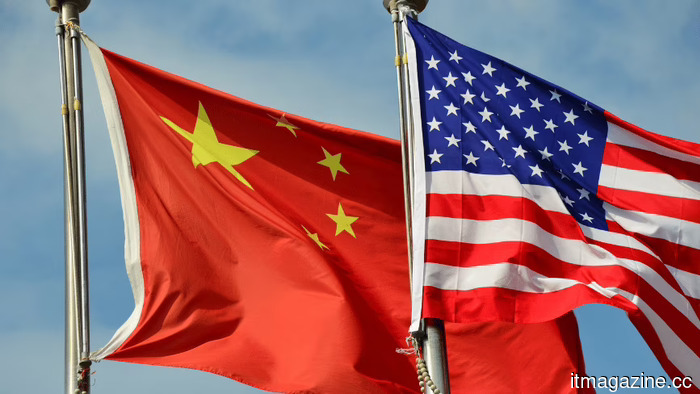
The global consensus is that China is leading in the AI competition.
When asked globally who is leading in the AI race, an unexpectedly high number of respondents now point to China. In a survey conducted by the London consultancy Public First across 15 countries, a significant majority in 11 of those countries indicated they believe China surpasses the United States in AI capabilities and innovation. The research involved over 18,000 participants, with countries such as Canada, Britain, and France—some of America's closest allies—ranking China at the top.
This reflects a change in perception rather than a direct assessment of the technology's performance. However, perceptions are significant and indicate a notable shift. According to the Stanford AI Index, the difference in performance between leading AI models from the US and China has narrowed to just a few percentage points.
The public appears to have taken note of reports highlighting cost-effective and proficient Chinese AI models, leading them to believe the competition is more competitive than what Washington might prefer to acknowledge. The survey included both advanced economies like Canada, France, Germany, Japan, and the UK, as well as emerging markets such as Brazil, India, Indonesia, and Nigeria, with the belief that China is in the lead prevalent in both groups.
Yet, here's the interesting part: being viewed as the most capable does not equate to being the most trusted. When Public First asked which models people actually had faith in, the results were more complex. Respondents primarily trusted models from their own countries, with Japan being viewed as the most reliable source overall, followed closely by the US. Despite being perceived as leading in capability, China did not rank first in trust, revealing divided opinions that included both strong trust and significant distrust. Additionally, 19 percent of non-Americans expressed mistrust towards American models.
This disparity between admiration and trust encapsulates the entire issue. People may believe that China excels in AI but are hesitant to share their data with them.
A backlash in the West is starting to form. In the United States, the overall sentiment regarding AI has shifted from being strongly positive two years ago to barely positive today. In the UK, net positivity among young adults aged 18 to 24 decreased from 62 percent in 2023 to 46 percent in 2026. Conversely, optimism remains much stronger in Asian and emerging markets, highlighting a growing divide between AI experts and the general public.
These findings underscore a global desire for AI development that aligns with national interests. Over three-quarters of those surveyed emphasized the importance of keeping their data within their own borders, favoring digital sovereignty amid ongoing disputes over which AI models should be globally used. However, pragmatism prevails; many individuals who expressed distrust in US models continue to use platforms like ChatGPT, Claude, or Gemini. While they may perceive China as winning the race and prefer localized data practices, they still opt for whatever solutions are most effective.
Other articles
 macOS 27 Golden Gate: What we know about the upcoming features arriving on your Mac.
Apple's macOS Golden Gate update introduces Siri AI, Visual Intelligence, enhanced Apple Intelligence features, improvements to Liquid Glass, and a significant compatibility change for Mac users. Here's all the information you need.
macOS 27 Golden Gate: What we know about the upcoming features arriving on your Mac.
Apple's macOS Golden Gate update introduces Siri AI, Visual Intelligence, enhanced Apple Intelligence features, improvements to Liquid Glass, and a significant compatibility change for Mac users. Here's all the information you need.
 Big Tech claimed that AI would replace your job. Now employers are saying otherwise.
Jeff Bezos predicts that AI will lead to a shortage of labor, while Sam Altman expresses his pleasure in being mistaken about job losses. The layoffs and the timing of the IPO add complexity to the situation.
Big Tech claimed that AI would replace your job. Now employers are saying otherwise.
Jeff Bezos predicts that AI will lead to a shortage of labor, while Sam Altman expresses his pleasure in being mistaken about job losses. The layoffs and the timing of the IPO add complexity to the situation.
 This research discovered an unexpected mental health benefit lurking in your game collection.
A recent study discovered that adults who engage in open-world games or casual titles tend to feel less lonely and exhibit greater emotional resilience compared to those who do not play games at all.
This research discovered an unexpected mental health benefit lurking in your game collection.
A recent study discovered that adults who engage in open-world games or casual titles tend to feel less lonely and exhibit greater emotional resilience compared to those who do not play games at all.
 In two recent medical studies, AI either matched or surpassed the performance of doctors.
In studies published in Nature, Germany's Mira and Google's Amie, two AI systems, either matched or surpassed doctors in diagnosis and treatment; however, this was only demonstrated in simulated environments.
In two recent medical studies, AI either matched or surpassed the performance of doctors.
In studies published in Nature, Germany's Mira and Google's Amie, two AI systems, either matched or surpassed doctors in diagnosis and treatment; however, this was only demonstrated in simulated environments.
 AI cheating tools are succeeding. The focus isn't on detection.
AI humanizers and autotypers have now outperformed the detectors designed to identify cheaters. The core issue lies not in the tools themselves, but in what schools decide to evaluate.
AI cheating tools are succeeding. The focus isn't on detection.
AI humanizers and autotypers have now outperformed the detectors designed to identify cheaters. The core issue lies not in the tools themselves, but in what schools decide to evaluate.
 Guardrails Alliance: a $5 million political action committee for tech workers taking on Big Tech.
The Guardrails Alliance, a super PAC for tech workers and unions with a budget of $5 million, has been established to challenge the over $100 million in funding from Silicon Valley supporting pro-AI candidates.
Guardrails Alliance: a $5 million political action committee for tech workers taking on Big Tech.
The Guardrails Alliance, a super PAC for tech workers and unions with a budget of $5 million, has been established to challenge the over $100 million in funding from Silicon Valley supporting pro-AI candidates.
The global consensus is that China is leading in the AI competition.
A Public First survey of 18,000 individuals across 15 nations revealed that a majority now perceives China as surpassing the US in AI capabilities, although China remains behind in terms of trust.