
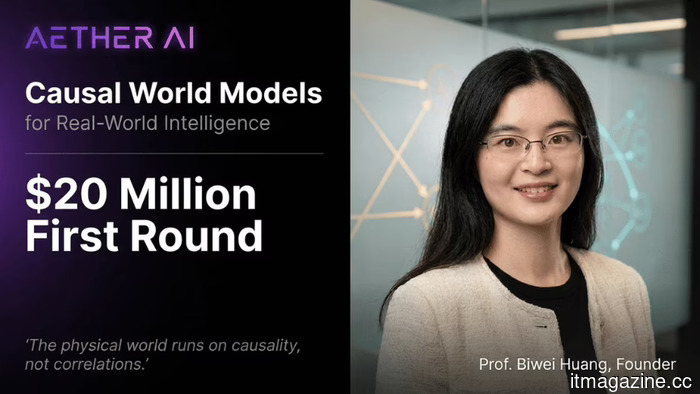
Aether AI secures $20 million to develop causal world models.
Much of the AI sector believes that larger models equate to smarter machines, but a new startup is taking a different stance. Aether AI, located in San Diego, has secured a $20 million seed round to pursue an alternative concept. Its founder argues that the next breakthrough will not originate from scaling but from instructing machines on cause and effect.
Correlation vs. causation
Current large models learn by identifying patterns in vast data sets. While this approach can be successful in controlled environments, it often falters in the unpredictable real world, where statistical shortcuts may fail. Aether aims for machines to understand the underlying mechanisms of events instead. Its "causal world models" are designed to enable a system to anticipate the outcomes of its actions before executing them. The company claims this approach leads to more dependable AI that requires significantly less data. This notion is part of a broader discussion on whether advancements in AI are beginning to slow down.
Focus on robotics first
The initial focus is on physical AI and robotics. The reasoning is straightforward: every action a robot takes directly affects its environment, making errors immediately visible through dropped items or unsuccessful tasks. This creates a challenging environment for testing causal reasoning. Aether's long-term vision includes developing a singular "causal brain" capable of directing various types of robots, an objective shared by many, including Google DeepMind’s world models and Jeff Bezos’s $10 billion physical-AI lab.
Strong credentials
The founder's background lends credibility to this venture. Biwei Huang, an assistant professor at UC San Diego, is a recognized figure in the field of causal discovery. She has developed the open-source tools Causal-Learn and Causal-Copilot and has published extensively in prestigious journals in the field. Aether also references the pioneers of modern causality, citing Judea Pearl, Bernhard Schölkopf, and others as supporters of its initiatives. The funding round was led by MPCi, with contributions from Inno Angel Fund, SWC Global, and Unity Ventures.
Significance of the endeavor
Causality remains one of AI’s longstanding challenges, and transforming it into a viable product is no small feat. Thus, the reservations are important. Aether's preliminary results are not peer-reviewed and its $20 million funding is modest compared to the billions being invested in competing labs. Most of its backers are funds based in Asia, rather than the typical names from Silicon Valley.
Nonetheless, this concept arrives at a critical time. There is a growing skepticism regarding the effectiveness of purely scaling methods, and robots continue to struggle with tasks that appear simple for humans. If causal models do indeed reduce data requirements and enhance reliability, their implications would extend far beyond robotics. That remains a significant "if," but it's a noteworthy proposition to monitor.
Other articles
 France increases its Tibi tech-funding model by €13 billion.
France has raised an additional €13 billion through its Tibi initiative, the insurer-supported model that Europe continues to examine, now focused on financing scale-ups across the continent.
France increases its Tibi tech-funding model by €13 billion.
France has raised an additional €13 billion through its Tibi initiative, the insurer-supported model that Europe continues to examine, now focused on financing scale-ups across the continent.
 The UK’s leading data and AI regulator resigns in a groundbreaking move.
John Edwards has stepped down as the UK's information commissioner after acknowledging the use of 'inappropriate' humor, marking the first resignation of its kind in the position's 40-year history.
The UK’s leading data and AI regulator resigns in a groundbreaking move.
John Edwards has stepped down as the UK's information commissioner after acknowledging the use of 'inappropriate' humor, marking the first resignation of its kind in the position's 40-year history.
 Aether AI secures $20 million to develop causal world models.
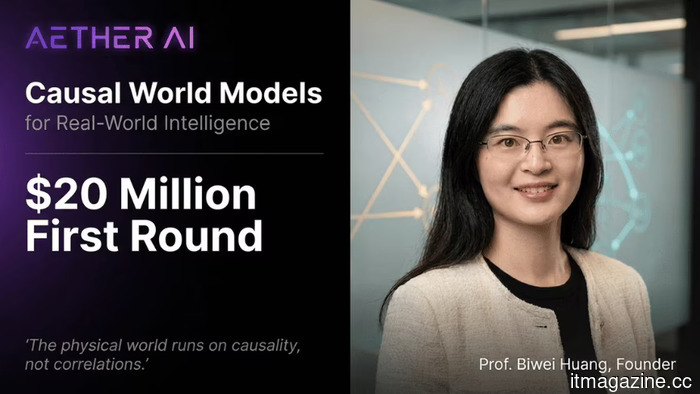
Aether AI, established by UCSD researcher Biwei Huang, has secured $20 million to develop causal world models for robots, directly challenging the conventional approach to AI scaling.
Aether AI secures $20 million to develop causal world models.
Aether AI, established by UCSD researcher Biwei Huang, has secured $20 million to develop causal world models for robots, directly challenging the conventional approach to AI scaling.
 This free app provides your photos with the distinctive style of the Game Boy Camera, without requiring a cartridge.
Epilogue's latest Flashback app emulates the grainy, low-resolution photography style of the Game Boy Camera utilizing your smartphone's camera.
This free app provides your photos with the distinctive style of the Game Boy Camera, without requiring a cartridge.
Epilogue's latest Flashback app emulates the grainy, low-resolution photography style of the Game Boy Camera utilizing your smartphone's camera.
 Norway is prohibiting generative AI in primary schools beginning this fall.
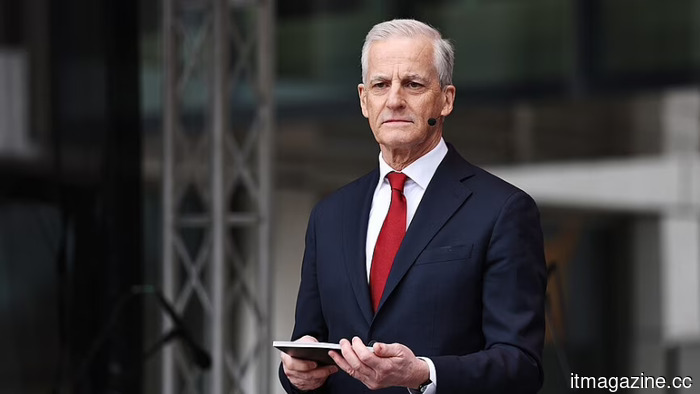
Norway will prohibit students aged 6 to 13 from utilizing generative AI tools in schools starting in late August. Teens aged 14 to 16 will only be allowed to use these tools with teacher supervision.
Norway is prohibiting generative AI in primary schools beginning this fall.
Norway will prohibit students aged 6 to 13 from utilizing generative AI tools in schools starting in late August. Teens aged 14 to 16 will only be allowed to use these tools with teacher supervision.
 France increases its Tibi tech-funding framework by €13 billion.
France has raised an additional €13 billion through its Tibi initiative, which is the insurance-backed model that Europe continues to examine, now focused on financing scale-ups across the continent.
France increases its Tibi tech-funding framework by €13 billion.
France has raised an additional €13 billion through its Tibi initiative, which is the insurance-backed model that Europe continues to examine, now focused on financing scale-ups across the continent.
Aether AI secures $20 million to develop causal world models.
Aether AI, established by UCSD researcher Biwei Huang, has secured $20 million to develop causal world models for robots, posing a direct challenge to the prevailing AI scaling paradigm.