
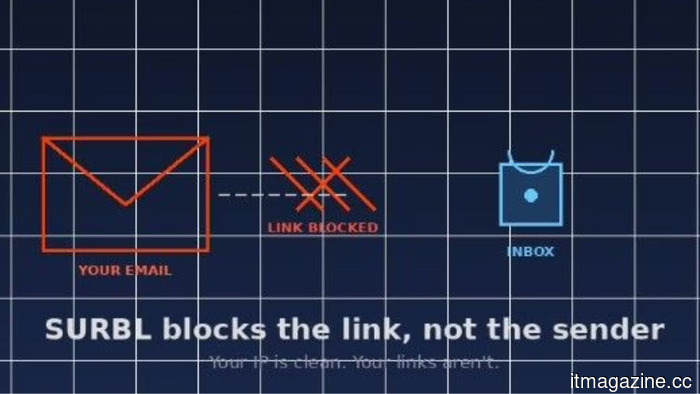
Within SURBL, the email blacklist that verifies your links rather than your IP address.
Observing email marketers meticulously track their sender IP, inspect it daily, carefully warm it, and treat it like a precious orchid is not only relatable but also serves as a reminder of how conventional wisdom can leave one vulnerable. The blacklist ruining your campaigns in 2026 likely has little to do with your IP address. Instead, it concerns the content of your email, particularly the links.
This unsettling concept lies at the heart of SURBL, the Spam URI Realtime Blocklist. Once you grasp how it operates, many of the “mysteries” behind delivery failures become clear. The research team at Warmy.io has provided an extensive analysis of the causes of listings, how to identify them, and ways to recover, insights we reference throughout this article.
SURBL focuses on the destination of your email rather than its origin. While traditional blocklists like Spamhaus or Barracuda evaluate the sender, SURBL scrutinizes the message itself, investigating every URL embedded in your content, every social media icon, and every tracking pixel.
This distinction alters everything. A clean sending IP offers no safeguard if a link in your email points to a flagged domain. Your message will reach the inbox, but the links will be silently disabled. Your click-through rate will quietly plummet, leaving you unaware of the reason. For a more technical analysis of the system's workings, the SURBL blacklist report from Warmy.io is currently the most comprehensive public resource.
Five lists, five distinct issues
SURBL is not just a single list; it comprises five, each addressing a different type of threat and requiring specific solutions for any that land on one.
PH (Phishing): Domains utilized for credential theft or identity fraud.
MW (Malware): Sites that host or spread spyware, viruses, or ransomware.
CR (Cracked Sites): Legitimate websites that have been covertly compromised and repurposed by spammers, often without the owner's knowledge.
AB (AbuseButler): Domains flagged due to high-volume sending and automated spam pattern detection.
Multi: A combined super-list allowing mail servers to query all four in a single DNS query.
The CR list is particularly concerning for legitimate business owners. Your site may appear entirely normal—loading correctly, processing orders, and passing all visual checks—while hidden redirection scripts implanted by attackers trigger SURBL flags in the background.
How you can find yourself listed without any wrongdoing
Here’s a truth that many dislike hearing: you don’t need to send spam to get listed on SURBL. This characteristic sets it apart from nearly all other blacklists and makes it disorienting when it occurs.
A compromised WordPress installation can insert redirect scripts that remain hidden from you but are evident to SURBL scanners. An affiliate link inherits the reputation of every sender who has ever used it, including those who previously abused it. A vulnerable contact form on your website is an open avenue for spammers to channel their links through your domain. Furthermore, linking to any domain registered within the last 72 hours activates one of SURBL’s strongest triggers. New domains lack history and trust.
The warning signs that are easily overlooked
Failures related to SURBL are often silent, making them perilous. The indicators are present; they just may not initially appear to resemble a blacklisting.
Keep an eye out for SMTP 554 bounce codes on a clean sending IP (typically indicative of a URI block), a sudden and unexplained decline in click-through rates (as Gmail and Outlook use SURBL data to deactivate links in delivered messages), or “too many hops” alerts, indicating that a receiving server reached its limit while scanning your URLs. Any spike in complaints linked to a specific URL rather than your sending domain should be immediately investigated. Warmy’s deliverability monitoring automatically flags these signals before they escalate into a complete listing.
The importance of sequence in resolution
Getting removed from SURBL doesn't involve merely filling out a form and waiting. The order of steps is critical: identify the root cause, address it thoroughly, then submit a request. Submitting a removal request before resolving the underlying issue not only fails but also hinders progress, as vague submissions without technical documentation are deprioritized.
Start at surbl.org/lookup to identify which sub-list you are on. This will determine your path to remediation. If listed on CR, clean your site with Sucuri or a Cloudflare WAF and document your findings. For AB listings, pinpoint and stop the high-volume activity that triggered spam trap hits. Then submit a detailed removal request, outlining specific causes and actions taken instead of being vague. The complete step-by-step remediation framework is detailed in Warmy.io’s SURBL report, including breakdowns of the sub-lists aimed at technical teams.
Prevention is more cost-effective than dealing with a crisis
Establishing a few habits can significantly decrease SURBL risk before it emerges as an issue. Review every link in your email templates, including those you might forget:
Other articles
 Pre-orders for GTA 6 will begin on June 25 as Rockstar intensifies its launch campaign.
Rockstar Games has announced that pre-orders for GTA 6 will commence on June 25, providing fans with further assurance that the eagerly awaited game is still set for its November 2026 launch.
Pre-orders for GTA 6 will begin on June 25 as Rockstar intensifies its launch campaign.
Rockstar Games has announced that pre-orders for GTA 6 will commence on June 25, providing fans with further assurance that the eagerly awaited game is still set for its November 2026 launch.
 Ford introduces a $2 billion battery storage division for AI data centers.
Ford Energy plans to produce grid-scale LFP battery systems at a refurbished plant in Kentucky, with initial deliveries expected by late 2027. EDF has entered into a five-year agreement for up to 20 GWh.
Ford introduces a $2 billion battery storage division for AI data centers.
Ford Energy plans to produce grid-scale LFP battery systems at a refurbished plant in Kentucky, with initial deliveries expected by late 2027. EDF has entered into a five-year agreement for up to 20 GWh.
 A 201-year-old mutual bank has recently established an AI Center of Excellence in collaboration with a startup partner.
Liberty Bank, the oldest mutual bank in the United States with assets amounting to $9 billion, has established an AI Center of Excellence in collaboration with enterprise AI partner Flare AI.
A 201-year-old mutual bank has recently established an AI Center of Excellence in collaboration with a startup partner.
Liberty Bank, the oldest mutual bank in the United States with assets amounting to $9 billion, has established an AI Center of Excellence in collaboration with enterprise AI partner Flare AI.
 FERC accelerates the process for connecting data centers to the grid.
FERC instructed grid operators to expedite the connection of data centers to the grid. Meanwhile, the Trump administration allocated $765 million on the same day to terminate offshore wind leases.
FERC accelerates the process for connecting data centers to the grid.
FERC instructed grid operators to expedite the connection of data centers to the grid. Meanwhile, the Trump administration allocated $765 million on the same day to terminate offshore wind leases.
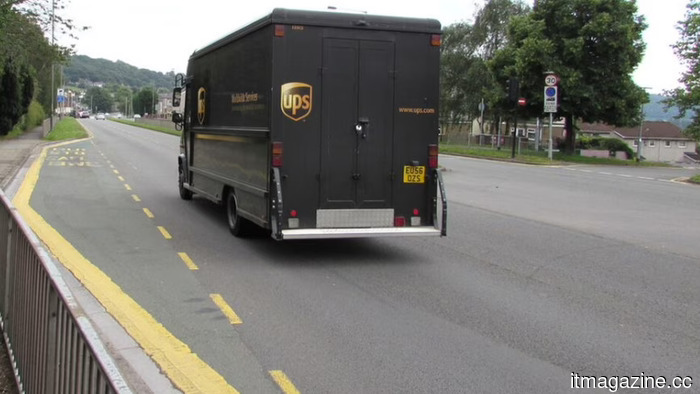 UPS is creating a real-time digital replica of its entire logistics network, with updates occurring every 10 minutes.
UPS outlined its AI initiatives, which feature a digital twin of its worldwide network, agentic control towers for customer service, and RFID-enabled tracking for all vehicles in the US.
UPS is creating a real-time digital replica of its entire logistics network, with updates occurring every 10 minutes.
UPS outlined its AI initiatives, which feature a digital twin of its worldwide network, agentic control towers for customer service, and RFID-enabled tracking for all vehicles in the US.
 FERC accelerates connections for data centers to the grid.
FERC instructed grid operators to expedite data center connections to the grid. Simultaneously, the Trump administration disbursed $765 million to terminate offshore wind leases.
FERC accelerates connections for data centers to the grid.
FERC instructed grid operators to expedite data center connections to the grid. Simultaneously, the Trump administration disbursed $765 million to terminate offshore wind leases.
Within SURBL, the email blacklist that verifies your links rather than your IP address.
SURBL identifies the URLs within your emails instead of the sender's IP address. A single link to a flagged domain can quietly deactivate every link in a sent message, and most senders remain unaware of this occurrence.