

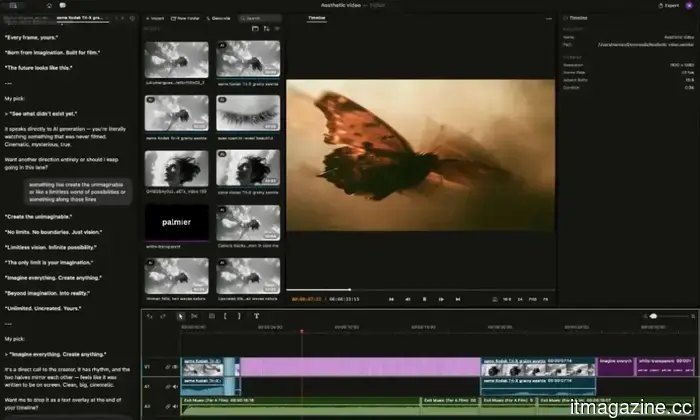
This updated video editor allows Claude to organize, create, and edit directly within your timeline.
Nadeem Sarwar / Digital Trends
For many years, AI video tools have primarily functioned outside the editing workflow. You would create a clip, download it, import it into your editor, and then continue your work. A new application named Palmier Pro seeks to streamline this process by integrating AI directly into the video timeline.
This newly launched software, which is available for macOS, is promoted as a video editor that Claude can utilize. Rather than relegating AI to the role of a separate chatbot or content creator, Palmier is crafted to enable an AI assistant to engage with an ongoing video project and make modifications within it.
It's a video editor centered around AI, not simply adding it as an auxiliary feature.
Most creative tools powered by AI today incorporate artificial intelligence as an added function. Palmier, however, is opting for a different path by constructing the editing experience with AI at its core right from the beginning. The application allows users to request assistance from AI to organize footage, create visual assets, generate audio, and perform edits without the hassle of constantly shifting between different applications. The aim is to keep creators focused within one unified workspace instead of having to juggle various AI tools and editing software.
What makes Palmier especially intriguing is its compatibility with AI agents. By integrating with tools like Claude, the software provides AI with access to project data and the editing timeline. This means that an assistant can comprehend the context of a project and execute editing tasks on behalf of the user.
The latest indication that AI is progressing beyond mere chat interactions.
The launch of Palmier signifies a wider trend within the AI sector. Companies are actively seeking methods to advance assistants beyond basic text conversations and integrate them into genuine software workflows. Rather than engaging a chatbot for guidance and then manually completing each task, newer utilities are being created to allow AI to interact directly with applications. Video editing seems to be a recent field where developers are exploring this concept.
However, Palmier is not aiming to completely replace traditional editors. The software still encompasses familiar editing functionalities such as multi-track timelines, trimming controls, speed modifications, and export options suitable for professional workflows. It remains to be seen whether creators will feel comfortable entrusting AI with significant editing decisions. Nonetheless, Palmier’s methodology appears distinct from many existing AI video tools. It shifts focus from merely generating content to providing AI with a role in the editing process.
Shimul is a contributor at Digital Trends with over five years of experience in the technology sector.
MIT experts have just created a special memory. When humans forget, robots can retrieve the lost item.
MIT's new robot memory could make misplaced keys the responsibility of your robot.
Robots could become the new best friends for forgetful humans. Researchers at MIT have developed a long-term memory system for robots, enabling them to construct a detailed mental representation of large and complex environments. This system, known as DAAAM (Describe Anything, Anywhere, Anytime, at Any Moment), aims to allow robots to remember objects, locations, and specific details over time.
Though it may not seem particularly exciting, robots remain surprisingly incompetent at tasks that humans handle effortlessly. For example, you might remember leaving your keys on the kitchen counter last night or a partially completed item in a factory bin. In contrast, a robot working alongside you would struggle to associate that object with its location meaningfully.
Read more
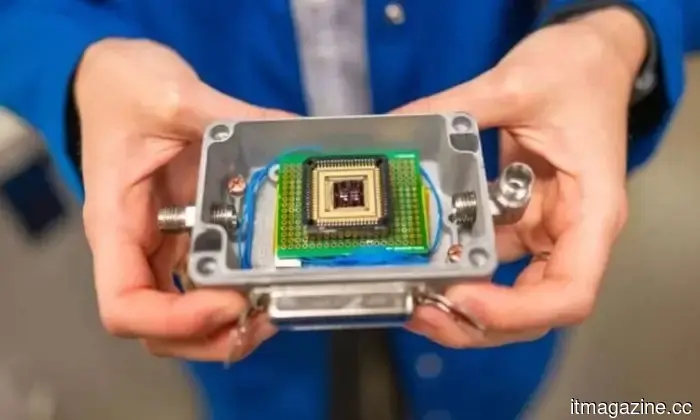
A peculiar little electric nose may complete the technology needed for smart fridges.
The carbon nanotube chip detects food, allergens, and spoilage signals at room temperature.
Researchers at UC Berkeley have created an electronic nose capable of detecting gases linked to spoiled food and common allergens with greater reliability than a human sniff test. The device employs a 16-sensor gas sensor chip that converts reactions with food-related gases into electrical signals.
Assessing food quality can be tricky, as food does not always appear or smell hazardous before it becomes a problem. Milk, eggs, chicken, fruits, and nuts emit various chemical signatures, and people typically have to rely on what their nose detects in real-time.
Read more
Samsung's pet technology only requires a photo to identify health issues affecting your furry companions.
This is the first mainstream smartphone-based pet health monitoring system that does not need dedicated hardware.
Samsung has utilized AI for various applications, from analyzing your sleep quality to optimizing your TV display and monitoring your refrigerator’s contents. At VivaTech 2026 in Paris, the company revealed a notably more personal and practical feature: a pet health option that leverages AI to identify potential health concerns before they escalate into costly veterinary bills.
Read more




Other articles
 General Intuition is securing $300 million for AI developed using gaming data.
The startup turned down OpenAI's $500 million offer for its gaming video data. It is now seeking to raise $300 million at a valuation of $2 billion to develop AI agents using 2 billion video game clips annually.
General Intuition is securing $300 million for AI developed using gaming data.
The startup turned down OpenAI's $500 million offer for its gaming video data. It is now seeking to raise $300 million at a valuation of $2 billion to develop AI agents using 2 billion video game clips annually.
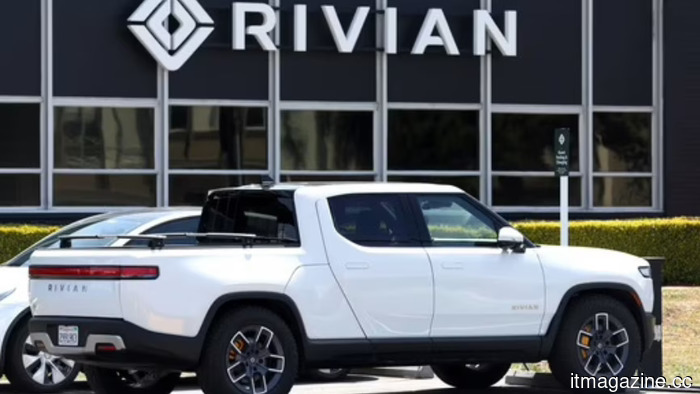 Rivian faces a lawsuit for misleading claims regarding self-driving capabilities for the first generation R1.
A class action lawsuit claims that Rivian spent five years assuring customers of hands-free driving capabilities for its R1T and R1S vehicles, despite being aware that the first-generation hardware was incapable of supporting such features.
Rivian faces a lawsuit for misleading claims regarding self-driving capabilities for the first generation R1.
A class action lawsuit claims that Rivian spent five years assuring customers of hands-free driving capabilities for its R1T and R1S vehicles, despite being aware that the first-generation hardware was incapable of supporting such features.
 BMW cuts profit expectations as China puts pressure on Europe.
BMW has reduced its forecast for the car division's margin to as low as 1%. Chinese manufacturers now account for almost 10% of the car market in Europe, significantly impacting European profits in China.
BMW cuts profit expectations as China puts pressure on Europe.
BMW has reduced its forecast for the car division's margin to as low as 1%. Chinese manufacturers now account for almost 10% of the car market in Europe, significantly impacting European profits in China.
 Ford introduces a $2 billion battery storage division for AI data centers.
Ford Energy will produce grid-scale LFP battery systems at a reconfigured plant in Kentucky, with the initial deliveries set for late 2027. EDF has entered into a five-year agreement for as much as 20 GWh.
Ford introduces a $2 billion battery storage division for AI data centers.
Ford Energy will produce grid-scale LFP battery systems at a reconfigured plant in Kentucky, with the initial deliveries set for late 2027. EDF has entered into a five-year agreement for as much as 20 GWh.
 A mutual bank that has been in operation for 201 years has recently established an AI Center of Excellence in collaboration with a startup partner.
Liberty Bank, the oldest mutual bank in the United States with $9 billion in assets, has established an AI Center of Excellence in collaboration with enterprise AI partner Flare AI.
A mutual bank that has been in operation for 201 years has recently established an AI Center of Excellence in collaboration with a startup partner.
Liberty Bank, the oldest mutual bank in the United States with $9 billion in assets, has established an AI Center of Excellence in collaboration with enterprise AI partner Flare AI.
 Pre-orders for GTA 6 will begin on June 25 as Rockstar intensifies its marketing efforts for the game's launch.
Rockstar Games has announced that pre-orders for GTA 6 will begin on June 25, providing fans with further assurance that the eagerly awaited game is still set for its November 2026 launch.
Pre-orders for GTA 6 will begin on June 25 as Rockstar intensifies its marketing efforts for the game's launch.
Rockstar Games has announced that pre-orders for GTA 6 will begin on June 25, providing fans with further assurance that the eagerly awaited game is still set for its November 2026 launch.
This updated video editor allows Claude to organize, create, and edit directly within your timeline.
Palmier Pro is an open-source video editing tool that enables AI assistants such as Claude to arrange, create, and modify content right within a project timeline.