
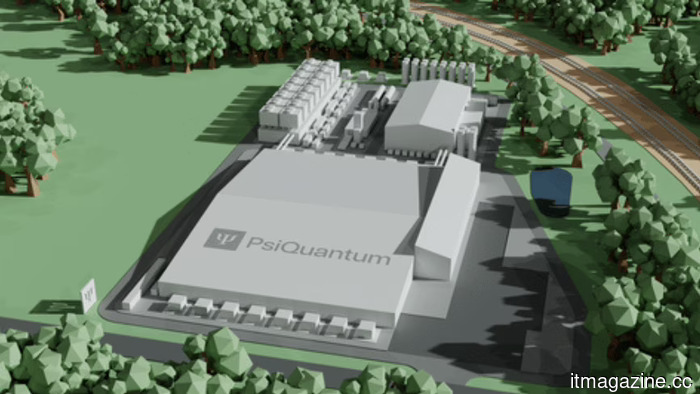
PsiQuantum makes advancements in the development of a utility-scale quantum computer.
**TL;DR** PsiQuantum has initiated construction on a facility in Queensland, Australia, where it intends to create what it claims will be the world's first utility-scale quantum computer. This project has received nearly $1 billion in government funding from both Australia and the US, along with a private valuation of $7 billion.
PsiQuantum has begun building a site in Moreton Bay, Queensland, where it plans to create and implement what it refers to as the first utility-scale, fault-tolerant quantum computer. The facility will ultimately house tens of thousands of photonic quantum chips that will be cooled using one of the largest cryogenic systems ever designed for quantum computing.
Victor Peng, the CEO of PsiQuantum and a former AMD president, stated that Australia is "starting to turn that promise into reality." Co-founder and executive chair, Prof. Jeremy O’Brien, who conducted much of his foundational research in photonics in the area, described the facility as “critical infrastructure” for Australia's sovereign computing capabilities.
**Project Overview**
The Moreton Bay location will be developed in stages. In the initial phase, PsiQuantum is readying the site for a large cryoplant produced by Linde Engineering, which was ordered in late 2024 and is expected to be delivered in the latter half of 2027.
Once operational, the facility will accept cryogenic cabinets containing photonic quantum chips that are interconnected using standard optical fibers. PsiQuantum’s photonic method is distinct from the superconducting models utilized by IBM and Google, as it relies on light particles traveling through silicon chips produced in traditional semiconductor fabrication facilities.
In May 2026, the company launched a Test and Validation Lab at Griffith University, located nearby, to enhance the chips and subsystems that will eventually be integrated into the Moreton Bay system. A timeline for when the complete system will be functional has not been provided, and no existing company has yet demonstrated a fault-tolerant quantum computer at a commercial scale.
**Funding Sources**
PsiQuantum has gathered a significant amount of funding from both public and private sectors. The Australian Commonwealth and Queensland governments have allocated A$940 million (approximately US$620 million) through equity, grants, and loans, although this arrangement faced criticism for circumventing a public tender process and mandating prospective applicants to sign non-disclosure agreements.
In May 2026, the company entered a $100 million letter of intent with the US Department of Commerce under the CHIPS and Science Act, part of a larger $2 billion federal initiative aimed at supporting nine quantum companies. Additionally, PsiQuantum concluded a $1 billion Series E funding round in September 2025, led by BlackRock and Temasek, with involvement from Nvidia’s venture branch, putting the company's valuation at $7 billion.
Australia has aggressively pursued large technological investments, with Microsoft pledging A$25 billion to enhance the country’s digital infrastructure by 2029. PsiQuantum’s initiative adds quantum computing to a mix of investments that has previously been dominated by AI and cloud infrastructure.
**Photonic Technology**
PsiQuantum’s innovation uses photons, or light particles, as qubits. The company asserts that this method is more scalable than the superconducting circuits used by its competitors since photonic chips can be produced with current semiconductor manufacturing processes, avoiding the need for entirely new production lines.
The appointment of Intel CEO Lip-Bu Tan to the board in April 2026 highlighted this semiconductor connection. Funding from the CHIPS Act will be directed towards enhancing barium titanate optical switches, high-temperature single-photon detectors, and sophisticated packaging, all elements that connect quantum and classical chip production.
Whether the photonic strategy can produce a machine capable of solving real-world problems before its competitors remains uncertain. Google has leveraged AI to hasten its own quantum initiatives, while IBM launched its first European quantum data center earlier this year.
PsiQuantum possesses $7 billion in support and backing from two governments, yet it currently lacks a functioning commercial system, rendering this project one of the most costly engineering endeavors in computing history.
Other articles
 Apple investors are growing impatient with the delays in AI developments following WWDC.
Apple's stock lags behind the Nasdaq 100 by nine points this year. Following an underwhelming WWDC and the introduction of Siri AI as a beta, Wall Street is seeking tangible results rather than just plans.
Apple investors are growing impatient with the delays in AI developments following WWDC.
Apple's stock lags behind the Nasdaq 100 by nine points this year. Following an underwhelming WWDC and the introduction of Siri AI as a beta, Wall Street is seeking tangible results rather than just plans.
 France ends EDF's monopoly on hydropower with new auction legislation.
The French Parliament passed a legislation that changes EDF's hydropower concessions into permits and mandates annual auctions of 6 GW. Reports suggest that EDF intends to invest 4.5 billion euros in new pumped-hydro projects.
France ends EDF's monopoly on hydropower with new auction legislation.
The French Parliament passed a legislation that changes EDF's hydropower concessions into permits and mandates annual auctions of 6 GW. Reports suggest that EDF intends to invest 4.5 billion euros in new pumped-hydro projects.
 China promotes free AI for developing nations as the G7 discusses access to American models.
China's leading diplomat has proposed the establishment of a global organization for AI collaboration while the G7 deliberated on "trusted partner" access to American models. Two different perspectives on AI governance are emerging.
China promotes free AI for developing nations as the G7 discusses access to American models.
China's leading diplomat has proposed the establishment of a global organization for AI collaboration while the G7 deliberated on "trusted partner" access to American models. Two different perspectives on AI governance are emerging.
 France disrupts EDF's monopoly on hydropower by implementing a new auction law.
The French Parliament approved a bill that changes EDF's hydropower concessions into permits and mandates annual auctions of 6 GW. EDF is said to be planning a new investment of 4.5 billion euros in pumped-hydro projects.
France disrupts EDF's monopoly on hydropower by implementing a new auction law.
The French Parliament approved a bill that changes EDF's hydropower concessions into permits and mandates annual auctions of 6 GW. EDF is said to be planning a new investment of 4.5 billion euros in pumped-hydro projects.
 Meloni states that kids can easily circumvent social media bans.
Italy's Prime Minister stated at the G7 that prohibiting children from social media is "easily bypassed" and that it is the platforms, rather than parents, who should be held accountable.
Meloni states that kids can easily circumvent social media bans.
Italy's Prime Minister stated at the G7 that prohibiting children from social media is "easily bypassed" and that it is the platforms, rather than parents, who should be held accountable.
 Xreal Aura glasses bring Android to your face and are expected to be priced below $1,500.
Xreal Aura is now available for reservations, introducing Android XR, Gemini, and spatial computing to tethered smart glasses anticipated to launch in Fall 2026.
Xreal Aura glasses bring Android to your face and are expected to be priced below $1,500.
Xreal Aura is now available for reservations, introducing Android XR, Gemini, and spatial computing to tethered smart glasses anticipated to launch in Fall 2026.
PsiQuantum makes advancements in the development of a utility-scale quantum computer.
The Palo Alto startup has begun construction in Queensland, supported by A$940 million from the Australian government and $100 million from the US CHIPS Act. A functional machine is still years in the future.