
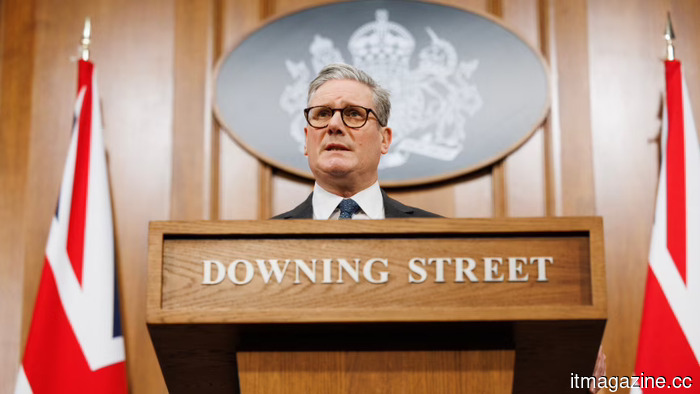
Social media regulations for under-16s in the UK will extend to gaming and AI chatbots.
Britain is likely to establish restrictions on social media usage for children under 16, with possibilities of banning access to major platforms and limiting features deemed overly addictive for young users, based on reports regarding the government's intentions.
Prime Minister Keir Starmer reportedly decided to take more stringent measures after discussions with parents and considering evidence from Australia, which implemented a similar ban for those under 16 last year. The proposal, as reported by the Guardian, would prohibit all individuals under 16 from using the primary social media platforms. Apps that do not fall under the social media categorization, including gaming applications, would face their own set of restrictions instead of a complete ban, including measures to prevent children from being contacted by strangers.
Additionally, reports have mentioned possible evening curfews and restrictions on AI chatbots as part of what officials are calling an “Australia-plus” strategy.
Currently, there is already a legislative foundation in place. Part 3 of the Children’s Wellbeing and Schools Act 2026 mandates the government to implement some form of age or functionality restrictions for those under 16, meaning the ministers are now faced with determining the specifics of the regulations rather than deciding whether to implement them. A public consultation process will involve gathering parental feedback before finalizing the details.
Britain will not be alone in this endeavor. Australia’s ban serves as a key reference for ministers, while Malaysia has also expressed plans to introduce its own restrictions for under-16s. This trend highlights a growing consensus among various governments regarding children’s interactions with major platforms within a similar timeframe.
The inclusion of gaming apps and AI chatbots extends the proposal beyond a simple platform ban, as it encompasses products that are not typically classified as social networks. Chatbots, in particular, have emerged as a more recent concern for regulators compared to the social feeds that initiated this debate, and their inclusion suggests that ministers are attempting to develop regulations for a landscape that has evolved since the initial online safety laws were designed.
The practical implications pose more significant challenges. Age verification on such a large scale has been contentious wherever attempted, raising concerns about potentially intrusive identity checks or systems easily bypassed by determined teenagers.
Australia's implementation, which has been consistently referenced by ministers, has also faced scrutiny over these issues, and the British consultation will likely consider these experiences closely. Industry representatives contend that rigid age limits could push children towards less regulated areas of the internet rather than away from it, an argument ministers will need to balance with the parental concerns that are driving the policy.
The effectiveness of enforcement measures and the age verification process that does not inadvertently impact adults will be addressed in the forthcoming consultation and subsequent legislation. The announcement sets the intended direction, while the operational details will be determined later.
Other articles
 AT&S invests as much as €2 billion in Malaysia and China to capitalize on the AI chip surge.
Austria's AT&S plans to invest as much as €2 billion to increase its IC-substrate production capacity in Malaysia and China to support AI and high-performance computing, a move that is supported by a partnership with AMD.
AT&S invests as much as €2 billion in Malaysia and China to capitalize on the AI chip surge.
Austria's AT&S plans to invest as much as €2 billion to increase its IC-substrate production capacity in Malaysia and China to support AI and high-performance computing, a move that is supported by a partnership with AMD.
 Tesla provided European regulators with inaccurate self-driving safety information.
A review by Reuters revealed that Tesla provided self-reported FSD safety data to regulators in Sweden and the Netherlands, which researchers claim are misleading.
Tesla provided European regulators with inaccurate self-driving safety information.
A review by Reuters revealed that Tesla provided self-reported FSD safety data to regulators in Sweden and the Netherlands, which researchers claim are misleading.
 The US directive to restrict foreign access to Anthropic's leading models signifies a change in direction.
Washington mandated that Anthropic prevent foreign nationals from accessing Fable 5 and Mythos 5. In response, the company disabled access worldwide and described the action as excessive.
The US directive to restrict foreign access to Anthropic's leading models signifies a change in direction.
Washington mandated that Anthropic prevent foreign nationals from accessing Fable 5 and Mythos 5. In response, the company disabled access worldwide and described the action as excessive.
 Tesla provided European regulators with deceptive safety data regarding its self-driving features.
Tesla submitted self-reported FSD safety data to regulators in Sweden and the Netherlands, which researchers claim are misleading, according to a review by Reuters.
Tesla provided European regulators with deceptive safety data regarding its self-driving features.
Tesla submitted self-reported FSD safety data to regulators in Sweden and the Netherlands, which researchers claim are misleading, according to a review by Reuters.
 The US directive to prevent foreign access to Anthropic's leading models signifies a shift in policy.
Washington instructed Anthropic to exclude foreign nationals from accessing Fable 5 and Mythos 5. The company responded by disabling these products globally and described the action as excessive.
The US directive to prevent foreign access to Anthropic's leading models signifies a shift in policy.
Washington instructed Anthropic to exclude foreign nationals from accessing Fable 5 and Mythos 5. The company responded by disabling these products globally and described the action as excessive.
Social media regulations for under-16s in the UK will extend to gaming and AI chatbots.
Keir Starmer is anticipated to outline limitations on social media for those under 16, with restrictions extending to AI chatbots and interactions with strangers in gaming applications.