

ChatGPT is suggesting fraudulent websites that may steal your credit card information.
The chatbot is highlighting fake replicas of defunct retail brands, and scammers are intentionally creating websites designed to manipulate its recommendations.
Nadeem Sarwar / Digital Trends
Fraudsters have discovered a fresh method to reach consumers: utilizing ChatGPT for their advertising. As reported by The Guardian, the scam-checking service Ask Silver has identified that OpenAI’s chatbot is directing users to fraudulent retail sites constructed to collect payment information from unsuspecting buyers. These sites replicate genuine storefronts and employ legitimate-looking URLs, making them challenging to detect without careful examination.
Defunct brands are particularly vulnerable
Scammers seem to be specifically targeting brands that have recently ceased operations or been acquired, creating a disconnect between consumer interest and an online presence.
Anna Jones from Ask Silver informed The Guardian that Russell & Bromley, a British footwear retailer that went into administration in January 2026, serves as a case in point. With no official site existing after Next took over the brand, fraudsters developed a convincing duplicate and optimized it for visibility in ChatGPT’s search results. Shoppers inquiring about Russell & Bromley products are directed straight to this clone.
Jones mentioned that one possible explanation is that malicious actors have infused ChatGPT’s training data with material crafted to promote fake pages, a strategy often referred to as data poisoning.
Pranob Mehrotra / Digital Trends
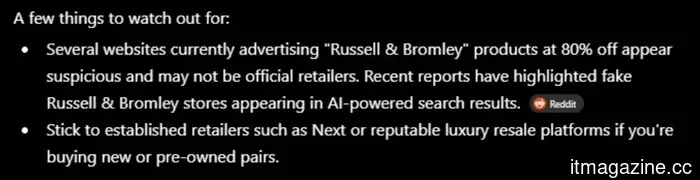
OpenAI seems to have updated its shopping query results concerning Russell & Bromley. It now includes a warning, stating, “Several websites promoting Russell & Bromley products at 80% appear suspicious and may not be official retailers. Recent reports have indicated the emergence of fake Russell & Bromley stores in AI-generated search results.”
An escalating issue as AI takes charge of shopping
Research from last year indicated that ChatGPT already faces challenges in providing consistent and trustworthy product recommendations, but misdirecting users to fraudulent sites marks a more severe issue. This concern is likely to intensify as AI further integrates into the purchasing process.
Louise Baxter of the UK’s National Trading Standards warned The Guardian that scammers quickly adapt to new technologies. With proactive AI shopping still in its infancy, the opportunity to tackle this vulnerability is limited.
Pranob is an experienced technology journalist with over eight years dedicated to covering consumer technology. His writing has been…
Intel reveals Project Firefly and its initiative to introduce affordable laptops to compete with the MacBook Neo
Affordable laptops are finally receiving the upgrade they deserve!
It’s well-known that the Windows budget-market sector has been stagnant for years. While high-end machines have continued to become thinner, lighter, and faster, the low-cost segment lagged behind with outdated technology and minimal improvements. Intel aims to change that. In a recent Talking Tech interview, the company discussed how Project Firefly intends to significantly revamp the budget laptop market by developing an entirely new ecosystem of laptops.
Your ChatGPT expenses may soon see a significant reduction
The AI pricing competition has begun, benefitting your finances.
If you’ve ever grimaced at your monthly AI bill, there’s some positive news. According to a report from The Wall Street Journal, OpenAI is contemplating substantial price reductions for its services as it vies for customers against its competitor, Anthropic. The company is considering major cuts to its token pricing, the unit that AI firms utilize for billing their services. Interestingly, this move is in response to anticipated similar reductions from Anthropic. Consequently, regardless of the AI service you choose, your expenses should decrease.
Waiting for your Framework Laptop 13 Pro? It appears the wait will be a bit longer.
Good news: the issues have been resolved. Bad news: your laptop is delayed.
If you pre-ordered the Framework Laptop 13 Pro expecting delivery in June or July, there’s some unfortunate news. Framework has notified customers via email that shipments are being postponed by about a month. According to the email shared by a Reddit user, the first batch of shipments is being shifted from late June to late July, with some possibly being delayed until early August. Framework plans to return to its initial schedule in August, although the company acknowledges that the last batches in August carry a risk of being pushed into early September.





Other articles
 A botnet associated with the Chinese state has expanded to include 1,500 compromised routers and is identifying susceptible targets within hours of being revealed.
The JDY botnet, associated with China's Volt Typhoon, has increased its size twofold and now searches for recently exposed vulnerabilities within a matter of hours. The majority of its nodes are located in the United States.
A botnet associated with the Chinese state has expanded to include 1,500 compromised routers and is identifying susceptible targets within hours of being revealed.
The JDY botnet, associated with China's Volt Typhoon, has increased its size twofold and now searches for recently exposed vulnerabilities within a matter of hours. The majority of its nodes are located in the United States.
 ChatGPT is suggesting fraudulent websites that could take your credit card information.
According to the scam-checking service Ask Silver, ChatGPT is displaying fraudulent replicas of inactive retail websites when users seek product suggestions. These counterfeit stores are created to capture payment details.
ChatGPT is suggesting fraudulent websites that could take your credit card information.
According to the scam-checking service Ask Silver, ChatGPT is displaying fraudulent replicas of inactive retail websites when users seek product suggestions. These counterfeit stores are created to capture payment details.
 iOS 27: What We Know About the Upcoming Features Coming to Your iPhone
The iOS 27 update from Apple introduces enhancements to Siri AI and Apple Intelligence, but the less notable updates to Mail, AirDrop, Photos, Shortcuts, AirPods, and compatibility are equally important. Here’s a summary of everything disclosed about iOS 27.
iOS 27: What We Know About the Upcoming Features Coming to Your iPhone
The iOS 27 update from Apple introduces enhancements to Siri AI and Apple Intelligence, but the less notable updates to Mail, AirDrop, Photos, Shortcuts, AirPods, and compatibility are equally important. Here’s a summary of everything disclosed about iOS 27.
 A botnet connected to the Chinese state has expanded to 1,500 compromised routers and is identifying vulnerable targets within hours of their announcement.
The JDY botnet, associated with China's Volt Typhoon, has increased in size and now searches for newly revealed vulnerabilities within hours. The majority of its nodes are located in the United States.
A botnet connected to the Chinese state has expanded to 1,500 compromised routers and is identifying vulnerable targets within hours of their announcement.
The JDY botnet, associated with China's Volt Typhoon, has increased in size and now searches for newly revealed vulnerabilities within hours. The majority of its nodes are located in the United States.
 Paramount is integrating Pluto TV, BET+, and Paramount+ into a single technology platform in anticipation of HBO Max.
By mid-2026, Paramount aims to consolidate its streaming technology to reduce expenses, enhance advertising, and create a strategy for integrating HBO Max following the completion of the Warner Bros. merger.
Paramount is integrating Pluto TV, BET+, and Paramount+ into a single technology platform in anticipation of HBO Max.
By mid-2026, Paramount aims to consolidate its streaming technology to reduce expenses, enhance advertising, and create a strategy for integrating HBO Max following the completion of the Warner Bros. merger.
 You can now specify to Instagram’s algorithm exactly what you’d like to see on your main feed.
Instagram is providing users with true influence over their feeds through a feature called Your Algorithm, which allows you to add and remove topics throughout the entire app.
You can now specify to Instagram’s algorithm exactly what you’d like to see on your main feed.
Instagram is providing users with true influence over their feeds through a feature called Your Algorithm, which allows you to add and remove topics throughout the entire app.
ChatGPT is suggesting fraudulent websites that may steal your credit card information.
According to the scam-checking service Ask Silver, ChatGPT is displaying fraudulent replicas of inactive retail websites when users seek product suggestions. These counterfeit storefronts aim to capture payment details.