
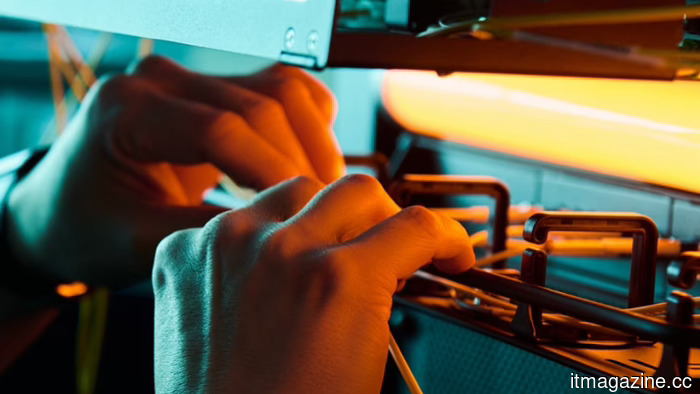
Oriole launches its first entirely photonic AI network, asserting an 81% reduction.
**TL;DR** UK startup Oriole Networks is launching the world's first large-scale pure photonic AI network, claiming an 81% reduction in core power consumption and less than 1% GPU idle time. This system is integrated with AMD hardware within the UK’s £50 million ARIA Scaling Inference Lab.
For many years, data centers have relied on electrical switches that consume a lot of power, generate significant heat, and increasingly limit the speed at which AI systems can process and share data. Oriole Networks, a startup based in the UK, asserts it has a solution: substituting electrical switches in the core network with optical circuits that manage data using light rather than electricity.
On Monday, Oriole declared it will implement what it calls the world's first large-scale AI system utilizing a pure photonic network, as part of the UK's ARIA Scaling Inference Lab. The system combines Oriole’s PRISM networking platform with AMD Instinct GPUs and AMD EPYC CPUs. This marks the company’s inaugural commercial deployment, with plans for broader industry implementation by 2027.
**What PRISM Achieves**
PRISM entirely removes electronic packet switches from the network core. In traditional data centers, electrical switches are placed between GPUs, causing delays, consuming energy, and producing heat. Oriole replaces these with optical circuit switching that operates at nanosecond speeds, enabling direct photon transfer between chips.
The company claims this results in an 81% reduction in core network power consumption. It also states that GPU idle time decreases from around 60% in current setups to below 1%, as the network is no longer the limiting factor. According to Oriole, this leads to a significant increase in inference throughput, allowing for more tokens processed per second and supporting more users simultaneously with the same hardware.
These claims are substantial. The reported 81% power reduction and sub-1% GPU idle time have not yet been independently verified at a production scale. The deployment at ARIA will be the initial examination of whether laboratory performance can be replicated in commercial applications.
**The ARIA Scaling Inference Lab**
The deployment takes place within the ARIA Scaling Inference Lab, a £50 million ($68 million) testing ground funded by the UK government via the Advanced Research and Invention Agency to tackle challenges in large-scale AI inference. Established by legislation and sponsored by the Department for Science, Innovation, and Technology, the lab is run by CommonAI and aims to evaluate and enhance AI systems under practical conditions.
Inference, the phase where trained models generate predictions and outputs, constitutes the majority of AI computing costs and energy consumption and is the stage where the global AI infrastructure’s expansion is most restricted by network performance.
“AMD is thrilled to partner with Oriole on the ARIA Scaling Inference Lab cluster,” stated Madhu Rangarajan, AMD's corporate vice president of compute and enterprise AI. “Oriole’s nanosecond optical circuit-switching AI backend networking signifies a fundamentally new method of connecting accelerators on a large scale.”
**From R&D to Deployment in Three Years**
Founded in the UK, Oriole has secured about $35 million in funding from investors such as Plural, UCL Technology Fund, Clean Growth Fund, XTX Ventures, and Dorilton Ventures. The company advanced from research to commercial deployment in just three years, an unusually quick trajectory for photonic technology.
CEO James Regan characterized the announcement as a shift from proving the physics to demonstrating commercial viability. “A year ago, we verified the physics; today, we’re validating the business,” he noted. “This is how photonic networking transitions from being a research novelty to the foundational element of robust AI infrastructure.”
Importantly, PRISM is designed to be chip-agnostic, functioning across various accelerator platforms, not exclusively on AMD, thus providing data center operators an avenue to enhance network performance without tying themselves to a proprietary system. The broader industry rollout in 2027 will test whether this agnosticism can be maintained across various hardware configurations.
**Why It Matters**
Energy consumption in AI data centers is expected to double by 2030. Cooling alone accounts for about 40% of a data center's energy use. Networks add another layer of inefficiencies, as each electrical switch between GPUs consumes energy while converting light into electricity and back, which heats the environment.
If PRISM meets its claims, the consequences extend beyond just energy savings. Efficient communication between chips means better utilization of costly GPU capacity, leading to reduced inference costs per token. In a landscape where enterprises are grappling with escalating AI expenses, a network that enables existing hardware to yield more output without additional investment is clearly commercially valuable.
However, a major consideration is the difference between a government-funded test facility and a commercial hyperscale data center. While Oriole's ARIA deployment is significant, it has yet to operate at the scale seen in a Meta or Google cluster. The planned 2027 rollout will reveal
Other articles
 GALVANY secures €10 million to improve Germany's heat pump sector.
Berlin's GALVANY secured €10 million from SET Ventures and AENU to expand its heat pump platform in Germany, following a sevenfold increase in revenue to €20.1 million.
GALVANY secures €10 million to improve Germany's heat pump sector.
Berlin's GALVANY secured €10 million from SET Ventures and AENU to expand its heat pump platform in Germany, following a sevenfold increase in revenue to €20.1 million.
 AI determines which online stores you will see, often overlooking the majority of them.
A study involving 9,720 ecommerce stores revealed that Google Gemini made no recommendations for 60% of them. The successful stores were not necessarily the largest brands, but rather those whose product data could be effectively interpreted by AI.
AI determines which online stores you will see, often overlooking the majority of them.
A study involving 9,720 ecommerce stores revealed that Google Gemini made no recommendations for 60% of them. The successful stores were not necessarily the largest brands, but rather those whose product data could be effectively interpreted by AI.
 Bending Spoons submits a filing for a US IPO on Nasdaq.
Bending Spoons, the Milan-based company responsible for Evernote, WeTransfer, and Vimeo, has submitted a filing for a US IPO on Nasdaq, aiming for a revenue of $1.31 billion in 2025 and a stated target valuation of $20 billion.
Bending Spoons submits a filing for a US IPO on Nasdaq.
Bending Spoons, the Milan-based company responsible for Evernote, WeTransfer, and Vimeo, has submitted a filing for a US IPO on Nasdaq, aiming for a revenue of $1.31 billion in 2025 and a stated target valuation of $20 billion.
 Uber launches a waitlist in London for Wayve's robotaxi service.
Uber has established a waitlist in London for self-driving rides powered by the British startup Wayve, in preparation for a trial set for 2026, while Waymo is planning a competing launch.
Uber launches a waitlist in London for Wayve's robotaxi service.
Uber has established a waitlist in London for self-driving rides powered by the British startup Wayve, in preparation for a trial set for 2026, while Waymo is planning a competing launch.
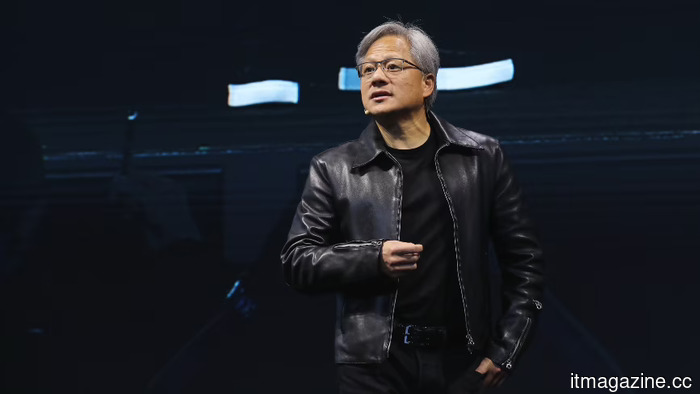 Nvidia and Hyundai are intensifying their focus on robotics with regards to Atlas.
Following discussions in Seoul, Nvidia and Hyundai are strengthening their partnership in physical-AI, centered around Boston Dynamics' Atlas humanoid and a $5.9 billion Korean "AI Valley."
Nvidia and Hyundai are intensifying their focus on robotics with regards to Atlas.
Following discussions in Seoul, Nvidia and Hyundai are strengthening their partnership in physical-AI, centered around Boston Dynamics' Atlas humanoid and a $5.9 billion Korean "AI Valley."
 Cosine unites UK giants to create a sovereign AI model.
During London Tech Week, Britain's Cosine secured partnerships with BT, HSBC, BAE, and others to develop Lumen Sovereign, a UK frontier AI model utilizing the Isambard-AI supercomputer for training.
Cosine unites UK giants to create a sovereign AI model.
During London Tech Week, Britain's Cosine secured partnerships with BT, HSBC, BAE, and others to develop Lumen Sovereign, a UK frontier AI model utilizing the Isambard-AI supercomputer for training.
Oriole launches its first entirely photonic AI network, asserting an 81% reduction.
UK-based startup Oriole Networks is implementing the initial large-scale pure photonic AI network in collaboration with AMD, asserting an 81% reduction in power usage and less than 1% idle time for GPUs in the ARIA lab in the UK.