
Oriole launches its first completely photonic AI network, claiming an 81% reduction.
TL;DR: UK startup Oriole Networks is implementing the first large-scale pure photonic AI network, claiming an 81% reduction in core power usage and less than 1% GPU idle time. This system integrates AMD hardware within the UK’s £50 million ARIA Scaling Inference Lab.
For many years, data center networks have relied on electrical switches, which are energy-intensive, generate substantial heat, and increasingly hinder the speed of AI data processing. Oriole Networks has proposed a solution: substituting every electrical switch in the core network with optical circuits that transmit data through photons rather than electrons.
On Monday, Oriole announced its plan to roll out what it claims is the world's first large-scale AI system powered by a pure photonic network, as part of the UK’s ARIA Scaling Inference Lab. This system combines Oriole’s PRISM networking platform with AMD Instinct GPUs and AMD EPYC CPUs, marking the company's initial commercial deployment, with broader industry implementation expected by 2027.
What PRISM Does
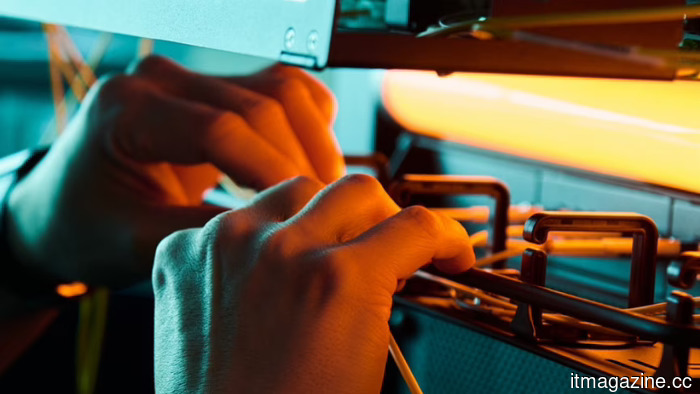
PRISM entirely removes electronic packet switches from the network core. In traditional data centers, electrical switches create latency, consume power, and produce heat between GPUs. Oriole’s solution involves optical circuit switching at nanosecond speeds, enabling photons to move directly from one chip to another.
The company asserts that this innovation reduces core network power consumption by 81% and decreases GPU idle time from about 60% in current systems to under 1%, as the network is no longer a limiting factor. According to Oriole, these advancements result in a significant increase in inference throughput, leading to more tokens per second and more simultaneous users served by the same hardware.
These claims are substantial, but the 81% power reduction and the less than 1% GPU idle time have not yet been independently validated at production scale. The ARIA deployment will serve as the first true assessment of whether lab results can be replicated in commercial environments.
The ARIA Scaling Inference Lab
The deployment is part of the ARIA Scaling Inference Lab, a £50 million ($68 million) testing facility funded by the UK government via the Advanced Research and Invention Agency to tackle bottlenecks in large-scale AI inference. Established by Act of Parliament and supported by the Department for Science, Innovation, and Technology, the lab is hosted by CommonAI and aims to test and refine AI systems under real-world conditions.
Inference, the phase in which trained models provide predictions and outputs, constitutes the majority of AI's computing costs and energy usage. This phase is where the performance of global AI infrastructure is most limited by network efficiency.
“AMD is thrilled to partner with Oriole on the ARIA Scaling Inference Lab cluster,” said Madhu Rangarajan, corporate vice president of compute and enterprise AI at AMD. “Oriole’s AI backend networking using nanosecond optical circuit switching introduces a fundamentally new way to connect accelerators on a large scale.”
Transitioning from R&D to Deployment in Three Years
Founded in the UK, Oriole has secured around $35 million to date from investors such as Plural, UCL Technology Fund, Clean Growth Fund, XTX Ventures, and Dorilton Ventures. The company transitioned from research to commercial deployment in just three years, an unusually rapid pace for photonic hardware.
CEO James Regan described the announcement as a movement from proving physics to proving business viability. “A year ago, we were demonstrating the physics; today, we’re demonstrating the business,” he stated. “This illustrates the shift of photonic networking from a research novelty to a crucial component of advanced AI infrastructure development.”
Importantly, PRISM is designed to be compatible with any chip, functioning across various accelerator platforms, not just AMD, which provides data center operators with a means to enhance network efficiency without committing to a specific proprietary stack. The broader industry rollout planned for 2027 will evaluate whether this compatibility stands at scale with different hardware configurations.
Why It Matters
Energy consumption in AI data centers is expected to double by 2030, with cooling alone constituting around 40% of a data center’s power usage. Networks contribute additional energy waste; every electrical switch situated between GPUs consumes power in the process of converting photons to electrons and vice versa, generating heat in the environment.
If PRISM achieves its claims, the implications go beyond energy savings. Enhanced chip-to-chip communication translates to more efficient usage of high-cost GPU capacity, resulting in lower inference costs per token. In a climate where businesses are grappling with soaring AI costs, a network that maximizes existing hardware output without necessitating additional purchases presents a clear commercial advantage.
However, a significant challenge remains between a government-funded testing facility and a commercial hyperscale data center. While Oriole’s ARIA deployment is legitimate, it has not yet reached the scale of operations seen in Meta or Google clusters. The 2027 rollout will reveal whether PRISM can successfully transition from a £50 million publicly funded lab
Other articles
 Bending Spoons submits an application for a US IPO on Nasdaq.
Bending Spoons, the Milan-based company responsible for Evernote, WeTransfer, and Vimeo, has submitted a request for a U.S. IPO on Nasdaq, aiming for a revenue of $1.31 billion in 2025 and a target valuation of $20 billion.
Bending Spoons submits an application for a US IPO on Nasdaq.
Bending Spoons, the Milan-based company responsible for Evernote, WeTransfer, and Vimeo, has submitted a request for a U.S. IPO on Nasdaq, aiming for a revenue of $1.31 billion in 2025 and a target valuation of $20 billion.
 AI determines which online stores are visible to you, overlooking many of them.
A research of 9,720 ecommerce stores revealed that Google Gemini suggested nothing for 60% of these stores. The successful stores weren’t necessarily the largest brands, but rather those whose product data was comprehensible to AI.
AI determines which online stores are visible to you, overlooking many of them.
A research of 9,720 ecommerce stores revealed that Google Gemini suggested nothing for 60% of these stores. The successful stores weren’t necessarily the largest brands, but rather those whose product data was comprehensible to AI.
 Nvidia and Hyundai are intensifying their focus on robotics with regards to Atlas.
Following discussions in Seoul, Nvidia and Hyundai are strengthening their partnership in physical-AI, centered around Boston Dynamics' Atlas humanoid and a $5.9 billion Korean "AI Valley."
Nvidia and Hyundai are intensifying their focus on robotics with regards to Atlas.
Following discussions in Seoul, Nvidia and Hyundai are strengthening their partnership in physical-AI, centered around Boston Dynamics' Atlas humanoid and a $5.9 billion Korean "AI Valley."
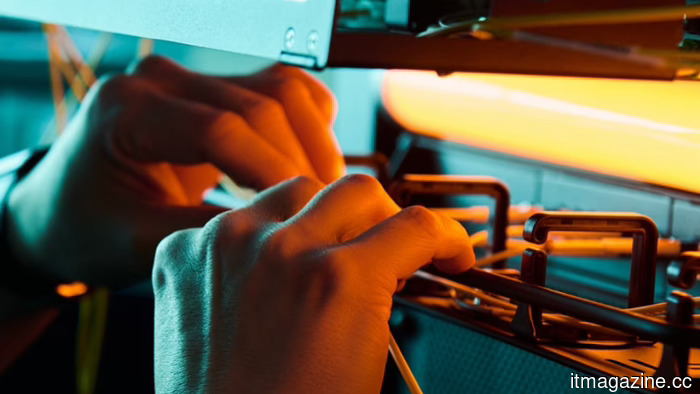 Oriole launches its first entirely photonic AI network, asserting an 81% reduction.
UK-based startup Oriole Networks is implementing the initial large-scale pure photonic AI network in collaboration with AMD, asserting an 81% reduction in power usage and less than 1% idle time for GPUs in the ARIA lab in the UK.
Oriole launches its first entirely photonic AI network, asserting an 81% reduction.
UK-based startup Oriole Networks is implementing the initial large-scale pure photonic AI network in collaboration with AMD, asserting an 81% reduction in power usage and less than 1% idle time for GPUs in the ARIA lab in the UK.
 The US encourages NATO partners to allocate defense budgets to substitute Huawei.
A US official advised allies to allocate NATO defense budgets to remove Huawei equipment from their networks, but the suggestion failed to gain traction as Europe remains divided on implementing a ban.
The US encourages NATO partners to allocate defense budgets to substitute Huawei.
A US official advised allies to allocate NATO defense budgets to remove Huawei equipment from their networks, but the suggestion failed to gain traction as Europe remains divided on implementing a ban.
 Uber launches waitlist for Wayve robotaxis in London.
Uber has launched a waitlist in London for autonomous rides facilitated by British startup Wayve, in anticipation of a trial set for 2026, while Waymo prepares for a competing rollout.
Uber launches waitlist for Wayve robotaxis in London.
Uber has launched a waitlist in London for autonomous rides facilitated by British startup Wayve, in anticipation of a trial set for 2026, while Waymo prepares for a competing rollout.
Oriole launches its first completely photonic AI network, claiming an 81% reduction.
UK-based startup Oriole Networks is implementing the first large-scale pure photonic AI network in collaboration with AMD, asserting a power reduction of 81% and less than 1% GPU idle time at the ARIA lab in the UK.