

Apple has officially released its revamped AI: Siri AI, now available as a standalone application, along with a three-tier privacy framework.
**TL;DR** Apple introduced Siri AI at WWDC 2026, a complete redesign powered by Gemini, featuring a standalone app, personalized context search, and a privacy-centric cloud structure.
During its annual developer conference on Monday, Apple revealed Siri AI, marking the most significant redesign of its voice assistant in 15 years, built from scratch on a proprietary Google Gemini model. The WWDC 2026 keynote at Apple Park also signified Tim Cook's final appearance as CEO before passing the role to hardware chief John Ternus on September 1.
The revamped assistant appears as a standalone app on iPhone, iPad, and Mac, functioning as a conversational chatbot alongside its current system-wide capabilities. It can utilize personal context to search messages, emails, and photos, perform multi-step tasks across applications, respond to questions based on on-screen content, and access the web for real-time information. A dedicated Siri app leverages iCloud to privately synchronize conversation history across devices.
Apple’s announcement framed this technology as “the next generation of Apple Intelligence” without explicitly mentioning Google. However, various reports have confirmed that Siri AI operates on a custom Gemini model with around 1.2 trillion parameters, in a deal estimated to cost about $1 billion per year. The architecture consists of three layers: simple tasks are handled on-device using Apple’s models, moderately complex requests go through Apple’s Private Cloud Compute, and the most demanding reasoning is processed in Google Cloud. Apple stated that queries are processed without retaining data, and the agreement prevents Google from training future models with Apple user information.
Craig Federighi, Apple’s senior vice president of Software Engineering, emphasized during the keynote, “We believe privacy in AI is non-negotiable. Data is only utilized to fulfill your request, and external experts can verify this commitment at any point.” Cook acknowledged in what various outlets described as a farewell tour that Apple Intelligence had “not yet delivered on everything we promised,” marking a rare admission from a company known for tightly controlling its messaging.
This acknowledgment holds significant importance. Last month, Apple settled a $250 million consumer class action suit related to misleading marketing of Siri AI features in 2024 that weren’t ready when the iPhone 16 was launched. The personalized Siri features that were initially promised at WWDC 2024 were postponed indefinitely in March 2025. The keynote effectively represented the delivery of features for which Apple had previously faced legal action.
In addition to Siri, the next generation of Apple Intelligence enhances features throughout the system. In Photos, Spatial Reframing allows users to improve composition after capturing a shot. Image Playground now supports photorealistic image generation. In Messages, one-tap suggestions can create notes or reminders from conversations. iOS 27 Extensions will enable users to set a third-party AI model, such as Claude or ChatGPT, as their default assistant, responding to competitive pressures and the EU’s Digital Markets Act, which previously caused Apple to halt its AI rollout in Europe.
Performance enhancements across iOS 27 are notable, including apps launching up to 30 percent faster, photos loading up to 70 percent faster after capture, and AirDrop transfers being up to 80 percent quicker. Browsing external drives on iPad is now up to five times faster, comparable to Finder on Mac. Apple also introduced a Liquid Glass slider in Settings that allows users to adjust interface transparency from ultra-clear to fully tinted, addressing criticism of last year’s design, which was deemed difficult to read.
Significant attention was given to parental controls during the keynote. A new child account setup immediately activates age-appropriate protections, allowing parents to select available apps. Contact approval now mandates parental consent for each new connection a child makes. Communication safety features automatically intervene when explicit or violent content is shared. A revamped Screen Time system allows parents to set daily time limits across Entertainment, Games, and Social Media, with default recommendations based on insights from clinical and child development professionals.
The software releases encompass iOS 27, iPadOS 27, macOS 27, watchOS 27, visionOS 27, and tvOS 27. Developer betas are available immediately, with public betas expected in mid-July and a general release planned for this autumn alongside the next iPhone. On Apple Watch, a dynamic app grid displays five Siri-suggested apps, and a new Find My app consolidates Find Devices, Find Items, and Find People. AirPods gain custom EQ and expanded GymKit support. Apple Vision Pro users can transform panoramas into spatial environments, and Wi-Fi connectivity is now up to three times faster.
The key question remains whether Monday’s keynote restores Apple’s AI credibility or simply brings it up to date. Competitors like Google, Meta, Microsoft, and an increasing number of startups have been launching conversational AI at scale for two years. Apple’s Gemini partnership effectively acknowledges its inability to develop a competitive large language model in-house within the necessary timeframe.
Other articles
 The resurgence of Xbox exclusives begins with Gears of War and Clockwork Revolution.
Microsoft has confirmed that Gears of War: E-Day and Clockwork Revolution will be exclusive to Xbox consoles, with both titles also set to be available on PC and through Game Pass.
The resurgence of Xbox exclusives begins with Gears of War and Clockwork Revolution.
Microsoft has confirmed that Gears of War: E-Day and Clockwork Revolution will be exclusive to Xbox consoles, with both titles also set to be available on PC and through Game Pass.
 An affiliate of the Qilin ransomware utilized a zero-day vulnerability in Check Point's VPN for a month prior to the availability of a fix.
Check Point has addressed CVE-2026-50751, a critical vulnerability related to VPN authentication bypass that has been exploited since May 7. A Qilin ransomware group utilized this vulnerability to target multiple organizations.
An affiliate of the Qilin ransomware utilized a zero-day vulnerability in Check Point's VPN for a month prior to the availability of a fix.
Check Point has addressed CVE-2026-50751, a critical vulnerability related to VPN authentication bypass that has been exploited since May 7. A Qilin ransomware group utilized this vulnerability to target multiple organizations.
 The SANDISK Extreme Portable SSD is transforming your perspective on storage upgrades.
Seeking a more intelligent solution for increasing storage without replacing your laptop? The SANDISK Extreme Portable SSD provides fast performance, versatile capacities of up to 4TB, and easy plug-and-play functionality.
The SANDISK Extreme Portable SSD is transforming your perspective on storage upgrades.
Seeking a more intelligent solution for increasing storage without replacing your laptop? The SANDISK Extreme Portable SSD provides fast performance, versatile capacities of up to 4TB, and easy plug-and-play functionality.
 You can now place a pre-order for Halo: Campaign Evolved, and it's coming sooner than you might expect.
Halo Studios has announced that Halo: Campaign Evolved, a complete remake of the original campaign from 2001, will launch on July 28. Alongside this, there will be a three-mission prequel storyline titled Operation: METEORITE. Pre-orders are now available, starting at $49.99.
You can now place a pre-order for Halo: Campaign Evolved, and it's coming sooner than you might expect.
Halo Studios has announced that Halo: Campaign Evolved, a complete remake of the original campaign from 2001, will launch on July 28. Alongside this, there will be a three-mission prequel storyline titled Operation: METEORITE. Pre-orders are now available, starting at $49.99.
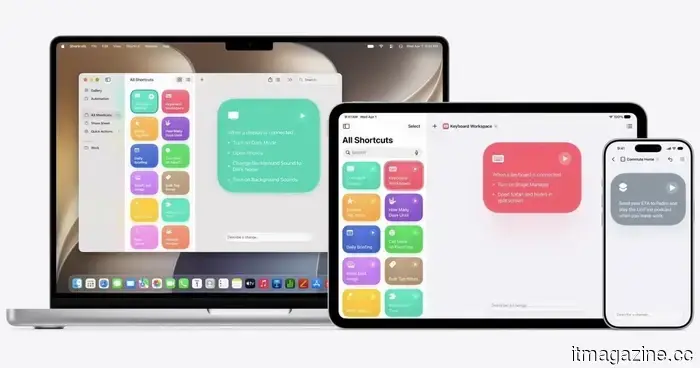 iOS 27 has simplified Shortcuts to the point where you have no reason not to utilize them.
iOS 27 employs Apple Intelligence to allow you to create Shortcuts simply by describing them in everyday language. You can say goodbye to the hassle of managing countless actions to streamline your daily activities.
iOS 27 has simplified Shortcuts to the point where you have no reason not to utilize them.
iOS 27 employs Apple Intelligence to allow you to create Shortcuts simply by describing them in everyday language. You can say goodbye to the hassle of managing countless actions to streamline your daily activities.
 FCC grants Amazon Leo an extension for satellite deployment but removes its spectrum priority.
The FCC granted Amazon an exemption from the July 30 deadline to launch 1,616 satellites but removed its spectrum priority until March 2028. SpaceX objected to the extension.
FCC grants Amazon Leo an extension for satellite deployment but removes its spectrum priority.
The FCC granted Amazon an exemption from the July 30 deadline to launch 1,616 satellites but removed its spectrum priority until March 2028. SpaceX objected to the extension.
Apple has officially released its revamped AI: Siri AI, now available as a standalone application, along with a three-tier privacy framework.
At WWDC 2026, Apple introduced Siri AI, redesigned using a custom Gemini model, featuring a standalone application, personal context capabilities, and a three-tier privacy framework.