
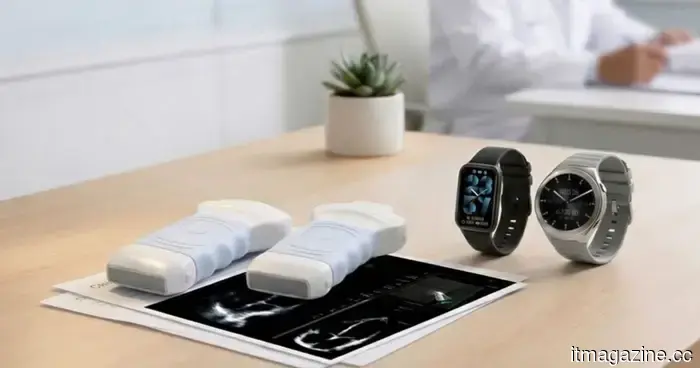
Asus Vivowatch 6 Plus debuts featuring blood pressure monitoring and ECG capabilities, accompanied by a wellness coach.
ASUS is advancing its focus on health-oriented wearables with the introduction of the VivoWatch 6 Plus at Computex 2026. Unlike many current smartwatches that offer vague AI claims and fitness jargon, ASUS aims for a more practical approach: real-time health tracking supported by medical-grade sensors and AI-driven wellness advice.
The VivoWatch 6 Plus features built-in ECG monitoring, blood pressure tracking, body composition analysis, sleep monitoring, and stress tracking in a compact smartwatch design. ASUS is heavily marketing the watch's new AI-powered wellness coach, which analyzes health data and provides personalized recommendations based on user habits and biometric measurements.
This initiative underscores the aggressive pivot of wearable brands towards preventive health monitoring rather than merely counting steps or logging workouts.
A health-centric smartwatch utilizing sensors and AI
The VivoWatch 6 Plus incorporates both ECG and PPG sensors that can measure heart rhythm and cardiovascular data directly from the wrist. ASUS states that the smartwatch can monitor blood pressure trends without needing a bulky cuff, though, like most consumer wearables, it is not designed to replace professional medical devices.
Additionally, the device supports blood oxygen monitoring, skin temperature tracking, sleep analysis, activity tracking, and stress assessment. ASUS asserts that the watch employs AI-driven analysis to provide insights into overall wellness trends rather than just displaying isolated raw data.
One of the significant new features is the integrated wellness coach, which offers personalized health advice based on long-term data accumulation. The company claims this system can identify lifestyle patterns, recovery requirements, and stress indicators, aiding users in managing sleep, activity, and recovery more effectively.
Battery life is another key focus. ASUS claims that the VivoWatch 6 Plus can deliver several days of operation on a single charge while continuously monitoring health metrics in the background. The watch itself has a relatively understated design compared to more fitness-oriented smartwatches. ASUS appears to be marketing it more as a daily health companion for casual users rather than a rugged sports device.
Why ASUS believes health technology is the next significant wearable battleground
The wearable industry is increasingly leaning towards health monitoring as smartphone hardware innovation begins to stagnate. Companies like Apple, Samsung, and Huawei are investing significantly in medical-style wearable features, ranging from ECG functionality to sleep apnea detection and body composition analysis.
ASUS seems to be following a similar trajectory but with a stronger focus on AI-supported wellness analysis rather than merely fitness-centric branding. This strategy could be crucial, as wearable consumers increasingly seek actionable health insights over endless streams of biometric data that they may not fully comprehend.
Nonetheless, accuracy remains a critical concern. Consumer-grade blood pressure measurement has historically posed challenges, and regulatory constraints still prevent most smartwatches from serving as genuine medical devices.
Despite this, the VivoWatch 6 Plus illustrates the rapid evolution of wearables beyond basic notification tools. The smartwatch market is increasingly transforming into a competition to become your everyday digital health assistant – and ASUS clearly desires to be part of that dialogue.
Other articles
 Trump signs revised AI order featuring a voluntary 30-day model evaluation.
Trump signed a scaled-back AI executive order featuring a voluntary 30-day pre-release model review and a cybersecurity clearinghouse, a reduction from the previously mandatory 90-day draft that was eliminated in May.
Trump signs revised AI order featuring a voluntary 30-day model evaluation.
Trump signed a scaled-back AI executive order featuring a voluntary 30-day pre-release model review and a cybersecurity clearinghouse, a reduction from the previously mandatory 90-day draft that was eliminated in May.
 RogueDB presents a streamlined database platform aimed at minimizing infrastructure tasks for startups and IT teams.
RogueDB provides a fully managed, API-centric database that eliminates the need for configuration and tuning, allowing startup engineering teams to focus on product development rather than infrastructure maintenance.
RogueDB presents a streamlined database platform aimed at minimizing infrastructure tasks for startups and IT teams.
RogueDB provides a fully managed, API-centric database that eliminates the need for configuration and tuning, allowing startup engineering teams to focus on product development rather than infrastructure maintenance.
 Focused Energy secures $240 million to commercialize NIF laser fusion technology.
German fusion startup Focused Energy has secured $240 million in Series A funding, led by utility company RWE, to develop a laser-powered reactor inspired by the net energy gain breakthrough achieved by the NIF.
Focused Energy secures $240 million to commercialize NIF laser fusion technology.
German fusion startup Focused Energy has secured $240 million in Series A funding, led by utility company RWE, to develop a laser-powered reactor inspired by the net energy gain breakthrough achieved by the NIF.
 Hackers used brute force to compromise Dashlane's two-factor authentication and downloaded encrypted vaults.
Attackers circumvented Dashlane's 2FA on less than 20 accounts by brute-forcing numeric codes and retrieving encrypted password vaults. Zero-knowledge encryption safeguards data, provided that the master passwords are robust.
Hackers used brute force to compromise Dashlane's two-factor authentication and downloaded encrypted vaults.
Attackers circumvented Dashlane's 2FA on less than 20 accounts by brute-forcing numeric codes and retrieving encrypted password vaults. Zero-knowledge encryption safeguards data, provided that the master passwords are robust.
 5 fantastic sci-fi films on Netflix to enjoy this summer
Take a look at these five sci-fi films available on Netflix that are ideal for viewing this summer, featuring Godzilla Minus One, Atlas, and others.
5 fantastic sci-fi films on Netflix to enjoy this summer
Take a look at these five sci-fi films available on Netflix that are ideal for viewing this summer, featuring Godzilla Minus One, Atlas, and others.
 RogueDB presents an easy-to-use database platform aimed at minimizing infrastructure tasks for startups and IT teams.
RogueDB provides a completely managed, API-based database that eliminates the need for configuration and tuning, allowing startup engineering teams to focus more on product development rather than infrastructure maintenance.
RogueDB presents an easy-to-use database platform aimed at minimizing infrastructure tasks for startups and IT teams.
RogueDB provides a completely managed, API-based database that eliminates the need for configuration and tuning, allowing startup engineering teams to focus more on product development rather than infrastructure maintenance.
Asus Vivowatch 6 Plus debuts featuring blood pressure monitoring and ECG capabilities, accompanied by a wellness coach.
ASUS has introduced the VivoWatch 6, which includes ECG monitoring, blood pressure monitoring, AI wellness coaching, and a range of advanced health-oriented features.