

The hybrid model: reasons the most intelligent finance teams are not fully committing to AI.
In the past 18 months, nearly every finance vendor has prominently featured “AI-powered” on their websites. Most are not doing so maliciously, but rather imprecisely. They equate forecasting with "modeling," extend trends and label them as "intelligence," and refer to pattern matching as "reasoning." This deliberate ambiguity exists because it sells.
Here’s a clearer interpretation of the situation: AI is truly revolutionizing finance tasks right now, but it is not in charge of creating your financial model. The disparity between these two claims is where many companies may face significant financial losses.
The straightforward explanation
A financial model extends beyond a collection of numbers in a spreadsheet. It is a structured analysis of how a business functions, what influences revenue, which costs are fixed versus variable, how hiring choices affect cash flow in six months, and what transpires if pricing decreases by three percent. Constructing one necessitates uncomfortable inquiries, challenging a founder's optimism, and identifying when an inconsistency appears between different sections of the model.
In contrast, a forecast is an extension of existing trends into the future. This is useful and essential work, but it is a different task.
AI excels at forecasting but is incapable of building a financial model. It cannot interrogate why your churn assumption fell from 4% to 2% in Q3 without an explanation. It cannot inform you that the hiring plan you just inserted clashes mathematically with the revenue plan from last week. It may calculate a 300% growth against stagnant costs and present it to you without context.
This limitation is not a temporary issue that will be resolved in the next model update; it represents a fundamental difference. Calculation and reasoning are not the same skill sets, and assuming otherwise can result in consequences when your board asks about the numbers.
What AI does effectively (and why it’s still significant)
Setting aside the marketing hype, there are five core areas where AI genuinely enhances finance workflows today.
1. It forecasts based on historical data. Machine learning is truly better than humans at identifying patterns across countless historical data points and extending them into the future with calibrated uncertainty. This capability represents a substantial improvement over an analyst's instinct.
2. It consolidates disorganized data. Extracting figures from your CRM, billing system, accounting platform, and multiple spreadsheet exports, and organizing them into a coherent format, is precisely the tedious effort AI excels in.
3. It quickly runs scenarios. For instance, it can provide rapid answers to questions like, “What if churn doubles?” or “What if we delay hiring for two months?” You receive responses in seconds rather than days or weeks.
4. It identifies anomalies: odd spending patterns, classification mistakes, transactions that don’t add up—AI is faster and more reliable than any human reviewer fatigued from analyzing the same ledger for hours.
5. It alleviates manual tasks. Activities such as data entry, categorization, formatting, and repetitive reconciliation constitute the monotonous 60% of finance work that has historically occupied the schedules of your best employees.
By adding these five benefits together, you create genuine value: finance teams can update forecasts weekly instead of quarterly, detect errors before they reach the board, and focus on critical judgment work instead of mundane tasks.
This represents a true productivity revolution that warrants discussion—even without the science-fiction overtones.
Where things break down
Problems arise when companies mistake “AI completed the work” for “the work is finished.”
Here are a few notable pitfalls:
- The confident hallucination: AI may generate an impeccably formatted forecast that is fundamentally incorrect due to faulty assumptions. It does not flag inaccuracies, so the output may appear authoritative.
- The missing dependency: AI might not recognize that your sales team cannot secure those Q4 deals without a marketing hire in Q2, treating revenue and costs as independent variables when they are not.
- The unquestioned assumption: If you inform a human analyst that churn will improve by half the next year, they will inquire about the reasoning behind it. If you tell an AI the same thing, it will accept it and incorporate it into the forecast without question, translating optimism into numbers with extra precision.
- The audit trail problem: Most AI tools deliver results without showing their methodology in a way that can withstand scrutiny in a board meeting. “The model says so” is not a valid response to “why,” and the board is likely to ask such questions.
None of this implies that AI is ineffective; it simply highlights that AI is a tool best used under the guidance of knowledgeable humans who can provide critical oversight.
Firms deriving actual value from AI aren’t those that have dismissed their finance teams; they are the ones that have equipped their finance teams with improved tools and encouraged deeper analytical thought.
The Big 4 have already grasped this
It's important to note that firms with ample resources to invest in complete AI automation are not choosing to go that route. Deloitte has allocated $3 billion to
Other articles
 Qualcomm's Snapdragon C chip targets low-cost laptops as the MacBook Neo reshapes the budget category.
Qualcomm's latest Snapdragon C chip is designed for budget laptops priced from $300, offering all-day battery life and reliable performance for students, families, and small businesses.
Qualcomm's Snapdragon C chip targets low-cost laptops as the MacBook Neo reshapes the budget category.
Qualcomm's latest Snapdragon C chip is designed for budget laptops priced from $300, offering all-day battery life and reliable performance for students, families, and small businesses.
 You should experience Marathon before the internet makes that choice for you.
Marathon's Open Play Week is just around the corner, making it the perfect moment for players to experience Bungie's sleek extraction shooter firsthand.
You should experience Marathon before the internet makes that choice for you.
Marathon's Open Play Week is just around the corner, making it the perfect moment for players to experience Bungie's sleek extraction shooter firsthand.
 The Oura Ring 5 is released as the smallest smart ring in the world, priced at $399.
Oura's Ring 5 is 40% more compact at a width of 6.09mm, introduces blood pressure pattern recognition, and features AI health monitoring. It will be released on June 4, with prices starting at $399. An IPO filing is expected soon.
The Oura Ring 5 is released as the smallest smart ring in the world, priced at $399.
Oura's Ring 5 is 40% more compact at a width of 6.09mm, introduces blood pressure pattern recognition, and features AI health monitoring. It will be released on June 4, with prices starting at $399. An IPO filing is expected soon.
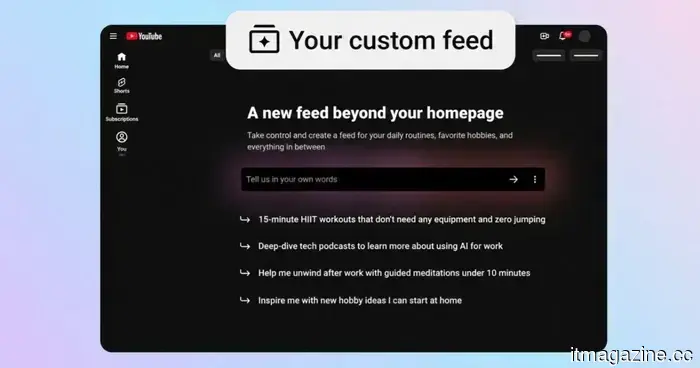 YouTube's Home feed is transforming into exactly what you request.
YouTube is introducing a prompt-based Home feed feature that allows signed-in viewers in the U.S. to create personalized video streams focused on particular moods, interests, or subjects, utilizing their watch and search history.
YouTube's Home feed is transforming into exactly what you request.
YouTube is introducing a prompt-based Home feed feature that allows signed-in viewers in the U.S. to create personalized video streams focused on particular moods, interests, or subjects, utilizing their watch and search history.
 Samsung aims to support your Ozempic weight loss journey with its smartwatch.
Samsung and Mass General are investigating if the Galaxy Watch8 can assist adults beginning GLP-1RA therapy by monitoring activity levels, heart rate, body composition, and muscle changes throughout the treatment process.
Samsung aims to support your Ozempic weight loss journey with its smartwatch.
Samsung and Mass General are investigating if the Galaxy Watch8 can assist adults beginning GLP-1RA therapy by monitoring activity levels, heart rate, body composition, and muscle changes throughout the treatment process.
 Anthropic's Claude Opus 4.8 is four times more truthful, with Mythos coming next.
Anthropic has launched Claude Opus 4.8, featuring improved judgement and reduced uncaught code errors. Mythos-class models are set to be released in the coming weeks. Series H has successfully raised $65 billion with a valuation of $965 billion.
Anthropic's Claude Opus 4.8 is four times more truthful, with Mythos coming next.
Anthropic has launched Claude Opus 4.8, featuring improved judgement and reduced uncaught code errors. Mythos-class models are set to be released in the coming weeks. Series H has successfully raised $65 billion with a valuation of $965 billion.
The hybrid model: reasons the most intelligent finance teams are not fully committing to AI.
AI is revolutionizing finance processes, but it is unable to create a financial model on its own. The organizations that are truly benefiting combine the speed of machines with the insights of human judgment, rather than relying on one alone.