
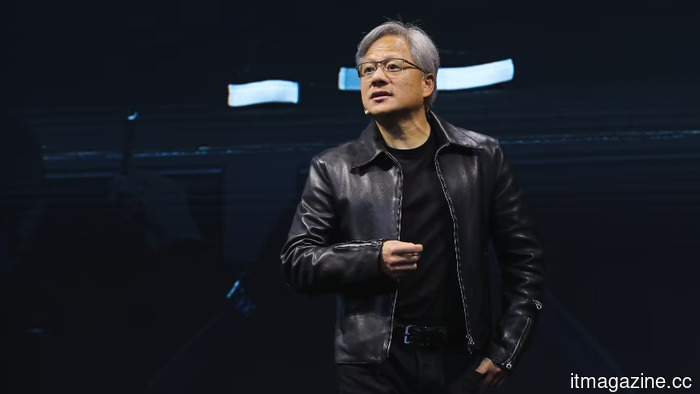
China halts imports of NVIDIA's RTX 5090D V2 while Jensen Huang visited Beijing.
The prohibition on the China-only Blackwell card came during the state visit of the Trump delegation, which saw the late addition of Nvidia's CEO. Chinese AI purchasers had been utilizing the 5090D V2 as a workaround due to the shortage of H200 procurements. According to the Financial Times, China halted the issuance of import permits for Nvidia’s RTX 5090D V2 gaming card on May 15, coinciding with Jensen Huang's presence in Beijing as part of Donald Trump’s delegation.
This ban specifically encompasses the China-only Blackwell-architecture card that NVIDIA launched last August to adhere to US export regulations. The 5090D V2 had been marketed in China to gamers and 3D animators, but in reality, AI buyers in China, cut off from the more advanced H100, H200, and Blackwell-class data center products, were using this card as a workaround because it retained the Blackwell architecture and was suitable for large-scale training and inference tasks outside the explicit export-control framework.
Huang’s presence in Beijing during the enforcement window was a last-minute addition to the Trump delegation. He joined the trip on May 13 following a phone call from the president while Air Force One was refueling in Alaska. The NVIDIA CEO participated in the formal state visit alongside Tim Cook, Elon Musk, and other US tech leaders.
The broader Chinese domestic chip procurement directive associated with the ban has seen escalation throughout spring, with Beijing directing its largest AI firms to cease acquiring NVIDIA processors, including the H20 and the RTX Pro 6000D, claiming that Huawei’s Ascend line and Cambricon’s Siyuan accelerators now offer comparable performance for relevant workloads.
The launch of Alibaba’s T-Head Zhenwu M890 reflects this procurement directive on the chip design front, with the company’s executive stating they have achieved “scaled mass production” for domestic alternatives. The US perspective on the situation is more pointed. Trump remarked earlier this month that China is blocking H200 purchases, despite the US having granted the necessary export licenses. This perspective portrays Beijing’s procurement policies as the primary limitation on Nvidia’s revenue from China, rather than US export controls, which is an atypical diplomatic stance for a US administration to adopt publicly.
The Trump-Xi summit in Beijing regarding AI safety also included discussions on procurement and licensing. The 5090D V2 ban marks the first visible action taken by Beijing since the summit concluded. Regarding the commercial implications, NVIDIA projected $91 billion in Q2 revenue yesterday, surpassing the $86.84 billion consensus. In their remarks, they characterized the China revenue as “small but material” while maintaining that overall data center demand remains in its early stages.
In terms of unit economics, the 5090D V2 accounts for a low-single-digit percentage of Nvidia’s quarterly revenue. However, its signaling effect is considered more significant. The global version, the RTX 5090, has also risen to $5,300 on the Korean grey market due to heightened procurement demand.
NVIDIA has not made any public comments regarding the ban on the 5090D V2 beyond confirming Huang’s participation in the delegation. China’s customs administration has yet to issue a formal notice detailing the permit decision in writing, and the rationale behind it (whether for national security review, anti-competition considerations, or procurement policy enforcement) remains undisclosed.
The next clear indicator will be Nvidia’s Q2 earnings report detailing China-specific revenue, which is expected during the company’s August reporting period, when the impact of the V2 ban on China revenue is anticipated to be formally revealed.
Other articles
 Manus is targeting a $1 billion fundraising effort to facilitate its buyout from the Meta acquisition following a blockage from China.
Manus AI, the Singapore-based agentic-AI start-up at the heart of China's regulatory obstruction regarding Meta's over $2 billion acquisition in December, is considering a new funding round of up to $1 billion to support the unwinding process.
Manus is targeting a $1 billion fundraising effort to facilitate its buyout from the Meta acquisition following a blockage from China.
Manus AI, the Singapore-based agentic-AI start-up at the heart of China's regulatory obstruction regarding Meta's over $2 billion acquisition in December, is considering a new funding round of up to $1 billion to support the unwinding process.
 AMD has pledged over $10 billion to Taiwan's AI ecosystem, with ASE, SPIL, and Helios being the prominent results.
AMD has revealed investments exceeding $10 billion in Taiwan's AI semiconductor ecosystem, designating ASE and SPIL as packaging partners, while the rack-scale Helios platform is planned for customer deployment in the second half of 2026.
AMD has pledged over $10 billion to Taiwan's AI ecosystem, with ASE, SPIL, and Helios being the prominent results.
AMD has revealed investments exceeding $10 billion in Taiwan's AI semiconductor ecosystem, designating ASE and SPIL as packaging partners, while the rack-scale Helios platform is planned for customer deployment in the second half of 2026.
 AMD has dedicated over $10 billion to support Taiwan's AI ecosystem, with ASE, SPIL, and Helios as the prominent outcomes.
AMD has revealed investments exceeding $10 billion in Taiwan's AI semiconductor sector, designating ASE and SPIL as its packaging partners, while the rack-scale Helios platform is planned for customer deployment in the second half of 2026.
AMD has dedicated over $10 billion to support Taiwan's AI ecosystem, with ASE, SPIL, and Helios as the prominent outcomes.
AMD has revealed investments exceeding $10 billion in Taiwan's AI semiconductor sector, designating ASE and SPIL as its packaging partners, while the rack-scale Helios platform is planned for customer deployment in the second half of 2026.
 Pivot secures $40 million in Series B funding to promote an agentic-AI procurement operating system aimed at addressing issues that legacy software has failed to resolve for enterprises.
Pivot, which operates out of Paris and New York, has secured $40 million in a Series B funding round led by Forestay Capital and Notion Capital to expand its agentic-AI procurement operating system.
Malaysia has issued a legal demand to TikTok regarding shortcomings in content moderation.
Malaysia's Communications and Multimedia Commission has formally delivered a Section 39 statutory demand to TikTok due to its ongoing inability to manage inappropriate content.
SpaceX submits S-1, paving the way for what could become the largest IPO in history.
SpaceX has submitted its S-1 prospectus to the US SEC, paving the way for what could become the biggest IPO in the history of financial markets.
Pivot secures $40 million in Series B funding to promote an agentic-AI procurement operating system aimed at addressing issues that legacy software has failed to resolve for enterprises.
Pivot, which operates out of Paris and New York, has secured $40 million in a Series B funding round led by Forestay Capital and Notion Capital to expand its agentic-AI procurement operating system.
Malaysia has issued a legal demand to TikTok regarding shortcomings in content moderation.
Malaysia's Communications and Multimedia Commission has formally delivered a Section 39 statutory demand to TikTok due to its ongoing inability to manage inappropriate content.
SpaceX submits S-1, paving the way for what could become the largest IPO in history.
SpaceX has submitted its S-1 prospectus to the US SEC, paving the way for what could become the biggest IPO in the history of financial markets.
China halts imports of NVIDIA's RTX 5090D V2 while Jensen Huang visited Beijing.
On May 15, 2026, China halted the issuance of import permits for Nvidia's RTX 5090D V2, coinciding with CEO Jensen Huang's presence in Beijing with Donald Trump's state visit delegation.