
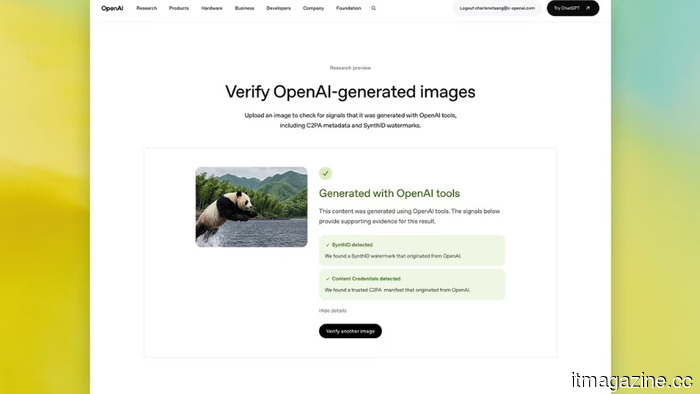
OpenAI incorporates C2PA metadata and SynthID watermarks into AI-generated images.
TL;DR: OpenAI is becoming a part of the C2PA open standard and collaborating with Google to incorporate invisible SynthID watermarks in its AI-generated images. The company is also introducing a public verification tool; however, these initiatives are limited to OpenAI's own products and will not impact images created by other AI technologies.
OpenAI has revealed two new initiatives aimed at helping the public identify images generated by its AI models. The company is officially joining the Coalition for Content Provenance and Authenticity (C2PA) open standard and is partnering with Google to embed invisible SynthID watermarks in its images.
These actions signify a significant step toward transparency in AI-generated visuals, but their application is restricted to content created by OpenAI's tools.
Two systems, one objective
The C2PA standard, initiated in 2021 by Adobe, Arm, the BBC, Intel, Microsoft, and Truepic, attaches metadata to a file that documents its origin and any modifications made. It has been ratified as an ISO standard and integrated into various Google products, although its adoption is uneven across the broader industry. Since the C2PA signal is embedded in a file’s metadata, it is easily accessible, which also means it can be removed or altered. The standard is most dependable among trustworthy users and platforms that opt to preserve it.
In contrast, SynthID, created by Google DeepMind, utilizes a different method. Instead of adding readable metadata, it incorporates an invisible watermark directly into the image. This watermark is meant to endure through actions such as screenshots, resizing, compression, and other forms of manipulation, making it more difficult for malicious users to eliminate.
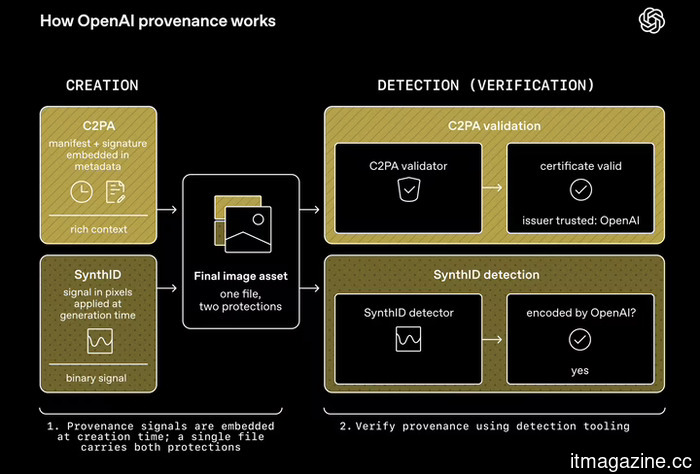
OpenAI's provenance methods, source: OpenAI
The two systems are designed to work in tandem. According to OpenAI, watermarking provides durability against transformations like screenshots, while metadata delivers richer context than a watermark alone. Together, they create a provenance framework that is more robust than either element would be in isolation.
A public verification tool, with limitations
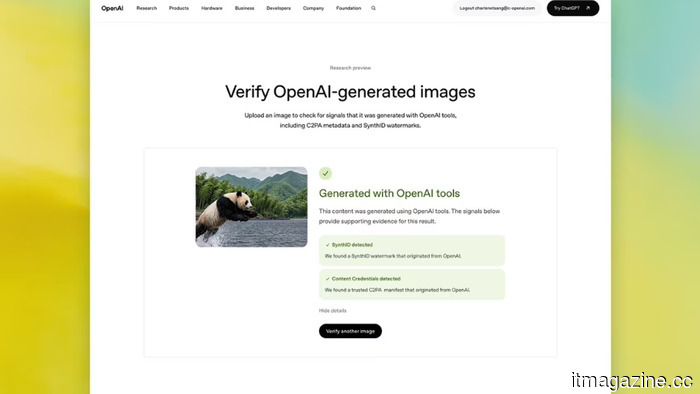
Along with the announcement, OpenAI is showcasing a public verification tool that checks for both C2PA credentials and the SynthID watermark. This tool will enable users to upload an image and verify whether it was created by one of OpenAI’s models.
Currently, the tool is limited to images generated by OpenAI’s products; however, the company has expressed a desire to broaden its scope in the future. This represents a significant limitation, as the surge of AI-generated images online arises from a wide range of tools, many of which lack motivation to adopt provenance standards. While OpenAI’s new measures can help ensure the company is not contributing to the issue, they will not address images produced by less reputable sources.
Part of a larger movement
The announcement comes amidst increasing concerns from governments and civil groups about the influence of AI-generated content on misinformation and public discourse. By early 2026, C2PA has attracted over 6,000 members and affiliates, and its specification reached version 2.1 last year. OpenAI has now joined the coalition’s steering committee, aligning itself with Adobe, Microsoft, and other founding members to help shape the future of the standard.
Google, for its part, has been promoting SynthID through its products. The partnership with OpenAI signifies the first instance of this technology being embedded in a major competitor's outputs, representing a notable cooperation in AI safety and transparency across industries.
Nonetheless, the practical effects of these initiatives depend on how widely they are adopted outside of the involved companies. Identifying AI-generated content remains a continuous challenge, and provenance signals are only valuable as long as platforms are willing to verify them. OpenAI's dual-layer strategy provides a solid technical foundation, but the greater challenge lies in persuading the rest of the industry to adopt similar measures, a problem no single company can resolve independently.
Other articles
 Google introduces Android CLI 1.0 for AI coding agents.
Google's stable Android CLI 1.0 provides AI agents such as Claude Code, Codex, and Antigravity with direct command line access to the Android Studio toolchain.
H2O.ai introduces the tabH2O foundation model designed for tabular data.
At Dell Technologies World 2026, H2O.ai introduced tabH2O, a foundation model capable of producing predictions from tabular data in seconds without the need for model training.
Google introduces Android CLI 1.0 for AI coding agents.
Google's stable Android CLI 1.0 provides AI agents such as Claude Code, Codex, and Antigravity with direct command line access to the Android Studio toolchain.
H2O.ai introduces the tabH2O foundation model designed for tabular data.
At Dell Technologies World 2026, H2O.ai introduced tabH2O, a foundation model capable of producing predictions from tabular data in seconds without the need for model training.
 OpenAI incorporates C2PA metadata and SynthID watermarks into AI-generated images.
OpenAI has become a member of the C2PA standard and has teamed up with Google to incorporate invisible SynthID watermarks, establishing a dual-layer system for recognizing AI-generated images.
OpenAI incorporates C2PA metadata and SynthID watermarks into AI-generated images.
OpenAI has become a member of the C2PA standard and has teamed up with Google to incorporate invisible SynthID watermarks, establishing a dual-layer system for recognizing AI-generated images.
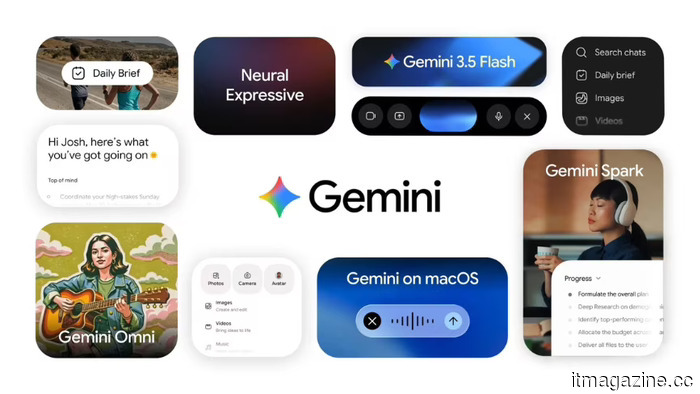 At I/O 2026, Google Gemini introduces the Daily Brief and a redesign of Neural Expressive.
At I/O 2026, Google introduced the Daily Brief, a redesigned Neural Expressive, and the Spark AI agent aimed at Gemini's 900 million users, intensifying its competition with ChatGPT and Claude.
At I/O 2026, Google Gemini introduces the Daily Brief and a redesign of Neural Expressive.
At I/O 2026, Google introduced the Daily Brief, a redesigned Neural Expressive, and the Spark AI agent aimed at Gemini's 900 million users, intensifying its competition with ChatGPT and Claude.
 Google showcases audio glasses created in collaboration with Gentle Monster and Warby Parker.
Google has unveiled a first glance at the Android XR audio glasses, which are powered by Gemini and set to be released later this year.
H2O.ai introduces the tabH2O foundation model designed for tabular data.
H2O.ai introduced tabH2O at Dell Technologies World 2026, a foundational model capable of producing predictions from tabular data in seconds without the need for model training.
Google showcases audio glasses created in collaboration with Gentle Monster and Warby Parker.
Google has unveiled a first glance at the Android XR audio glasses, which are powered by Gemini and set to be released later this year.
H2O.ai introduces the tabH2O foundation model designed for tabular data.
H2O.ai introduced tabH2O at Dell Technologies World 2026, a foundational model capable of producing predictions from tabular data in seconds without the need for model training.
OpenAI incorporates C2PA metadata and SynthID watermarks into AI-generated images.
OpenAI has become a participant in the C2PA standard and has teamed up with Google to incorporate invisible SynthID watermarks, establishing a dual-layer system for identifying images generated by AI.