
Google introduces Android CLI 1.0 for AI coding agents.
Google has launched Android CLI 1.0 during Google I/O 2026, providing AI coding agents like Claude Code, OpenAI Codex, and Antigravity with programmatic access to the Android Studio toolchain from the command line. This stable release allows agents to perform tasks such as semantic analysis, preview Compose layouts, and execute UI tests without needing to open the IDE.
The announcement, made on May 19, 2026, reflects Google’s recognition that many developers are increasingly utilizing third-party AI agents for Android development instead of relying solely on its own tools. The new CLI enables agents like Anthropic's Claude Code, OpenAI's Codex, and Google's Antigravity to conduct essential Android development functions from the terminal.
With the new `android studio` command, agents can resolve semantic symbols, check files for warnings, render Jetpack Compose previews, and run end-to-end UI tests through a feature called “Journeys.” This means developers can instruct an AI agent to set up a project, scan for lint warnings, preview a Compose layout, and execute automated UI tests—all without switching to a graphical interface. The CLI serves as a connection between the expanding ecosystem of AI coding agents and the robust tools already offered by Android Studio.
Additionally, Google has integrated Android CLI support within Antigravity, its agent-oriented development platform, which received a significant 2.0 update during the same event. Developers working with Antigravity can install the Android CLI along with relevant resources either during initial setup or later via the settings menu. After installation, the Antigravity agent can manage tasks from creating projects to deploying applications on a virtual Android device.
This initiative aligns with a broader trend showcased at this year's I/O, where Google introduced Gemini 3.5 Flash as the engine for its managed agents within the Gemini API, launched native Android app development in AI Studio, and released Antigravity 2.0, which supports parallel agent orchestration. The Android CLI is central to these efforts, ensuring compatibility with any agent a developer may choose.
For those already employing non-Google AI tools for Android development, this release alleviates a major obstacle. Access to specialized knowledge regarding Android's build system, Compose rendering, and testing frameworks is now available programmatically at d.android.com/tools/agents, rather than being confined to a desktop application.
It remains unclear whether this increased accessibility will hasten Android development or merely shift the bottleneck from coding to reviewing code. Nevertheless, it is evident that Google is investing in AI agents as the future of Android development tools, aiming for seamless integration with its platform for all types of agents.
Other articles
 Google introduces Android CLI 1.0 for AI programming assistants.
Google's stable Android CLI 1.0 allows AI agents such as Claude Code, Codex, and Antigravity to access Android Studio's toolchain directly from the command line.
Gmail Live enables you to use AI for voice-searching your inbox.
Google's updated Gmail Live feature incorporates Gemini AI, enabling users to voice their questions about their inbox. It will be launched this summer, along with a broadened AI Inbox for additional subscribers.
Google introduces Android CLI 1.0 for AI programming assistants.
Google's stable Android CLI 1.0 allows AI agents such as Claude Code, Codex, and Antigravity to access Android Studio's toolchain directly from the command line.
Gmail Live enables you to use AI for voice-searching your inbox.
Google's updated Gmail Live feature incorporates Gemini AI, enabling users to voice their questions about their inbox. It will be launched this summer, along with a broadened AI Inbox for additional subscribers.
 Google introduced the Gemini Spark agentic AI assistant during I/O 2026.
At I/O 2026, Google introduced Gemini Spark, a persistent AI agent that handles tasks through Gmail, navigates Chrome, and operates continuously on cloud VMs for AI Ultra subscribers.
Google introduced the Gemini Spark agentic AI assistant during I/O 2026.
At I/O 2026, Google introduced Gemini Spark, a persistent AI agent that handles tasks through Gmail, navigates Chrome, and operates continuously on cloud VMs for AI Ultra subscribers.
 Google substitutes the search box with AI agents at I/O 2026.
At I/O 2026, Google introduced its most significant redesign of Search in 25 years, featuring information agents, a generative user interface, and mini-apps driven by Gemini 3.5 Flash.
At I/O 2026, Google introduces voice prompting features for Docs, Keep, and Gmail.
At I/O 2026, Google introduced voice-enabled AI capabilities for Docs, Keep, and Gmail, allowing users to generate documents and search their emails through voice commands rather than typing.
Google substitutes the search box with AI agents at I/O 2026.
At I/O 2026, Google introduced its most significant redesign of Search in 25 years, featuring information agents, a generative user interface, and mini-apps driven by Gemini 3.5 Flash.
At I/O 2026, Google introduces voice prompting features for Docs, Keep, and Gmail.
At I/O 2026, Google introduced voice-enabled AI capabilities for Docs, Keep, and Gmail, allowing users to generate documents and search their emails through voice commands rather than typing.
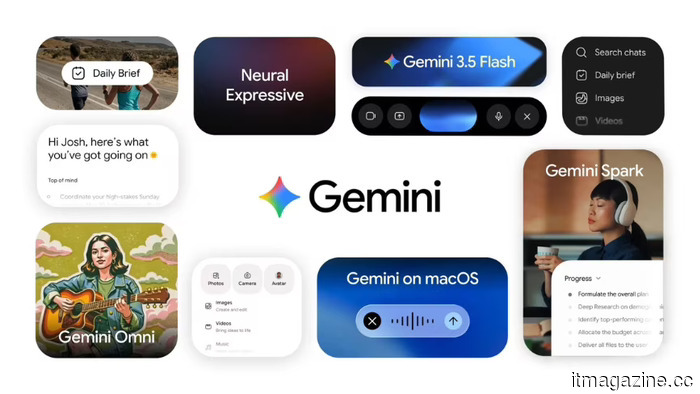 At I/O 2026, Google Gemini introduces the Daily Brief and a redesign of Neural Expressive.
At I/O 2026, Google introduced the Daily Brief, a redesigned Neural Expressive, and the Spark AI agent aimed at Gemini's 900 million users, intensifying its competition with ChatGPT and Claude.
At I/O 2026, Google Gemini introduces the Daily Brief and a redesign of Neural Expressive.
At I/O 2026, Google introduced the Daily Brief, a redesigned Neural Expressive, and the Spark AI agent aimed at Gemini's 900 million users, intensifying its competition with ChatGPT and Claude.
Google introduces Android CLI 1.0 for AI coding agents.
Google's stable Android CLI 1.0 provides AI agents such as Claude Code, Codex, and Antigravity with direct command line access to the Android Studio toolchain.